Category: Analysis & Opinion

In-depth analysis and expert opinion on Africa’s military unmanned systems landscape — strategic context beyond the daily headlines.

  • Layered ISR: Why African Defense Forces Need Manned Aircraft and Drones

    Layered ISR: Why African Defense Forces Need Manned Aircraft and Drones

    Force modernization reports across African air force headquarters show a clear trend in aerial procurement. Defense ministries from West Africa to the Horn of Africa are expanding uncrewed aerial vehicle inventories while simultaneously acquiring crewed turboprop surveillance aircraft. In recent operational cycles, air forces in Nigeria, Kenya, and Algeria integrated new Beechcraft King Air 350i and Cessna Grand Caravan EX surveillance planes alongside Class III Medium-Altitude Long-Endurance (MALE) drones such as the Bayraktar TB2 and Wing Loong II. This parallel purchasing strategy addresses a persistent debate among military planners over whether uncrewed systems can fully replace crewed reconnaissance platforms in modern operational theaters.

    Field data from active counter-insurgency and maritime domain awareness missions indicates that replacing crewed aircraft with uncrewed systems creates operational gaps. Rather than functioning as mutually exclusive choices, crewed surveillance planes and long-endurance drones address different tactical problems. Building an effective Intelligence, Surveillance, and Reconnaissance (ISR) architecture requires security organizations to deploy both capabilities in an integrated, layered network.

    Payload Capacity and Onboard Processing Dynamics

    Crewed turboprop surveillance platforms offer payload capacity and real-time processing capabilities that uncrewed platforms struggle to replicate. Aircraft such as the Beechcraft King Air 350i ISR and the ATR-42 Maritime Patrol Aircraft (MPA) feature maximum takeoff weights exceeding 5,000 to 18,000 kilograms. This structural capacity allows them to carry multi-sensor suites weighing several hundred kilograms, including dual Electro-Optical/Infrared (EO/IR) sensor gimbals, maritime search radars, and broad-spectrum Synthetic Aperture Radar (SAR) suites.

    Crucially, crewed ISR aircraft carry human intelligence analysts directly inside the cabin. Onboard systems operators process raw sensor imagery, evaluate tactical movements, and communicate actionable targeting data directly to ground commanders or strike aircraft in real time. This onboard processing avoids reliance on high-bandwidth satellite data links, eliminating transmission latency and mitigating vulnerability to ground-based signal interference. In high-density signal environments or remote coastal zones, a crewed platform functions as a mobile Airborne Command and Control (C2) node capable of directing complex joint operations.

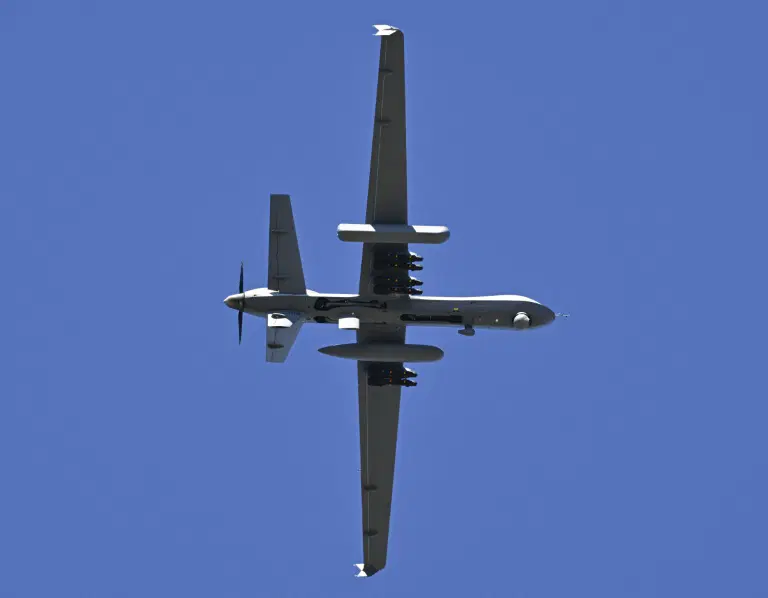
    Conversely, Class III MALE uncrewed systems operate under stricter weight and power budgets. A Bayraktar TB2 carries a maximum payload of approximately 150 kilograms, while the larger Wing Loong II carries up to 480 kilograms of sensors and weapons. While these systems carry advanced EO/IR gimbals like the L3Harris WESCAM MX-15, they generally stream raw sensor data back to a Ground Control Station (GCS) via Line-Of-Sight (LOS) radio relays or Satellite Communications (SATCOM). In remote sectors where satellite links are unavailable or bandwidth is limited, uncrewed systems cannot transmit full-motion, high-definition video over long distances without data degradation.

    Persistence Versus Speed and Weather Resilience

    Uncrewed systems hold a clear advantage in operational persistence. The primary operational value of MALE platforms lies in their ability to maintain continuous loiter time over a specific target area. A standard MALE drone can remain airborne for 24 to 30 hours without crew fatigue limits, providing an unblinking eye over known insurgent corridors or fixed infrastructure. Ground commanders rely on this persistence to track pattern-of-life behaviors, monitor remote border sectors, and maintain continuous target designation for ground artillery.

    However, crewed surveillance aircraft compensate for shorter flight endurance with superior transit speed and weather resilience. A King Air 350i cruises at speeds above 300 knots (555 kilometers per hour), allowing it to respond rapidly to unexpected distress calls, ambush reports, or maritime security incidents hundreds of kilometers away. By contrast, most MALE drones cruise between 110 and 150 knots, requiring hours to reach distant operational areas.

    Atmospheric conditions across tropical and desert regions further illustrate the operational trade-offs between both categories. Severe dust storms during the Harmattan season and heavy equatorial cloud belts frequently obstruct optical sensors on high-altitude drones. To maintain visual contact, drone operators must descend below the cloud base, exposing multi-million-dollar airframes to small arms and light anti-aircraft fire. Crewed surveillance planes equipped with heavy, high-powered SAR suites can penetrate cloud cover and rain, mapping terrain and tracking surface targets from safe operational altitudes.

    Strategic Integration Across African Security Theaters

    The operational realities of African defense sectors reinforce the necessity of a balanced fleet structure. According to the African drone procurement data, continental defense ministries acquired over 1,000 uncrewed aerial units between 2020 and 2026. Yet, nations facing active counter-insurgency campaigns continue to fund crewed ISR upgrades.

    In West Africa, the Nigerian Air Force operates a mixed ISR architecture combining ATR-42 MPA airframes, Beechcraft King Air 350i platforms, and Wing Loong II drones. During joint operations in the Lake Chad Basin, crewed surveillance planes execute wide-area maritime and land radar scans to detect suspicious movements. Once a potential target sector is identified, commanders dispatch loitering MALE drones to maintain continuous target tracking and execute precision strikes. This operational division maximizes the strengths of both platforms while minimizing overall flight-hour costs.

    Similarly, in East Africa, Kenya deploys crewed utility turboprops alongside tactical uncrewed assets for border monitoring and wildlife protection. While multirotor and small fixed-wing drones support localized perimeter defense and tactical reconnaissance for infantry patrols, crewed aircraft execute broad maritime patrols along the Indian Ocean coastline. Meanwhile, emerging domestic drone manufacturing initiatives in South Africa, Nigeria, and Algeria aim to build localized airframes that can seamlessly integrate into existing crewed communication networks. Further technical details on regional deployments appear in our analysis of counter-insurgency aerial operations.

    Security organizations that attempt to replace crewed surveillance aircraft entirely with uncrewed fleets run major operational risks. Over-reliance on drones creates single-point vulnerabilities to satellite link outages, cyber-interference, and seasonal weather disruptions. Conversely, relying solely on crewed aircraft drives up operating costs and exhausts flight crews during prolonged surveillance missions.

    Optimal defense capability stems from deploying the correct platform for each specific operational profile. MALE drones excel at persistent, localized loitering over known target zones. Crewed surveillance aircraft excel at wide-area search, rapid emergency response, heavy sensor processing, and weather-penetrating reconnaissance. Modern security organizations that invest in both platforms as complementary assets establish a resilient, multi-layered aerial defense architecture.

  • AI-Powered Autonomy for Tactical Drones: What’s Actually Happening in African Militaries

    AI-Powered Autonomy for Tactical Drones: What’s Actually Happening in African Militaries

    Interest in AI-driven drone autonomy is accelerating across Africa’s commercial drone sector. On the military side, the picture is narrower, messier, and considerably more consequential — and worth separating carefully from the sales pitch.

    “Tactical autonomy” has become one of the most overused phrases in defence marketing, and one of the least precisely defined. It gets applied equally to a drone that follows pre-programmed waypoints and avoids obstacles, and to a drone that identifies a target, decides it meets a strike criterion, and engages it without a human confirming that decision in real time. Those are fundamentally different capabilities with fundamentally different consequences, and the distinction matters more in Africa than almost anywhere else, because the continent is simultaneously the site of some of the world’s most-documented recent uses of autonomous and semi-autonomous strike systems, and one of the regions least equipped, legally, institutionally and technically to govern them.

    Automation is not autonomy

    Industry engineers increasingly draw a hard line here. Pre-programmed flight paths, collision avoidance, return-to-home behavior and waypoint coordination, the features most commonly marketed as “AI-powered” are, in the words of one autonomy-systems executive interviewed by Breaking Defense this year, simply “table stakes,” better described as automation than autonomy. True tactical autonomy, on that stricter definition, means a drone carrying real-time artificial intelligence on board that can interpret what its sensors are seeing and respond to a changing battlefield situation without an operator directing every movement, recognizing a target class, adjusting course around a new obstacle or threat, or coordinating with other drones in a swarm, all without a continuous human instruction for each step.

    That distinction is not academic. It is the difference between a surveillance drone flying a pre-set grid over a border post and a loitering munition that hunts, identifies and strikes on its own judgement. Both get called “autonomous” in vendor literature. Only one of them raises the legal and ethical questions that have made autonomous weapons a live subject at the UN.

    What has actually been documented

    Africa already has real, if limited, history with the sharper end of that spectrum. A March 2021 UN Panel of Experts report on Libya found that forces aligned with the internationally recognized government had used Turkish-made STM Kargu-2 loitering munitions against retreating fighters loyal to Khalifa Haftar in 2020, describing the drones as capable of pursuing targets without requiring a continuous data link between operator and munition. UN investigators stopped short of confirming the drones acted fully autonomously in that engagement, and other analysts have argued the Kargu-2 is better classified as a loitering munition than a true autonomous weapon, but the case remains the most-cited instance anywhere in the world of a drone potentially engaging human targets without direct human authorization of the individual strike.

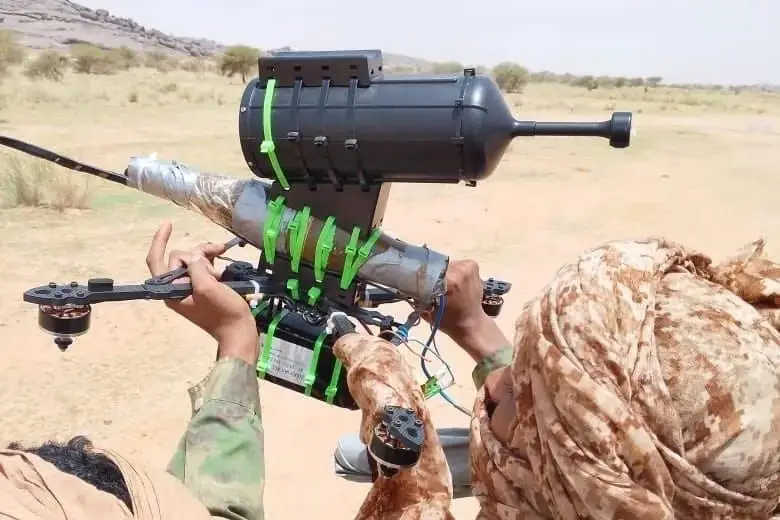
    Sudan’s civil war has since overtaken Libya as the continent’s clearest testing ground. The Armed Conflict Location and Event Data Project has recorded over 1,000 drone strikes in Sudan between April 2023 and early 2026, the large majority flown by the Sudanese Armed Forces using Turkish, Chinese and Iranian-supplied platforms. In September 2024, researchers documented what they described as the war’s first coordinated drone-swarm attack, when a formation of small drones flown as improvised loitering munitions struck Sudanese Armed Forces positions at El Fasher, prompting SAF-aligned units to begin fielding Chinese-made counter-swarm jamming systems in response. Researchers tracking the conflict have separately pointed to strikes such as the December 2024 attack on a hospital in Kalogi, which killed more than 110 people, as evidence of how quickly algorithmically assisted targeting can produce mass-casualty outcomes that oversight mechanisms are not built to keep pace with.

    Nigeria, Kenya and South Africa: three different starting points

    The three countries most often cited as leading Africa’s AI-drone adoption are, on closer inspection, at three quite different stages — and mostly not in the military domain.

    South Africa has gone furthest toward building institutional capacity specifically for military AI. The government has stood up a Defence Artificial Intelligence Research Unit (DAIRU) to pool government, private-sector and military resources for AI-related defence projects, and South African manufacturer Paramount Group has fielded the N-RAVEN, a family of small drones explicitly built around autonomous swarm coordination in units of up to twenty aircraft, marketed around local manufacture and technology transfer to partner militaries rather than sold as a finished import. That model speaks directly to the “no legacy systems to unwind” argument often made for African adoption, since it is designed to be built inside a customer’s own defence-industrial base rather than bolted onto it.

    Nigeria’s military services have each announced intentions to bring AI into their operations, including AI-enabled drones, and Nigeria has begun collaborating with Ethiopia on drone development tied to what is billed as Africa’s largest drone manufacturing facility, near Abuja. But by the assessment of researchers who track the continent’s drone programmes closely, Nigeria has not yet fielded a drone with genuine autonomous targeting or navigation capability; its most advanced systems remain human-piloted or remotely operated platforms, however sophisticated their sensors.

    Kenya is the outlier of the three, and its absence from the tactical conversation is itself informative. Kenya’s most visible drone-AI work is concentrated almost entirely in civilian applications — precision agriculture, infrastructure and pipeline inspection, and disaster and emergency response — the same categories, notably, that tend to get cited whenever someone wants to argue Africa is moving fast on AI-drone adoption in general. That is a genuine and significant trend. It is just not a military one, and conflating the two risks overstating how far tactical autonomy specifically has actually travelled into African armed forces.

    Why the interest is real anyway

    None of this means the underlying appeal is manufactured. African militaries have concrete reasons to want autonomy that reduces reliance on a continuous radio link between pilot and aircraft. Electronic warfare and GPS jamming have become standard features of the conflicts in Sudan and the Sahel, and a growing share of commercially available autonomy software, platforms like Applied Intuition’s recently launched Drone Stack and Tycho.AI’s Voyager system, both aimed squarely at defence integrators, are built specifically around GPS-denied navigation and onboard processing that keeps a drone flying and functioning if its communications link is jammed or cut. For militaries already struggling to counter cheap swarming drones and loitering munitions, as Sudan has demonstrated at scale, autonomy that survives jamming is not a luxury feature; it addresses one of the most immediate operational vulnerabilities in the region’s current conflicts. The same resource-constrained environment that limits legacy infrastructure also removes some of the institutional inertia that slows adoption in better-equipped militaries elsewhere — a genuine, if double-edged, advantage.

    The regional exercise circuit reflects the same pull. At AFRICOM’s African Lion exercise in Morocco this May, participating forces tested autonomous target systems and tactical UAS specifically aimed at compressing targeting and decision-making timelines, alongside partner nations. Even where African militaries are not yet fielding autonomous strike systems of their own, they are increasingly being brought into training environments built around them.

    The governance gap

    The more serious problem is not whether the technology arrives, researchers who study this closely are largely convinced it will, but whether the frameworks meant to govern its use arrive with it. Analysts at the Sudan-focused African Centre for the Constructive Resolution of Disputes (ACCORD) have argued that the African Union’s peace and security architecture, designed well before AI-enabled weapons entered African conflicts, is now straining to keep pace with technology capable of producing casualties faster than existing accountability mechanisms can respond to them. Writing for Africa Defense Forum, one security researcher put the risk starkly: without a clear African voice in the international conversation shaping norms around autonomous weapons, the continent risks becoming “a proving ground and a casualty for others’ technological ambitions” rather than a genuine participant in setting the rules.

    That risk sits uncomfortably alongside the already-documented pattern of civilian harm from existing, far less autonomous drone operations in Nigeria, the Democratic Republic of Congo and Burkina Faso — harm caused by systems that still had a human pulling the trigger. Layering machine-speed targeting decisions on top of an accountability gap that already exists is, by most serious accounts, a matter of when rather than if.

    A more useful question than “how fast”

    The framing that tactical autonomy is now simply table stakes, something every serious operator must adopt or fall behind, gets the urgency roughly right and the specifics roughly wrong. What is accelerating fastest across Nigeria, Kenya and South Africa is commercial and civilian AI-drone use, not tactical military autonomy, and the two should not be read as the same curve. What tactical autonomy Africa has actually seen, in Libya, and now more seriously in Sudan, has arrived through active conflict rather than considered procurement, ahead of any regional framework built to govern it. For African militaries genuinely weighing the technology, the more useful question is not how quickly they can adopt autonomy once it becomes standard, but whether they, and the regional institutions meant to oversee them, will have any real say in how it gets used before that happens.

  • How Turkish and Russian Drones Transformed Sahelian Aerial Warfare

    How Turkish and Russian Drones Transformed Sahelian Aerial Warfare

    The exit of French counter-terrorism forces and the suspension of security assistance from the United States (US) across Mali, Niger, and Burkina Faso triggered a rapid restructuring of airpower in the Sahel. Military leaders in Bamako, Niamey, and Ouagadougou, now organized under the Alliance of Sahel States (AES), systematically turned away from Western security arrangements. In place of conditional Western military aid, these governments embraced transactional defense agreements with Turkey and Russia. This strategic pivot replaced legacy Western surveillance networks with sovereign ownership of armed uncrewed aerial vehicle fleets, fundamentally altering counter-insurgency operations across the region.

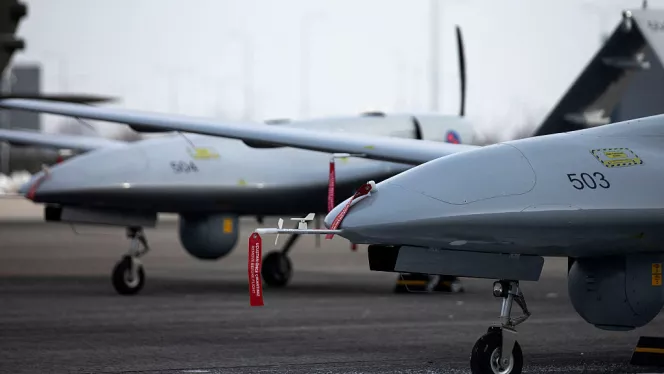
    Turkish aerospace manufacturers emerged as the principal beneficiaries of this shift. The Bayraktar TB2, a Class III Medium-Altitude Long-Endurance (MALE) platform, quickly became the primary strike asset at Sahelian air bases. Carrying up to 150 kilograms of payload, including laser-guided Smart Micro Munitions (MAM-L) manufactured by Roketsan, the platform offers 27 hours of operational endurance. Armed forces in Mali and Burkina Faso expanded their operational reach by acquiring the larger, twin-engine Bayraktar Akinci. The Akinci features a 1,500-kilogram payload capacity, satellite communication capability, and advanced synthetic aperture radar suites. These platforms provide immediate, unconditioned precision strike options, enabling military commanders to engage targets without navigating lengthy Western export approval procedures.

    Russian defense contributions complement Turkish strike capabilities through tactical reconnaissance hardware and military advisory personnel. Following the reorganization of former Wagner Group assets into the Russian Ministry of Defense’s Africa Corps, Russian operators introduced light tactical Uncrewed Aerial Vehicle (UAV) platforms such as the Orlan-10 and Supercam S35. These hand-launched systems provide real-time target acquisition for frontline artillery batteries and motorized units, filling short-range surveillance gaps. While Turkish platforms execute medium-altitude strikes, Russian tactical airframes conduct localized perimeter surveillance around forward bases, establishing a layered aerial network.

    This tactical realignment reflects a broader transformation in African defense diplomacy. Open-source procurement dataset records verified as of July 2026 show that Turkish suppliers have delivered 291 units across the continent, with heavy concentrations across Sahelian combat zones. Sourcing hardware from Ankara and Moscow allows Sahelian defense planners to align procurement choices directly with immediate operational needs. However, this model introduces notable operational trade-offs. Operating diverse foreign platforms creates maintenance bottlenecks, complicates spare parts inventory, and increases reliance on foreign technical contractors during active combat operations.

  • Operational Realities of African MALE Drone Fleets

    Operational Realities of African MALE Drone Fleets

    Between 2020 and 2026, African defense ministries acquired 1,054 uncrewed aerial units, marking a major acceleration in continental airpower modernization. High-profile Class III Medium-Altitude Long-Endurance (MALE) platforms, including the Turkish Bayraktar TB2 and the Chinese Wing Loong II, led this expansion. Says a comprehensive data from Military Africa.

    These systems promise continuous intelligence gathering and rapid precision strike capabilities over remote conflict zones. Field deployment data across multiple operational theaters reveals a stark contrast between contract announcements and sustained combat effectiveness. Procuring advanced uncrewed aircraft does not automatically guarantee air dominance. Operational bottlenecks, hardware constraints, and environmental factors frequently ground these high-value assets or compromise their mission profiles.

    Communication architecture presents the first primary obstacle for deploying military uncrewed aerial vehicles over large geographic sectors. Standard baseline variants of MALE platforms rely on Line-Of-Sight (LOS) radio data links, which restrict the operational radius of the aircraft to approximately 300 kilometers from its ground control station. In expansive theaters such as the Sahel, the Horn of Africa, or the Lake Chad basin, this line-of-sight limit severely restricts mission scope. To cover shifting frontlines, military commanders must frequently relocate heavy ground control terminals, relay antennas, and launch equipment across challenging terrain. Equipping platforms with Satellite Communications (SATCOM) solves the range constraint, but introduces substantial operational costs. Leasing commercial satellite bandwidth requires continuous foreign exchange expenditure, and relying on foreign satellite operators creates potential operational vulnerabilities during active crises.

    Human capital shortfalls represent a second critical constraint. Flying a Class III uncrewed platform requires a team of certified pilots, sensor operators, avionics technicians, and weapons specialists. Many regional armed forces acquired hardware faster than their training pipelines could produce qualified indigenous personnel. Consequently, several militaries rely heavily on foreign contractor support teams to handle flight operations, routine maintenance, and mission planning. This dependency limits operational flexibility and creates security risks at forward operating locations. Inexperienced crews and inadequate maintenance procedures also directly cause costly hull losses. A notable example occurred in Burkina Faso, where operational mistakes led to the crash and destruction of a multi-million dollar Bayraktar TB2 platform.

    Atmospheric conditions in Africa force operators to accept hazardous tactical trade-offs. Class III MALE platforms typically perform surveillance and target tracking from high altitudes using Electro-Optical/Infrared (EO/IR) sensor gimbals. Severe environmental weather, such as heavy seasonal cloud cover, intense tropical rain belts, and dense Harmattan dust plumes, routinely blinds these optical payloads. When cloud cover or dust haze obstructs sensor view, operators face a difficult choice. They must either abort the mission or descend below the cloud ceiling to regain visual line-of-sight with ground targets.

    Descending into lower altitude bands negates the principal survival mechanism of high-altitude platforms. Flying low brings aircraft within engagement envelopes of low-cost ground defenses. Irregular combatants and non-state armed groups across the continent increasingly field light anti-aircraft weapons. Operating below dust or cloud layers exposes multi-million dollar uncrewed platforms to Small Arms Fire (SAF), heavy Anti-Aircraft Artillery (AAA), and shoulder-launched Man-Portable Air Defense Systems (MANPADS). Multiple airframes have taken damage or suffered shootdowns while attempting low-altitude reconnaissance under poor weather conditions.

    Data verified as of July 2026 confirms that while uncrewed aircraft acquisitions will continue to rise, long-term success depends entirely on institutional support structures. Air force planners must prioritize logistics networks, secure satellite data links, and long-term operator training programs over raw airframe counts. Without sustained investment in ground infrastructure and technical personnel, uncrewed platforms will remain vulnerable to environmental interference, operational bottlenecks, and low-altitude ground fire.

  • How Non-Western Suppliers and Local Production Drive African Drone Adoption

    How Non-Western Suppliers and Local Production Drive African Drone Adoption

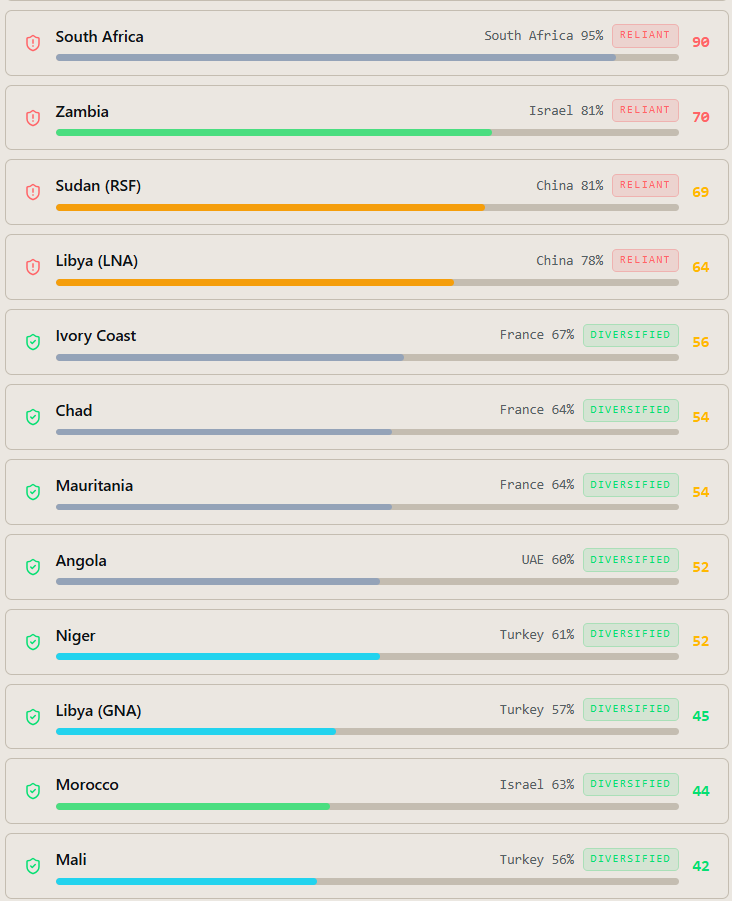
    Three non-Western defense suppliers (China, Turkey, and Israel) now dominate Africa’s uncrewed aerial vehicle market. Together, they account for 1,203 units, representing over 60 percent of all recorded transfers on the continent. Their market leadership stems from offering affordable platforms, fast delivery timelines, export terms free of political conditions, and systems thoroughly tested in operational combat. Vendors from the United States (US) and the European Union (EU) face a structural disadvantage that will persist unless export policies and unit pricing change substantially.

    Nigeria unveils advanced home-made drones, missiles, and bombs

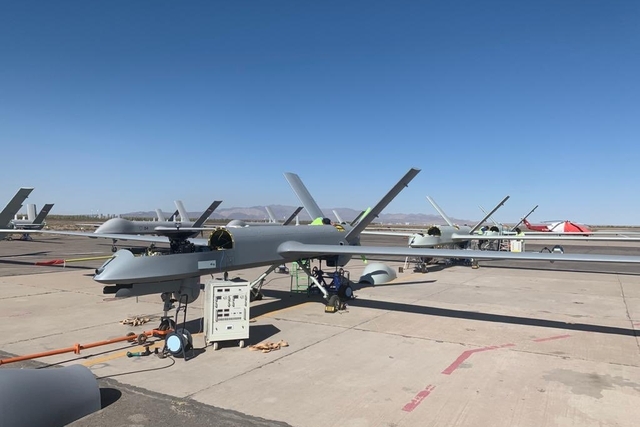
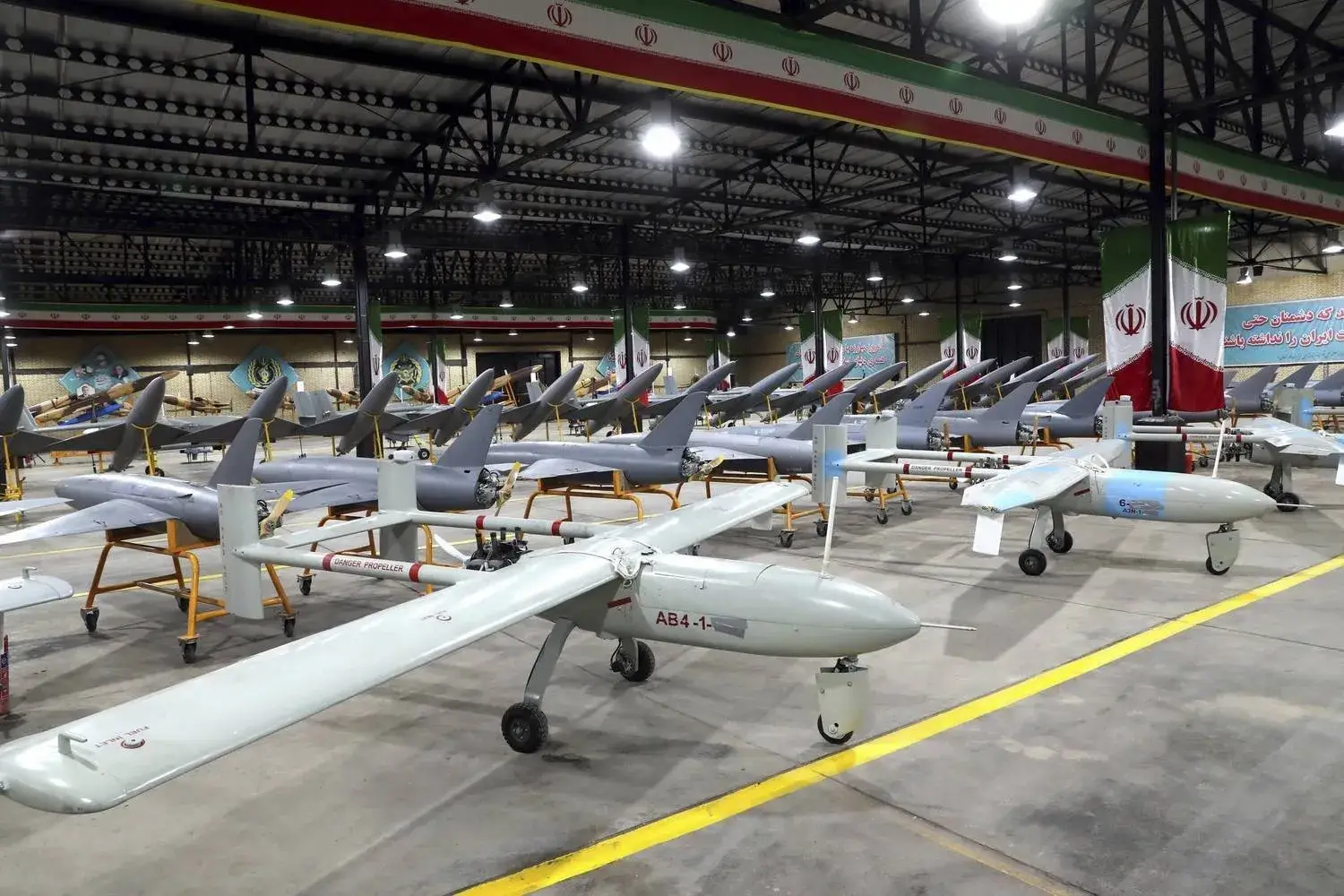
    According to research procurement data from Military Africa, Uncrewed strike capabilities have become standard across African operational theaters. Twenty-five nations deploy Class III Medium-Altitude Long-Endurance (MALE) systems. Compared to conventional crewed combat aircraft, these platforms offer a far lower cost of entry. This dynamic democratizes precision air-to-ground strike capability, introducing complex operational challenges for arms control frameworks and elevating risk factors for non-combatants during counter-insurgency engagements.

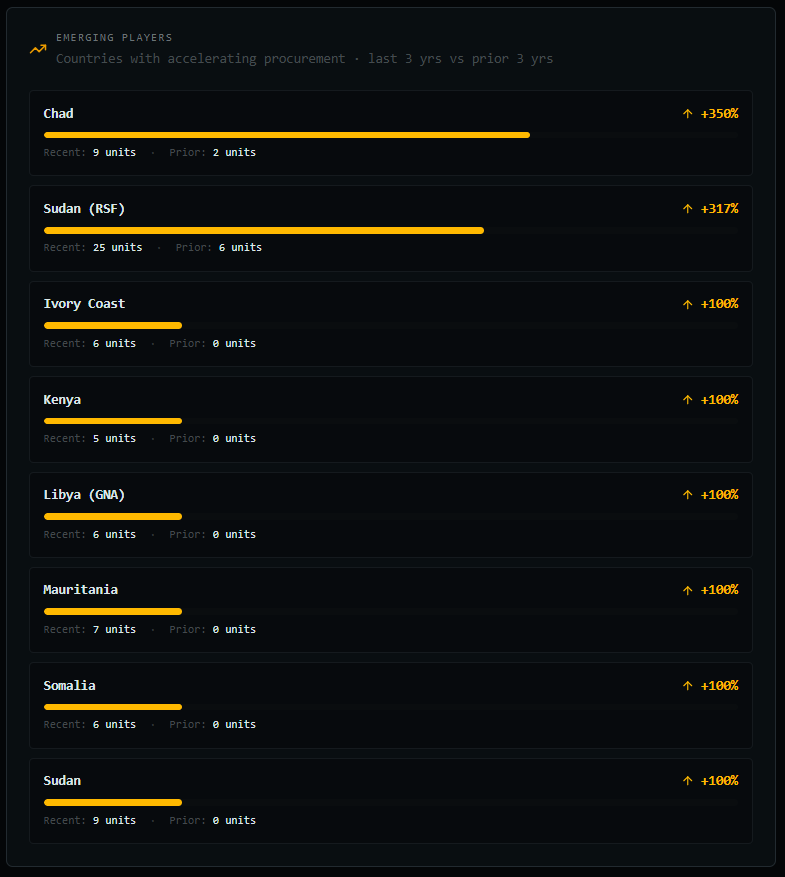
    In the Sahel region, uncrewed system acquisitions directly reflect shifting geopolitical alignments. Militaries in Mali, Niger, Burkina Faso, and Chad have systematically replaced historical French defense ties with hardware sourced from Turkish and Russian suppliers. These procurement decisions demonstrate how air power acquisitions now serve as explicit signals of political alliance, matching the strategic weight of traditional defense treaties.

    African defense planners increasingly view domestic manufacturing capacity as a strategic imperative rather than a minor niche. Nine nations have invested in local assembly and production, accounting for 216 locally built units. Established programs in South Africa, Nigeria, Algeria, and Ethiopia lead this effort to reduce reliance on foreign supply chains. Nigeria stands out due to its diverse inventory of 34 distinct platform types alongside active domestic Research and Development (R&D) programs, positioning the nation to become the continent’s next primary producer of Class III systems.

    Acquisition dataset entries verified as of July 2026 confirm that overall procurement volume will continue to accelerate through 2030. Strong order figures recorded through 2025 and 2026, driven by growing national defense budgets, ongoing regional conflicts, declining component costs, and competitive foreign vendor behavior, support this trajectory. While North Africa maintains the largest aggregate fleet size, active security dynamics in the Sahel and the Horn of Africa are rapidly closing the gap in West and East Africa.