
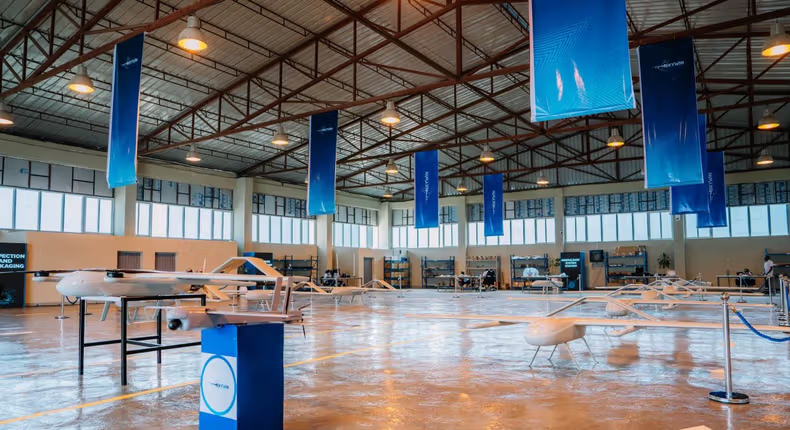
Africa’s Military Drone Manufacturers: A Continental Survey
Nine African countries can claim some domestic military drone production, but the phrase covers at least four different things. There are state aerospace groups with decades of engineering behind them, venture-backed startups building airframes from scratch, military research centres assembling home-grown surveillance drones to cut a messy import bill, and, in Sudan, a war economy turning a wrecked industrial complex into a drone assembly line because it has to.
Unmanned Africa has already profiled two of the best-known manufacturers, South Africa’s Milkor and Nigeria’s Terra Industries, so they get only a brief mention here. This piece covers the rest: the older South African firm that came before Milkor, Egypt’s fast-moving programme, and the earlier-stage efforts in Algeria, Kenya and Ethiopia that rarely get sustained attention.
South Africa: Denel’s head start
South African drone building did not start with Milkor. Denel, the state-linked defence group whose Denel Dynamics division has built reconnaissance drones since the Seeker entered service in the 1980s and 1990s, is still the continent’s largest drone maker by output, according to Military Africa’s tracking. Those decades of engineering, as much as recent MALE-class ambitions, make South Africa Africa’s most mature drone-building base. Milkor’s 380, the largest African-designed drone flying today, stands on that foundation. Newer entrants have nothing comparable to build on.
Egypt: from operator to producer
Egypt has moved faster than almost anyone else in the past year. The state-owned Arab Organisation for Industrialisation (AOI) and the Ministry of Military Production have run drone projects since at least 2021. That year the Egypt Defence Expo saw the debut of the Nut reconnaissance drone, a joint AOI and Military Technical College project with a 50-kilogram payload and ten hours’ endurance, and the EJune-30 SW from Industrial Complex Engineering Robots, widely seen as a technology-transfer descendant of the UAE’s Yabhon United 40.
In 2025 the scale changed. Tornex Egypt’s Jabbar family, unveiled at EDEX 2025, is the country’s first fully Egyptian-designed and built drone family, with versions for long-endurance surveillance, radar-threat emulation and long-range strike. A turbojet version is reported to reach cruise-missile-like speeds over a claimed 1,500 to 2,000 kilometres. AOI followed in February 2026 with the Hamza-3, shown at Saudi Arabia’s World Defense Show next to a new counter-drone jammer and detection system.
An AOI representative admitted some Hamza-3 subsystems still come from China while Cairo works to localise production. That is where most African programmes really are: building and increasingly designing airframes at home, with imported engines, optics and electronics inside. This site has covered the same constraint in Nigeria, and it comes up almost everywhere else on this list.
Nigeria: three models at once
Nigeria is unusual because it is trying three industrial models simultaneously. The Nigerian Air Force Research and Development Centre builds the Tsaigumi surveillance drone to ease the strain of a fleet spread across dozens of imported types. Terra Industries has turned Silicon Valley money into two factories and a strike and interceptor line in under two years, aimed at export markets as much as at Abuja. Babasky Technologies has built a counter-drone system through a more conventional partnership with the state-linked DICON.
No other African country is running private venture capital, state R&D and a state-industrial partnership side by side. Nigeria is therefore a live test of which approach builds a lasting industry. It is too early to say which, if any, will still be standing in five years.
Algeria, Kenya and Ethiopia
The rest of the field is far less proven, and few announced programmes match South Africa or Egypt. Algeria’s Amel series, developed since 2013 by Star Aviation and later by the state Research Centre in Industrial Technologies, has gone through at least five designs and produced about 17 Amel 300s. Independent trackers including Oryx judge that most Amel variants will probably never enter service. Algeria also says it builds the UAE’s Yabhon Flash 20 and United 40 locally as the El-Djazair-55 and El-Djazair-54. That is licensed assembly, not original design, and the two are too often lumped together as “locally built”.
Kenya’s main effort is a reverse-engineered version of Israel’s Aerostar, developed with Turkish help and unveiled in 2021 as the TAI. Ethiopia has its two-variant WanderB reconnaissance drone. Both are small programmes without the depth or announced production of Egypt or South Africa. Both come from the same impulse: militaries that have flown enough foreign drones to want a domestic alternative, however modest.
How far the sector has come
Military Africa’s tracking of the sector shows the scale of the change. In 2024 it counted about 180 locally made drones from seven countries and 13 companies. By mid-2026 the same tracking counted 216 units from nine countries and 35 models. Southern Africa still has the largest share, about 94 units across a dozen models, followed by North Africa with 51 units across 14 models, West Africa with 20 and East Africa with 15. The last two are adding new entrants fastest, Nigeria and Egypt above all.
Almost none of these programmes has solved the parts problem. State conglomerate, two-year-old startup or university research centre, the engines, precision optics and satellite navigation receivers inside an African-built drone still come mostly from abroad. The real measure of maturity will be how much of the inside African firms eventually make themselves.
