
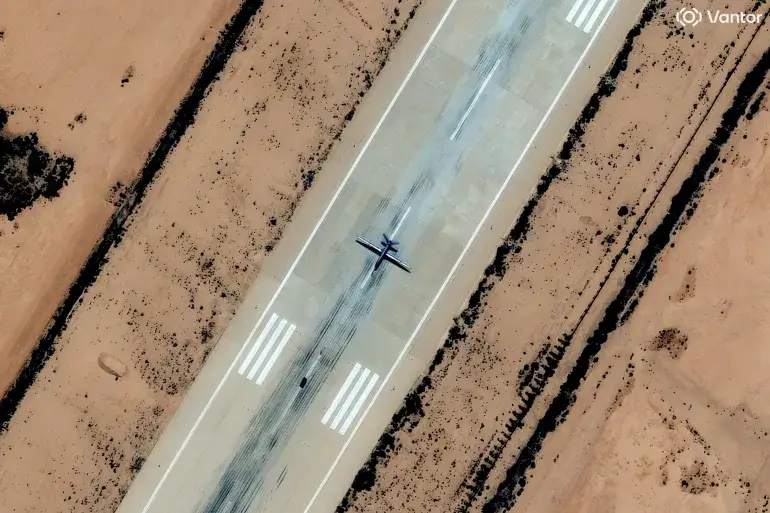
In April 2026, Reuters reported that satellite imagery showed drones arriving at Al Khadim airbase in eastern Libya, in territory controlled by Khalifa Haftar’s Libyan National Army (LNA). Image analysts who reviewed the pictures for the news agency identified one aircraft as most likely a Chinese Feilong-1 and a second, smaller airframe as resembling a Turkish Bayraktar TB2, deliveries that would breach the arms embargo the United Nations has maintained on Libya since 2011. The find matters less for its novelty, both sides in Libya’s long-running dispute have received prohibited weapons for years, than for its timing. It lands five years into a fragile ceasefire, revives interest in the conflict that first made the TB2 famous, and raises the question of whether the 2020 Tripoli stalemate is as settled as it has looked.
Libya has been split between two rival administrations since a UN-facilitated process failed to deliver the elections it promised in 2021. The Government of National Unity (GNU), based in Tripoli and led by Prime Minister Abdul Hamid Dbeibah, controls the west with the backing of an array of militias and, since 2020, direct Turkish military support. In the east, the House of Representatives in Tobruk backs a rival administration, the Government of National Stability (GNS), led by Prime Minister Osama Hamad, whose security is provided by Haftar’s LNA. The current division hardened after the LNA laid siege to Tripoli for fourteen months starting in April 2019, an offensive that Turkish intervention, including the Bayraktar TB2’s combat debut at scale, broke by mid-2020. The ceasefire that followed left the frontline roughly where the fighting stopped, and it has stayed there since, even as both governments’ claims to legitimacy have grown steadily weaker and elections remain unscheduled.
The Security Council imposed the arms embargo in February 2011 through Resolution 1970, which also gave its name to the committee that still oversees the sanctions regime today, and compliance has been thin almost since the resolution passed. A UN Panel of Experts concluded in 2017, and reaffirmed in later reporting, that the United Arab Emirates (UAE) had “most probably” supplied and helped operate Chinese-made Wing Loong II drones for Haftar’s forces during the Tripoli offensive, aircraft that gave the LNA a marked early edge before Turkey’s TB2s arrived to contest the skies. Enforcement since has stayed weak enough that violations barely register as news anymore: a March 2026 UN report found that a shipment of trucks, delivered to Libya after what investigators described as secret negotiations involving the European Union, Greece, the UAE, and both Libyan governments, was split between Tripoli-aligned Misrata and Haftar-aligned Benghazi, with some vehicles ending up with a militia that runs a notorious migrant detention camp.
Against that backdrop, the Al Khadim imagery is notable mainly for what it suggests about the LNA’s ambitions rather than for breaking new legal ground. The Feilong-1, built by the Xi’an-based Zhong Tian Guide Control Technology Company (marketed under the Zhongtian Feilong brand), first flew in January 2019 and bears a strong resemblance to China’s larger CH-5 (Rainbow-5) family, with a maximum takeoff weight of around 3,200 kilograms, a payload of up to 1,400 kilograms, and four underwing hardpoints. It had not previously been confirmed in African service. Reuters could not establish who supplied either aircraft at Al Khadim or precisely when they arrived, and neither the Chinese government, Turkish officials, nor the LNA responded substantively to requests for comment. What the imagery does suggest is that Haftar’s forces are working to close a gap that opened in October 2022, when Tripoli’s GNU signed a deal with Turkish manufacturer Baykar for the AKINCI, a larger, longer-range, and more heavily armed uncrewed combat aircraft than anything the LNA has been confirmed to operate.
Turkey’s position complicates any simple reading of the story. Ankara has spent years cultivating a working relationship with Haftar’s camp even while remaining the GNU’s principal military patron, a balancing act it has practiced elsewhere on the continent by selling rival buyers different tiers of the same product line. Whether that extends to supplying the LNA directly with combat drones remains unconfirmed, but Turkish officials have acknowledged publicly that exported drones carry technical safeguards, described in a December 2021 interview by then head of Turkey’s defence industries authority Ismail Demir as a form of remote lockout, that would let Ankara restrict how a buyer uses the aircraft. If Haftar’s forces are indeed flying Turkish-made drones, they would be doing so without the reassurance the UAE’s Wing Loong IIs offered during the 2019 to 2020 siege: aircraft supplied, and according to the UN panel’s findings partly operated, by a patron with no ambiguity about whose side it was on.
None of this has translated into renewed large-scale fighting, and there are reasons to think it might not, at least for now. In April 2026, mediation led by US Senior Advisor for Africa Massad Boulos helped the two governments agree on Libya’s first unified state budget in nearly a decade, a rare concrete step that UN officials have cited as evidence the political track still has life in it. But the same month’s satellite imagery is a reminder that Libya’s political and military tracks are not necessarily moving in step with each other. The country that gave the world its first large-scale demonstration of what an inexpensive, expendable drone could do to a conventional army is once again the place both sides are watching most closely to see whether that lesson needs relearning.

Africa’s dedicated and only military drone procurement intelligence.
Unmanned Africa bridges the critical gap between aerospace engineering, defense economics, and geopolitical strategy. As African defense forces rapidly modernize and scale their unmanned capabilities to address asymmetric conflicts, insurgencies, and border security, the platform functions as an essential, independent repository for defense analysts, policymakers, military professionals, and researchers.
