Category: Procurement & Defence Deals

Track African military drone procurement — acquisitions, contracts and government deals shaping the continent’s unmanned systems arsenals.

  • Ghana Army Drone Pilots Complete AeriusPro & Ghost OEM Training Programme

    Ghana Army Drone Pilots Complete AeriusPro & Ghost OEM Training Programme

    Newly certified Ghana Armed Forces operators are now qualified to fly the AeriusPro, an indigenously designed VTOL drone that has been doing real operational work over the country’s volatile northern border since January — the latest step in a military-industry training relationship that stretches back nearly a decade.

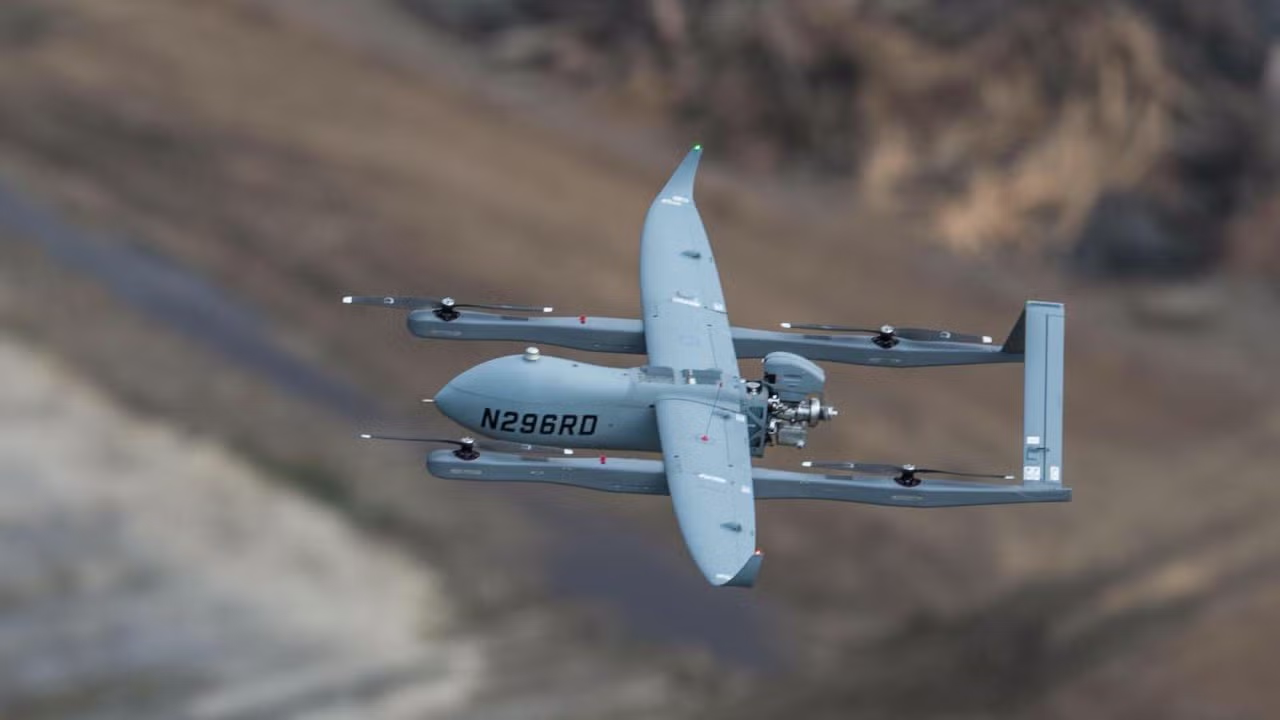
    A new cohort of Ghana Armed Forces personnel has completed training on the AeriusPro platform, adding to the pool of certified operators available to fly a drone that Ghana now designs, builds and deploys almost entirely on its own terms. The pilots finish the programme at a moment when the aircraft they’ve been trained on is already doing serious work: since January, the Ghana Armed Forces has flown the locally designed and manufactured AeriusPro operationally over Bawku and Binduri, two districts in the country’s Upper East Region, making Ghana one of a still-small group of African states that can design, manufacture, deploy and operationally sustain an indigenous unmanned aerial vehicle.

    A partnership years in the making

    The training is best understood as the continuation of a relationship rather than a one-off event. Accra-based SoKo Aerial Robotics, the company behind the AeriusPro’s design, was first invited into the Ghana Armed Forces in 2018 to train personnel from the Signal Regiment, at the time under the command of an officer who has since risen to major general. In the years since, that training relationship has expanded well beyond a single unit: SoKo puts the number of army and navy personnel it has trained at close to 200, alongside operators from Nigeria’s Defence Space Agency and staff from Ghana’s Forestry and Boundary Commissions. Along the way, the company built some of the Ghana Armed Forces’ earliest indigenous surveillance drones — aircraft named Nkonim, Chichis 1P and Mercury 1/2 — well before the AeriusPro existed as a programme.

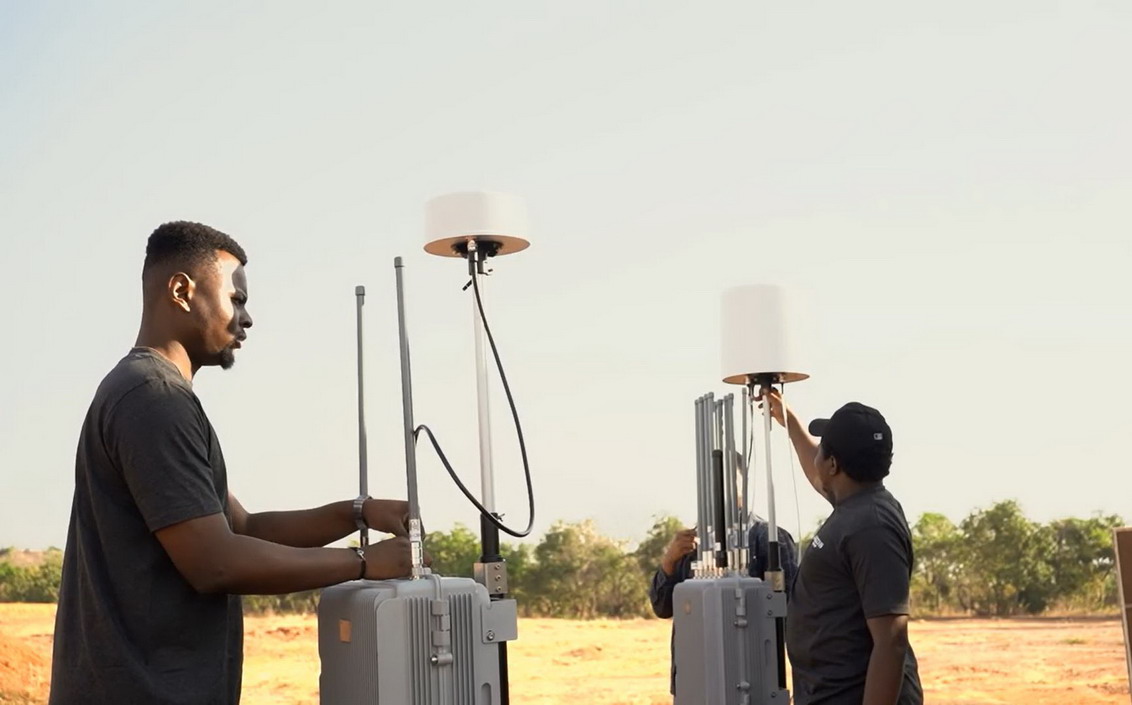
    Ghana Army drone pilots on successfully completing the AeriusPro & Ghost OEM Training Programme.
    The Ghanaian Armed Forces have operationally deployed the locally designed and manufactured VTOL AeriusPro drone in the northern regions of Bawku and Binduri.

    That history matters for understanding January’s deployment. Facing entrenched chieftaincy-linked communal tensions in Bawku and Binduri, along with cross-border security threats and illegal mining activity across Ghana’s Upper East Region, commanders needed persistent aerial coverage over terrain that ground patrols struggle to cover safely. The 93 Signal Regiment runs the technical backbone of the operation — the data pipelines and command integration that turn raw drone footage into usable intelligence — working alongside the Army’s Special Brigade and Northern Command. The AeriusPro now flies as part of a mixed fleet that includes the ZMO-120, DeltaQuad Pro and FIXAR 007, but it is the only one of the group designed and built inside Ghana.

    Hybrid design, AI-assisted flight

    The AeriusPro’s core engineering trick is the same hybrid approach used by comparable VTOL platforms elsewhere: four vertical-lift propellers mounted on under-wing pylons get it off the ground without a runway, then a rear-mounted pusher propeller takes over for efficient forward flight once it transitions to fixed-wing mode. That combination suits northern Ghana’s terrain well, letting the aircraft launch from remote, unprepared sites while still covering distance efficiently once airborne. The backpack-portable, V-tailed airframe offers up to three hours of endurance, a 40-kilometre control range and a service ceiling of around 4,000 metres, carries a gimbal-stabilised 4K camera, and is built to the IP43 ingress-protection standard for operation in poor weather. AI-assisted navigation adds obstacle avoidance and automated flight paths on top of manual control, reducing the operator workload during long surveillance legs.

    On its own, though, an aircraft like the AeriusPro is only half the picture. Its operational value depends on Sigtrack, SoKo’s own situational-awareness and data-coordination platform, which pulls live drone video, ground-based reporting and sensor data into a single operating picture that commanders and field teams can view in real time. Sigtrack was built specifically to keep working in the kind of remote, bandwidth-constrained conditions common across northern Ghana — an explicit point of difference from imported command-and-control systems designed around reliable broadband connections — caching data locally and syncing automatically once a connection is restored. That resilience, as much as the airframe itself, is what lets a single AeriusPro sortie feed directly into decisions about where to route a patrol or which mining site to flag for enforcement.

    The company behind the aircraft

    SoKo Aerial Robotics was founded in 2017 by Kofi Owusu-Adusei, a Ghanaian engineer with a telecoms and security background who also directs the Centre for Unmanned Aerial Vehicles Research and Education (CUAVRE), which functions as the company’s in-house research arm. The AeriusPro itself is now built by a related manufacturing partner, Aerius UAS, while SoKo continues to develop the surrounding software and sensor ecosystem, including Sigtrack. Owusu-Adusei has described the company’s edge as coming less from any single piece of hardware than from treating drones as one part of a full operational system — flying the aircraft, but also owning the data processing, analytics and safety layers around it, an approach he argues lets SoKo tailor solutions that larger foreign vendors tend to overlook. “It’s this blend of local relevance and operational rigour that defines our competitive edge,” he has said of the company’s approach. He has credited two Ghana Armed Forces officers in particular with shaping the programme’s direction early on — Major General Matthew Essien, a former commandant of the Ghana Armed Forces Command and Staff College, who Owusu-Adusei says impressed on him early just how much the Signal Corps and the country were counting on the programme succeeding, and Brigadier General Anthony Ntem, credited with backing the programme’s expansion and protecting it as a matter of national interest.

    Part of a much larger build-up

    The AeriusPro programme is a small piece of a considerably larger shift in Ghana’s defence spending. The Ministry of Defence’s budget rose sharply in 2025 and is set to climb again in 2026, to roughly GHS 10.8 billion — an increase government officials have attributed to a deliberate “retooling” of the armed forces, moving spending away from wages and toward capital investment in equipment and infrastructure. Alongside new surveillance and mobility assets and efforts to retool the Air Force, the government has also been funding new forward operating bases, an expansion at the Command and Staff College, and thousands of new housing units intended to improve troop welfare and readiness. Set against that backdrop, a homegrown VTOL drone flying real missions over one of the country’s most sensitive border regions is a small but visible proof point for a much larger argument the Ghanaian government is making: that sustained investment in its own defence-industrial base, rather than continued reliance on imported systems alone, is where the armed forces’ modernisation is ultimately headed.

  • Dominance of China and Turkey in Africa’s military UAV market

    Dominance of China and Turkey in Africa’s military UAV market

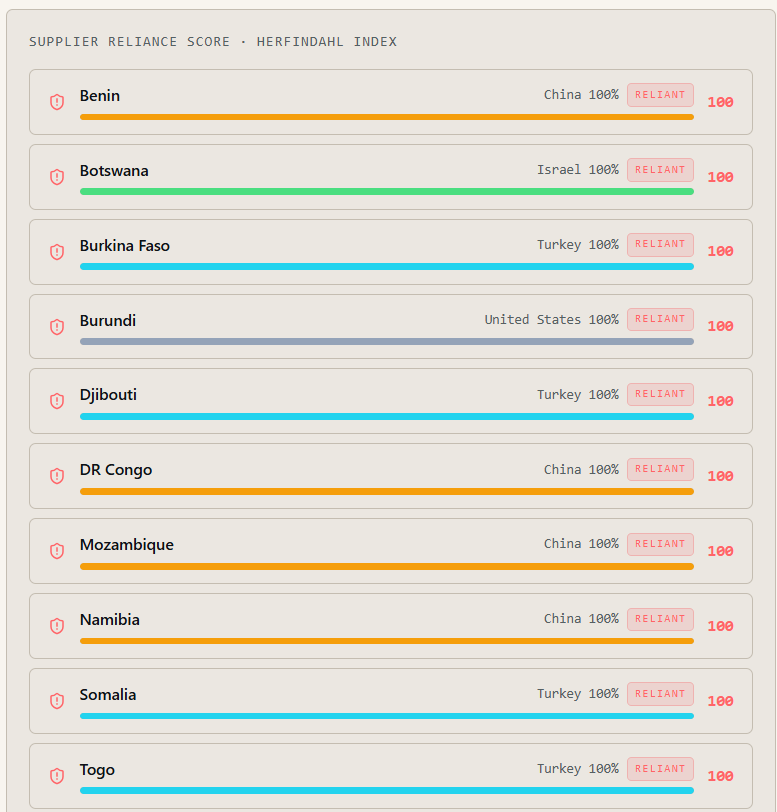
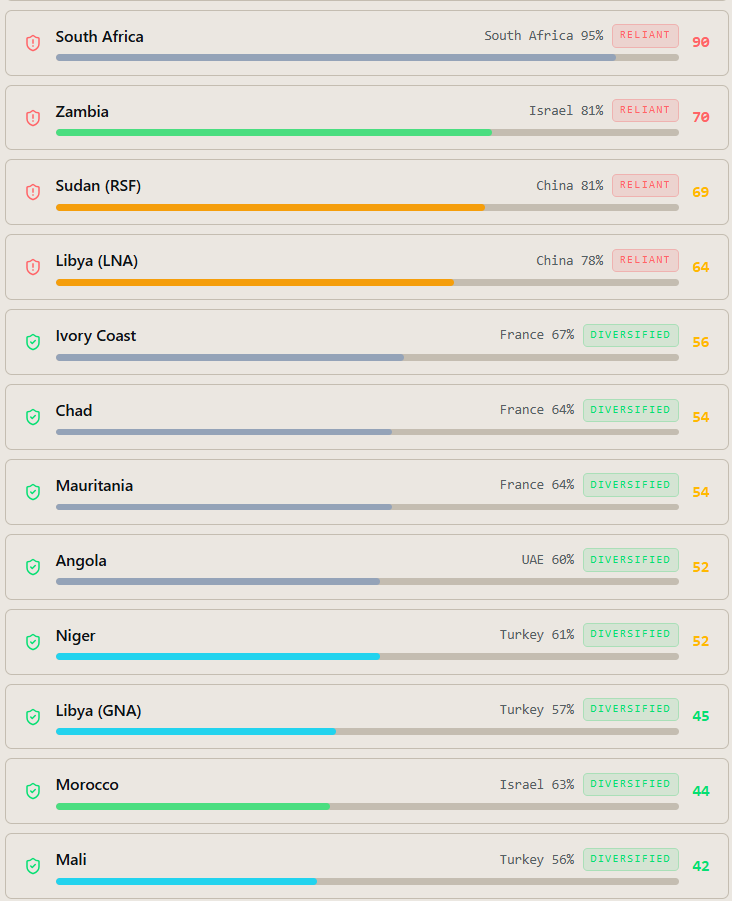
    The dominance of China and Turkey in Africa’s military uncrewed aerial vehicle (UAV) market—which, alongside Israel, accounts for over 60% of all recorded drone transfers on the continent—has reshaped regional defense diplomacy and combat doctrine.

    By offering affordable platforms without the strict political conditions typical of Western suppliers, Ankara and Beijing have fundamentally altered the strategic environment across several key dimensions:

    1. Realignment of Security Partnerships and Geopolitics

    For decades, African defense procurement depended heavily on Western nations—most notably France and the United States—or Russia. The rise of Turkish and Chinese drone exports has broken those traditional monopolies.

    • Fading Western Influence: In nations across the Sahel (such as Mali, Niger, and Burkina Faso), military governments have actively reduced or ended defense ties with Western partners. In their place, turnkey drone acquisitions from Ankara and Beijing provide immediate airpower options without requiring lengthy parliamentary debates, export vetting, or human rights agreements.
    • Transactional Diplomacy: Turkey uses drone sales from manufacturers like Baykar as a wedge to expand its diplomatic, commercial, and maritime footprint across East, West, and North Africa. Meanwhile, China leverages hardware transfers—such as Wing Loong and CH-series platforms—to secure bilateral trade access, resource concessions, and long-term infrastructure partnerships under the Belt and Road Initiative.

    2. Low Cost of Entry and Airpower Democratization

    Historically, establishing an air force required hundreds of millions of dollars in crewed jet trainers, supersonic fighters, specialized ground logistics, and years of pilot training.

    • Asymmetric Capability: Class III Medium-Altitude Long-Endurance (MALE) systems like the Bayraktar TB2 or Wing Loong II allow mid-sized and developing African militaries to establish precision air-to-ground strike and continuous Intelligence, Surveillance, and Reconnaissance (ISR) capabilities at a fraction of the cost.
    • Combat Normalization: Armed drones have become standard operational tools rather than luxury assets. Sovereign states can now project airpower deep into remote insurgent-held corridors, shifting the tactical balance in anti-access/area-denial (A2/AD) scenarios and counter-insurgency operations.

    3. Accelerated Conflict Escalation and Civilian Risk

    The influx of low-cost, unconditioned strike airframes directly impacts conflict dynamics across active African combat zones.

    • Reduced Threshold for Escalation: Because uncrewed systems remove physical risk to pilots, political and military leaders face fewer internal disincentives when launching cross-border strikes or offensive operations into contested territories (as seen in the Horn of Africa and the Sahel).
    • Collateral and Humanitarian Impact: Non-Western suppliers rarely attach restrictive operational end-use monitoring to their sales. When inexperienced operators fly strike missions under poor atmospheric conditions (such as Harmattan dust clouds or tropical rain) or execute strikes with limited target verification, the risk of non-combatant casualties rises.

    4. Technical Dependence and Supply Chain Vulnerability

    While buying foreign platforms provides rapid operational capabilities, it introduces critical long-term dependencies:

    • Contractor Reliance: Maintenance routines, specialized avionics servicing, satellite data-link relay access, and specialized munition resupply (such as Turkish Roketsan MAM-L laser-guided bombs) remain controlled by foreign technicians.
    • Geopolitical Leverage: Relying on Beijing or Ankara for hardware components and software updates gives these exporting nations indirect leverage over an African state’s operational flight hours and defense readiness during active diplomatic disputes.

    5. Catalyst for Sovereign Defense Production

    Observing their vulnerability to foreign supply chain shifts, forward-looking African defense planners increasingly view foreign drone dominance as a reason to build local capacity.

    Nations like Nigeria, South Africa, Algeria, and Ethiopia are channeling resources into domestic assembly plants, Research and Development (R&D) centers, and local software integrations to reduce total reliance on external vendors over the next decade.

  • Mali Receives Additional Bayraktar AKINCI UCAVs

    Mali Receives Additional Bayraktar AKINCI UCAVs

    A fresh delivery of Turkish-made combat drones, handed over at Sévaré this week, extends a fleet Mali has already had to partly rebuild once — and lands three months after the country’s defence minister was assassinated in the same rebel offensive that forced Malian troops out of a town their own drones had helped recapture less than two years before.

    Mali’s armed forces have taken delivery of another batch of Bayraktar AKINCI unmanned combat aerial vehicles, officially handed over at a ceremony in Sévaré on 30 July. General Oumar Diarra, the deputy minister attached to Mali’s Ministry of Defence, presented the drones to the army’s Chief of the General Staff, General Elisée Jean Dao, who in turn passed them to the Malian Air Force’s chief of staff, General Alou Boï Diarra — a formal chain of custody Malian officials framed as part of the continuing modernisation of the country’s armed forces in the face of the ongoing jihadist and separatist threat. The exact date the aircraft arrived in Mali was not disclosed, though a cargo aircraft was reported landing at Sévaré in early July, several weeks ahead of Thursday’s ceremony.

    This is not Mali’s first AKINCI delivery, and not even its first this year. Mali became the fourth African operator of the type — after Burkina Faso, Ethiopia and Libya — when Baykar’s high-altitude, long-endurance UCAV entered Malian service in late 2024, building on the roughly seventeen Bayraktar TB2s Mali had already integrated into its air force since December 2022. The TB2s had already proven their worth by then: drone strikes were credited with disrupting rebel defences during the Malian army’s recapture of Kidal in November 2023, allowing government forces to retake the northern stronghold without a prolonged ground battle.

    The AKINCI fleet has had a rougher time of it since. On 1 April 2025, Algeria’s military shot down one of Mali’s newly delivered AKINCIs after it crossed into Algerian airspace near the border town of Tinzaouaten — the first time Algeria’s air force had downed a foreign drone, and, because Mali had only acquired a handful of the type, a loss reported at the time to represent roughly half its entire AKINCI inventory. A further batch was handed over at Sévaré on 30 January this year in a near-identical ceremony, led on that occasion by the then defence minister himself. Thursday’s delivery extends that replenishment again, though Malian authorities have not disclosed how many aircraft were involved in either the January or July handovers, nor the value or scope of Mali’s underlying contract with Baykar.

    The steady stream of drone deliveries stands in contrast to the fortunes of Mali’s manned combat fleet, which has absorbed a string of losses over the past several years. Two Sukhoi Su-25 ground-attack jets have crashed since 2022 — one near Gao airport in October of that year, killing the pilot and a ground worker, and a second near Almoustarat in September 2023, from which both crew ejected safely — while a Super Tucano light attack aircraft crashed in 2020, killing both pilots aboard. Mali’s air force has not published a comprehensive account of how many manned combat aircraft remain serviceable, but the pattern of losses, set against the country’s repeated and continuing investment in Turkish UCAVs, points to a military leadership leaning further into unmanned systems as the backbone of its strike and surveillance capability.

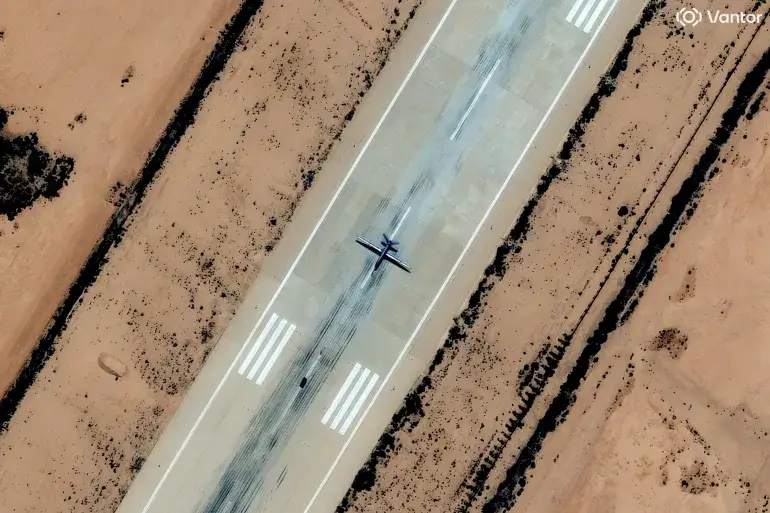
    Meanwhile, Open-source investigators have produced the clearest evidence yet that Shahed-136-type kamikaze drones — the long-range strike weapon that has come to define Russia’s air campaign against Ukraine — are now being used in combat in Mali.

    That shift is not without trade-offs, even within defence circles broadly supportive of drone-heavy force structures. Platforms like the TB2 and AKINCI offer loiter times measured in the tens of hours, a far smaller radar and infrared signature, and no risk to a pilot if the aircraft is lost — a genuine consideration for a military that has already lost aircrew to the crashes above, and an aircraft outright to a neighbouring state’s air defences. The AKINCI in particular was designed specifically to close the payload and altitude gap that separated earlier Turkish drones from crewed strike aircraft, and can carry a substantial mixed load of guided bombs and missiles. What it still cannot match is the raw speed of a dedicated attack jet like the Su-25, built to arrive over a target and deliver a heavy strike within minutes rather than the hours a propeller-driven UCAV needs to transit the same distance — a real constraint when troops in contact need air support immediately rather than after a lengthy transit to station. For an insurgency fought mostly against lightly armed, dispersed groups across Mali’s vast north, the persistent-surveillance and precision-strike case for drones is strong; for the rarer missions that call for heavy ordnance delivered in minutes, Mali’s shrinking manned fleet is a harder gap to paper over with UCAVs alone, whatever their endurance advantages.

    The timing of this delivery is hard to separate from the turmoil Mali’s military and political leadership have weathered since the last AKINCI handover. On 25 April, Mali’s defence minister, General Sadio Camara, was killed in a car-bomb attack on his home in the garrison town of Kati, part of a coordinated wave of attacks by JNIM and the Azawad Liberation Front that also struck Bamako and several northern towns and forced Malian and allied Africa Corps troops to abandon Kidal — the same town Mali’s TB2 fleet had helped recapture less than eighteen months earlier. Camara, a central figure in the 2020 and 2021 coups that brought the current junta to power and an architect of Mali’s pivot from French to Russian security partnerships, had personally presided over January’s AKINCI delivery; Thursday’s ceremony was instead led by his successor’s deputy, a changing of hands that reflects how much the chain of command has been reshuffled in the roughly three months since.

    Set against that backdrop, the steady arrival of new drones reads less as routine modernisation than as one of the few threads of continuity Mali’s military has managed to maintain. Officials at Thursday’s ceremony described the delivery in much the same terms used in January — as reinforcing surveillance and operational capacity against terrorist threats — but the deeper story is of a military that has lost a defence minister, ceded ground its drones once helped recover, and burned through a meaningful share of both its manned and unmanned combat fleets within the space of little more than a year, even as it continues to receive fresh aircraft from Ankara. Whether that pace of replacement can outrun the pace of loss remains, for now, an open question.

  • How Turkish and Russian Drones Transformed Sahelian Aerial Warfare

    How Turkish and Russian Drones Transformed Sahelian Aerial Warfare

    The exit of French counter-terrorism forces and the suspension of security assistance from the United States (US) across Mali, Niger, and Burkina Faso triggered a rapid restructuring of airpower in the Sahel. Military leaders in Bamako, Niamey, and Ouagadougou, now organized under the Alliance of Sahel States (AES), systematically turned away from Western security arrangements. In place of conditional Western military aid, these governments embraced transactional defense agreements with Turkey and Russia. This strategic pivot replaced legacy Western surveillance networks with sovereign ownership of armed uncrewed aerial vehicle fleets, fundamentally altering counter-insurgency operations across the region.

    Turkish aerospace manufacturers emerged as the principal beneficiaries of this shift. The Bayraktar TB2, a Class III Medium-Altitude Long-Endurance (MALE) platform, quickly became the primary strike asset at Sahelian air bases. Carrying up to 150 kilograms of payload, including laser-guided Smart Micro Munitions (MAM-L) manufactured by Roketsan, the platform offers 27 hours of operational endurance. Armed forces in Mali and Burkina Faso expanded their operational reach by acquiring the larger, twin-engine Bayraktar Akinci. The Akinci features a 1,500-kilogram payload capacity, satellite communication capability, and advanced synthetic aperture radar suites. These platforms provide immediate, unconditioned precision strike options, enabling military commanders to engage targets without navigating lengthy Western export approval procedures.

    Russian defense contributions complement Turkish strike capabilities through tactical reconnaissance hardware and military advisory personnel. Following the reorganization of former Wagner Group assets into the Russian Ministry of Defense’s Africa Corps, Russian operators introduced light tactical Uncrewed Aerial Vehicle (UAV) platforms such as the Orlan-10 and Supercam S35. These hand-launched systems provide real-time target acquisition for frontline artillery batteries and motorized units, filling short-range surveillance gaps. While Turkish platforms execute medium-altitude strikes, Russian tactical airframes conduct localized perimeter surveillance around forward bases, establishing a layered aerial network.

    This tactical realignment reflects a broader transformation in African defense diplomacy. Open-source procurement dataset records verified as of July 2026 show that Turkish suppliers have delivered 291 units across the continent, with heavy concentrations across Sahelian combat zones. Sourcing hardware from Ankara and Moscow allows Sahelian defense planners to align procurement choices directly with immediate operational needs. However, this model introduces notable operational trade-offs. Operating diverse foreign platforms creates maintenance bottlenecks, complicates spare parts inventory, and increases reliance on foreign technical contractors during active combat operations.

  • How Non-Western Suppliers and Local Production Drive African Drone Adoption

    How Non-Western Suppliers and Local Production Drive African Drone Adoption

    Three non-Western defense suppliers (China, Turkey, and Israel) now dominate Africa’s uncrewed aerial vehicle market. Together, they account for 1,203 units, representing over 60 percent of all recorded transfers on the continent. Their market leadership stems from offering affordable platforms, fast delivery timelines, export terms free of political conditions, and systems thoroughly tested in operational combat. Vendors from the United States (US) and the European Union (EU) face a structural disadvantage that will persist unless export policies and unit pricing change substantially.

    Nigeria unveils advanced home-made drones, missiles, and bombs

    According to research procurement data from Military Africa, Uncrewed strike capabilities have become standard across African operational theaters. Twenty-five nations deploy Class III Medium-Altitude Long-Endurance (MALE) systems. Compared to conventional crewed combat aircraft, these platforms offer a far lower cost of entry. This dynamic democratizes precision air-to-ground strike capability, introducing complex operational challenges for arms control frameworks and elevating risk factors for non-combatants during counter-insurgency engagements.

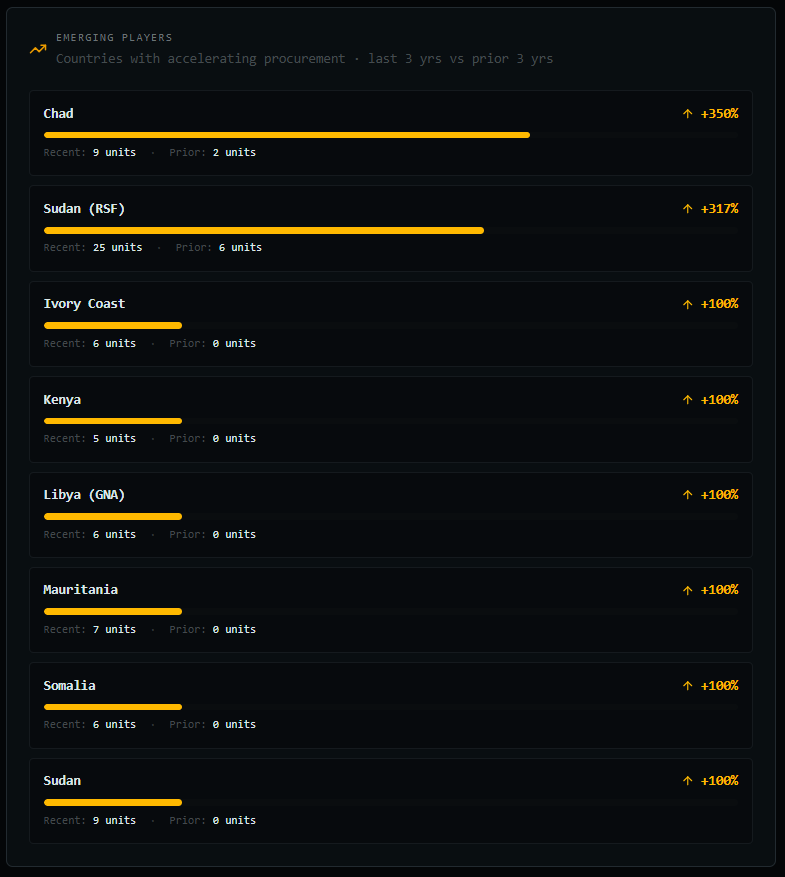
    In the Sahel region, uncrewed system acquisitions directly reflect shifting geopolitical alignments. Militaries in Mali, Niger, Burkina Faso, and Chad have systematically replaced historical French defense ties with hardware sourced from Turkish and Russian suppliers. These procurement decisions demonstrate how air power acquisitions now serve as explicit signals of political alliance, matching the strategic weight of traditional defense treaties.

    African defense planners increasingly view domestic manufacturing capacity as a strategic imperative rather than a minor niche. Nine nations have invested in local assembly and production, accounting for 216 locally built units. Established programs in South Africa, Nigeria, Algeria, and Ethiopia lead this effort to reduce reliance on foreign supply chains. Nigeria stands out due to its diverse inventory of 34 distinct platform types alongside active domestic Research and Development (R&D) programs, positioning the nation to become the continent’s next primary producer of Class III systems.

    Acquisition dataset entries verified as of July 2026 confirm that overall procurement volume will continue to accelerate through 2030. Strong order figures recorded through 2025 and 2026, driven by growing national defense budgets, ongoing regional conflicts, declining component costs, and competitive foreign vendor behavior, support this trajectory. While North Africa maintains the largest aggregate fleet size, active security dynamics in the Sahel and the Horn of Africa are rapidly closing the gap in West and East Africa.