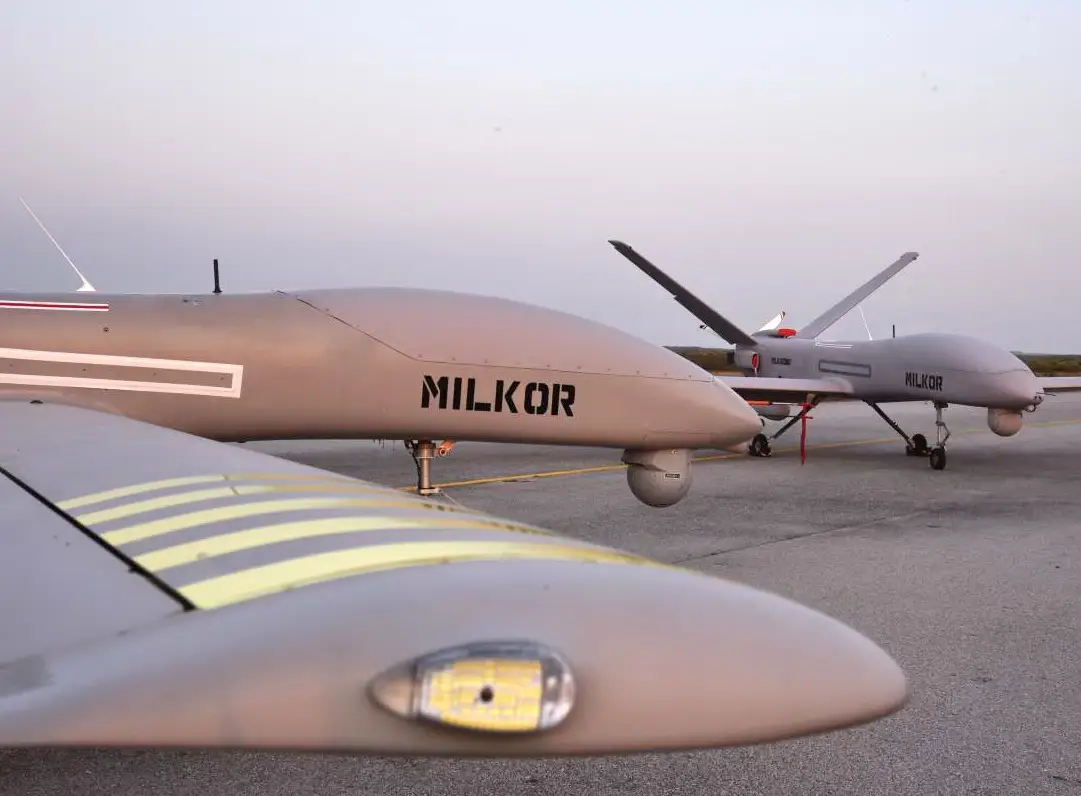
Nine African nations currently invest in domestic Uncrewed Aerial Vehicle (UAV) assembly and manufacturing facilities, accounting for 216 locally produced units out of total continental inventories.
According to Military Africa’s drone procurement data, this shift represents a deliberate move away from exclusive reliance on foreign suppliers toward sovereign defense industrial capacity. While foreign procurement continues to dominate aggregate numbers, domestic production facilities allow African militaries to tailor equipment to local terrain, lower long-term maintenance costs, and retain technical expertise within national defense sectors. This industrial evolution exhibits a clear contrast between established aerospace manufacturing hubs and emerging regional assembly programs.
South Africa leads the continent in high-end indigenous aerospace design and manufacturing. Armed with decades of advanced defense research, local firms produce sophisticated Class III Medium-Altitude Long-Endurance (MALE) platforms. The Milkor 380 serves as a primary example of this capability, featuring an 18.6-meter wingspan, a 1,500-kilogram Maximum Takeoff Weight (MTOW), a 220-kilogram payload capacity, and a 30-hour operational endurance. Built using composite resin infusion techniques, the system integrates multi-sensor pods and precision-guided ordnance. Alongside legacy platforms like the Denel Seeker series, South African industry demonstrates that continental firms can design, flight-test, and manufacture long-range systems capable of competing with international vendors.
In West Africa, Nigeria’s operational landscape presents a dual approach balancing foreign acquisitions with local innovation. The Nigerian Air Force currently operates a complex inventory comprising 34 distinct imported platform types. Managing such a fragmented fleet creates severe supply chain overheads, maintenance backlogs, and reliance on external vendors for replacement parts. To address these vulnerabilities, the Nigerian Air Force Research and Development (R&D) Centre developed indigenous platforms such as the Tsaigumi UAV. With a 95-kilogram MTOW, a 10-hour endurance, and an Electro-Optical/Infrared (EO/IR) sensor suite, the Tsaigumi demonstrates how local assembly provides targeted Intelligence, Surveillance, and Reconnaissance (ISR) capabilities for frontline counter-insurgency operations.
Despite these technological milestones, local supply chain constraints remain a critical bottleneck across all nine manufacturing nations. Domestic factories construct airframes, ground control stations, and electrical wiring, but key sub-components still originate overseas. Advanced internal combustion engines, specialized micro-electronics, high-definition optical sensors, and satellite navigation receivers depend heavily on foreign imports. Global supply chain disruptions, export licensing delays, and currency fluctuations directly affect local production rates. Building true sovereignty requires African defense sectors to establish localized manufacturing for raw composite materials and key avionics alongside basic airframe assembly.
The data shows that domestic manufacturing will play a pivotal role in shaping intra-continental defense trade over the next decade. As indigenous systems mature, African defense firms aim to supply neighboring states with field-tested platforms unencumbered by Western or Eastern political conditions. Establishing standardized regulatory frameworks and cross-border supply chains will determine whether these national initiatives transform into a self-sustaining continental defense market or remain limited to low-volume production runs.

Africa’s dedicated and only military drone procurement intelligence.
Unmanned Africa bridges the critical gap between aerospace engineering, defense economics, and geopolitical strategy. As African defense forces rapidly modernize and scale their unmanned capabilities to address asymmetric conflicts, insurgencies, and border security, the platform functions as an essential, independent repository for defense analysts, policymakers, military professionals, and researchers.
