
Three non-Western defense suppliers (China, Turkey, and Israel) now dominate Africa’s uncrewed aerial vehicle market. Together, they account for 1,203 units, representing over 60 percent of all recorded transfers on the continent. Their market leadership stems from offering affordable platforms, fast delivery timelines, export terms free of political conditions, and systems thoroughly tested in operational combat. Vendors from the United States (US) and the European Union (EU) face a structural disadvantage that will persist unless export policies and unit pricing change substantially.
According to research procurement data from Military Africa, Uncrewed strike capabilities have become standard across African operational theaters. Twenty-five nations deploy Class III Medium-Altitude Long-Endurance (MALE) systems. Compared to conventional crewed combat aircraft, these platforms offer a far lower cost of entry. This dynamic democratizes precision air-to-ground strike capability, introducing complex operational challenges for arms control frameworks and elevating risk factors for non-combatants during counter-insurgency engagements.
In the Sahel region, uncrewed system acquisitions directly reflect shifting geopolitical alignments. Militaries in Mali, Niger, Burkina Faso, and Chad have systematically replaced historical French defense ties with hardware sourced from Turkish and Russian suppliers. These procurement decisions demonstrate how air power acquisitions now serve as explicit signals of political alliance, matching the strategic weight of traditional defense treaties.
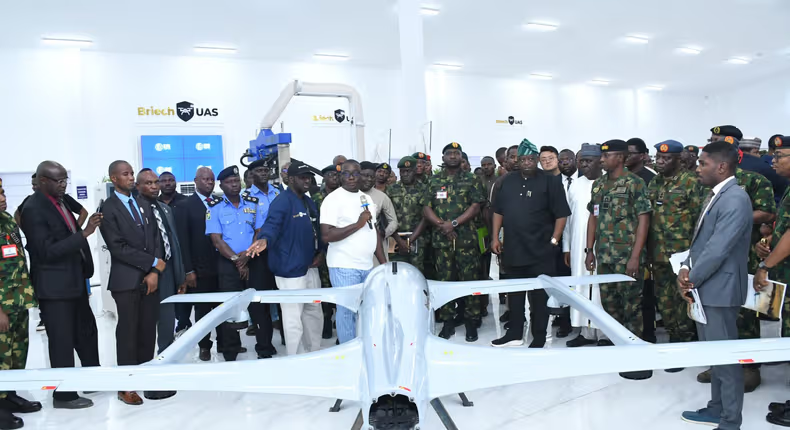
African defense planners increasingly view domestic manufacturing capacity as a strategic imperative rather than a minor niche. Nine nations have invested in local assembly and production, accounting for 216 locally built units. Established programs in South Africa, Nigeria, Algeria, and Ethiopia lead this effort to reduce reliance on foreign supply chains. Nigeria stands out due to its diverse inventory of 34 distinct platform types alongside active domestic Research and Development (R&D) programs, positioning the nation to become the continent’s next primary producer of Class III systems.
Acquisition dataset entries verified as of July 2026 confirm that overall procurement volume will continue to accelerate through 2030. Strong order figures recorded through 2025 and 2026, driven by growing national defense budgets, ongoing regional conflicts, declining component costs, and competitive foreign vendor behavior, support this trajectory. While North Africa maintains the largest aggregate fleet size, active security dynamics in the Sahel and the Horn of Africa are rapidly closing the gap in West and East Africa.

Africa’s dedicated and only military drone procurement intelligence.
Unmanned Africa bridges the critical gap between aerospace engineering, defense economics, and geopolitical strategy. As African defense forces rapidly modernize and scale their unmanned capabilities to address asymmetric conflicts, insurgencies, and border security, the platform functions as an essential, independent repository for defense analysts, policymakers, military professionals, and researchers.
Leave a Reply