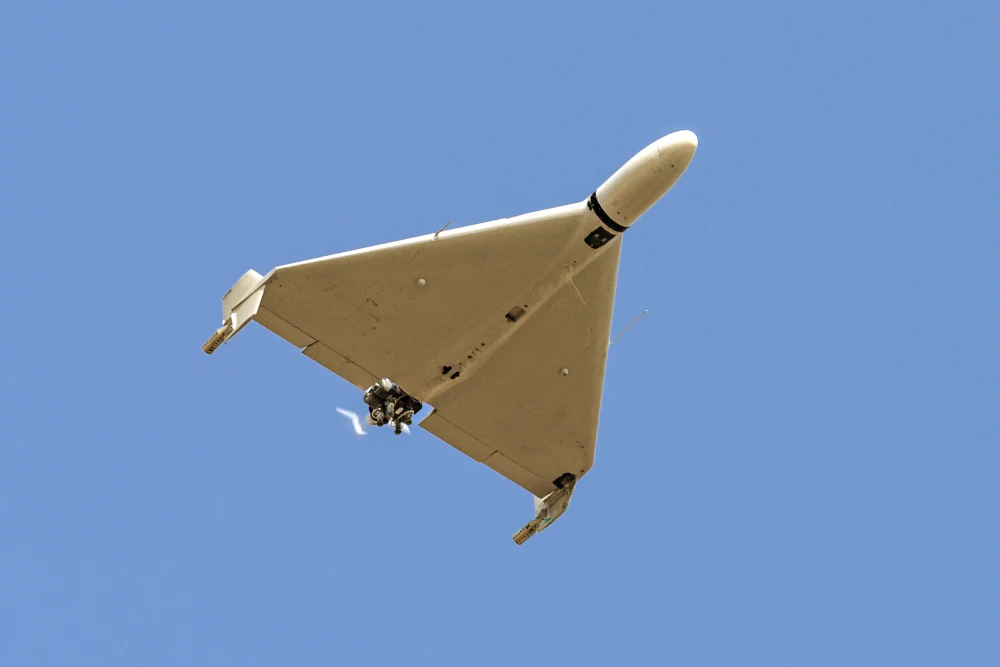
A Bellingcat and Jeune Afrique investigation has produced the first visually verified evidence of Shahed-136-family strike drones hitting targets in Mali, as Russian-backed forces lean on long-range strike technology first proven in Ukraine.
Open-source investigators have produced the clearest evidence yet that Shahed-136-type kamikaze drones — the long-range strike weapon that has come to define Russia’s air campaign against Ukraine — are now being used in combat in Mali. Working together, Bellingcat and Jeune Afrique geolocated footage of two strikes in the country’s remote north, hitting the village of Inafarak on 12 July and the village of Talahandak on 17 July 2026, and matched wreckage from the scene to the distinctive engine used across the Shahed-136 family.
The finding moves the story from circumstantial to confirmed. Reports that Russian-linked forces were flying these drones over northern Mali had already circulated for weeks: Defence Blog and France 24 had both published photographs of drone debris recovered near the town of Sévaré in May, and speculation about a growing Russian drone presence in the country had been building since. What had been missing was verified footage of the drones actually in flight and striking a target — which is what the new investigation supplies. Investigators geolocated the strike sites by matching surrounding buildings to satellite imagery, then matched wreckage from Talahandak — including the remains of a distinctive four-cylinder, two-stroke MD-550 engine — against the Shahed-136 family’s known signature, cross-referencing it against reference images held in the Open Source Munitions Portal and a similar Ukrainian government-linked weapons-remnant database. Two independent weapons researchers, Trevor Ball and Leo Jarry, confirmed the match after reviewing the footage separately.
The Talahandak strike, on 17 July, destroyed a truck that appeared to be carrying commercial cargo — video showed containers of cooking oil scattered across the road — and left at least one civilian casualty, according to the footage reviewed by investigators. Talahandak sits close to the Algerian border, roughly 160 kilometres southeast of Inafarak, where the earlier strike hit five days before.
Investigators say the available footage doesn’t allow the exact drone variant to be pinned down, but consider it likely the weapons were Russian-built, pointing to the established presence of Russia’s Africa Corps in the area and the wider pattern of Russian military backing for Mali’s junta. Jarry, a drone specialist with the firm Tungsten Strategies, suggested that Russian manufacture, if confirmed, would function as an unmistakable public signal of how far that backing now extends. The ambiguity in naming is deliberate, and reflects the weapon’s own tangled parentage: the Shahed-136 was designed in Iran, but Russia has spent the past three years building its own version domestically, referred to as “Geran” by its own forces and tracked in Western reporting as the Garpiya-A1 — hence open-source investigators’ preference for the more cautious label “Shahed-type” rather than crediting either country outright.
Mali had already produced one confirmed sighting of the type. In May, rebel fighters in the country’s north shot down a Garpiya-A1 fitted with the newest KK-series airburst warhead near Sévaré — an incident Ukrainian officials called the first confirmed appearance of the drone anywhere in the Sahel. Wreckage analysis at the time traced electronic components in the aircraft back to Chinese suppliers, underlining how thoroughly Russia’s wartime drone-manufacturing base now depends on parts sourced well beyond its own borders.
The Inafarak and Talahandak footage also surfaced through a channel that speaks to who is doing the flying. Both videos were reposted by a Wagner- and Africa Corps-linked Telegram channel that Bellingcat has separately traced to a wider network of Russian nationalist and extremist propaganda. The channel’s caption referred to the drones by their Russian nickname and paired that with an ethnic slur — one more commonly aimed at Ukrainians in Russian nationalist online spaces — redirected here at people from Azawad, the name Tuareg separatists use for northern Mali. It’s a small but telling detail: language built for one war being recycled, more or less intact, for another.
The timing is not incidental. Malian government forces and their Africa Corps allies have spent the past several months on the back foot across the country’s north. A coordinated offensive by JNIM, the regional al-Qaeda affiliate, and the separatist Azawad Liberation Front — the two have increasingly operated in tandem since a 2024 alignment — has pushed Malian and Russian forces out of Kidal, Tessalit, and other northern towns since late April, and cost the army dearly even where it has clawed territory back: retaking Anefis in mid-July reportedly cost around 30 soldiers killed and 60 wounded, and days later a convoy travelling from Anefis toward Gao was ambushed near Tabankort, with the rebel coalition claiming to have killed or captured scores more. Long-range strike drones give a stretched military and its Russian partners a way to hit rebel-held territory without moving troops through contested ground — one plausible reason the Shahed-type has surfaced now rather than earlier in the conflict.
Mali’s insurgents are not standing still on drones either. JNIM’s own use of the technology dates to September 2023, when the group flew its first documented drone mission near Bandiagara; researchers tracking the group’s activity count more than two dozen confirmed drone incidents across Mali, Burkina Faso, and Togo since, with the pace accelerating sharply over the past year and a half. That mirrors a pattern playing out well beyond Mali: armed non-state groups in at least nine African countries have now acquired and used drones of some kind, following the same broad playbook of cheap commercial airframes turned into surveillance tools and, increasingly, improvised strike weapons.
Research from the Africa Center for Strategic Studies has tracked the resulting surge: 484 recorded drone strikes across the continent in 2024 alone caused an estimated 1,176 casualties, and the centre’s broader tracking puts the cumulative toll in the thousands across more than a dozen countries, with Sudan and the Sahel accounting for the large majority. Much of that growth traces back to a handful of external suppliers — Turkey, China, Iran, and now increasingly Russia — competing for military influence and market share across the continent, often at a very low cost of entry: researchers studying the trend have argued that cheap Chinese, Iranian, and Turkish systems in particular have measurably lowered the political and financial threshold for outside powers to intervene in African conflicts.
What makes the Mali case distinct is less the drone itself than the route it travelled to get there. The Shahed-136 built its reputation over Kyiv, Kharkiv, and other Ukrainian cities, where swarms of the type have been flown against power stations and apartment blocks as part of a deliberate campaign against civilian infrastructure. Its arrival — verified, for the first time, with named coordinates and matched wreckage — over a Malian village suggests that battlefield playbook, and not just the hardware behind it, is now being exported along with it.

Africa’s dedicated and only military drone procurement intelligence.
Unmanned Africa bridges the critical gap between aerospace engineering, defense economics, and geopolitical strategy. As African defense forces rapidly modernize and scale their unmanned capabilities to address asymmetric conflicts, insurgencies, and border security, the platform functions as an essential, independent repository for defense analysts, policymakers, military professionals, and researchers.
Leave a Reply