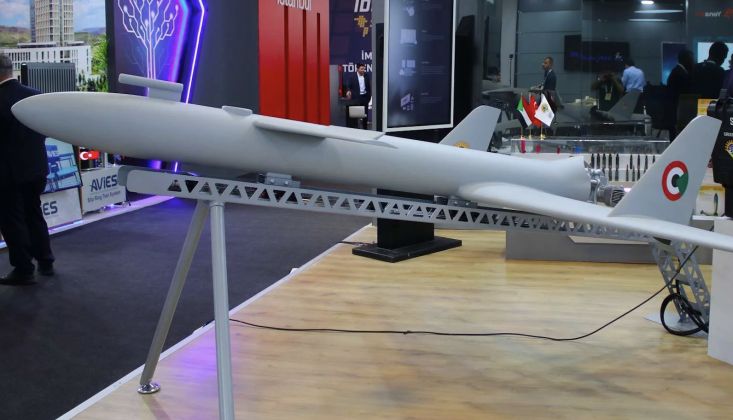
Sudan’s Military Industry Corporation (MIC), the state defence conglomerate, has fielded a domestically built loitering munition called the Safaroog, according to the corporation’s own disclosures and confirmed by Jane’s, marking the clearest evidence yet that Sudan’s decades-old defence-industrial base is now producing weapons for its own civil war rather than simply importing them.
MIC unveiled the Safaroog publicly for the first time at the International Defence Industry Fair (IDEF) in Istanbul in July 2025, according to Army Recognition and Military Africa, both of which reported the drone as already in active service with Sudan’s armed forces. A company representative told the outlets the system has also drawn interest from unnamed buyers in the Middle East.
The Safaroog is a single-engine, delta-wing one-way attack drone measuring 2.88 metres in length with a 3.3-metre wingspan, according to specifications reported by Militarnyi. It is powered by a 342cc gasoline engine driving a twin-blade pusher propeller, giving it a cruising speed of 160 kilometres per hour and a top speed of 200 kilometres per hour. Reported range varies between 300 and 600 kilometres depending on configuration, with flight endurance of two and a half to four and a half hours and a service ceiling of roughly 4,570 metres. Sudan’s Military Industry Corporation says the aircraft’s SNAP-5 autopilot, combined with GNSS and inertial navigation and a dedicated anti-jamming algorithm, gives it a claimed circular error probable of under ten metres, launched from either a catapult or a pneumatic system. Sudanese officials have not disclosed the drone’s warhead weight, though it has previously been reported at around 30 kilograms.
Sudan’s Armed Forces (SAF) developed the Safaroog specifically to counter Belarusian-made Groza-S electronic warfare systems the Rapid Support Forces (RSF) has used to detect and jam SAF’s existing fleet of Iranian and Turkish-supplied drones, Africa Defense Forum reported, citing evidence SAF commanders recovered mast-mounted jamming antennas matching Belarusian equipment at a captured RSF position north of Khartoum. The drone’s anti-jamming design is a direct response to that threat rather than a general-purpose export product.
The Safaroog is one of several systems the Military Industry Corporation has developed since Sudan came under an international arms embargo in the 1990s, when it began receiving technical assistance from Chinese, Russian and Iranian firms, according to DefenceWeb. MIC also produces the Kamin-25, a smaller loitering munition first displayed in 2023 that is launched from another aircraft and carries either a 5-kilogram anti-tank or 7-kilogram anti-personnel warhead, alongside the BK-3 precision-guided bomb and the SAFAT series of light aircraft. Iranian assistance to Sudan’s defence-industrial base, including the Yarmouk Military Industrial Complex south of Khartoum, predates the current civil war by decades and has continued to shape Sudanese production even as direct Iranian involvement has fluctuated with the conflict.
Unmanned Africa has previously reported on the broader long-range drone escalation between SAF and the RSF, and on the running exchange of shootdown claims between the two sides. The Safaroog’s emergence adds a distinct dimension to that pattern: rather than relying solely on Iranian, Turkish or Chinese hardware, Sudan’s state defence industry is now producing a purpose-built countermeasure to a specific enemy capability, developed and fielded while the war that created the need for it is still being fought.

Africa’s dedicated and only military drone procurement intelligence.
Unmanned Africa bridges the critical gap between aerospace engineering, defense economics, and geopolitical strategy. As African defense forces rapidly modernize and scale their unmanned capabilities to address asymmetric conflicts, insurgencies, and border security, the platform functions as an essential, independent repository for defense analysts, policymakers, military professionals, and researchers.
Leave a Reply