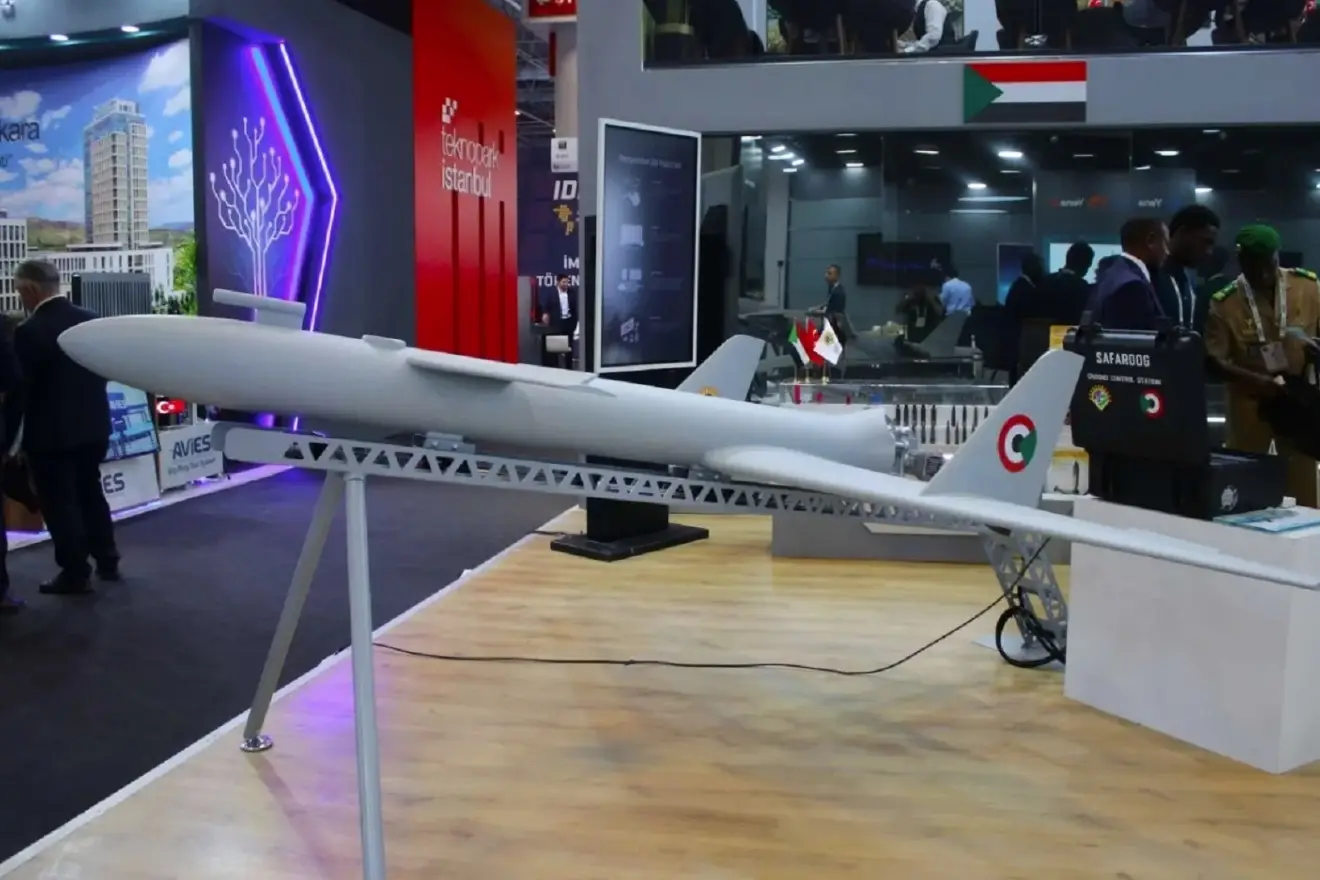
The escalation of long-range One-Way Attack (OWA) uncrewed aerial vehicles in Sudan has transformed a tactical ground stalemate into a strategic deep-strike conflict. Operating across distances exceeding 1,000 kilometers, delta-wing suicide drones allow both the Sudanese Armed Forces (SAF) and the paramilitary Rapid Support Forces (RSF) to strike airbases, fuel infrastructure, and command hubs far behind active frontlines.
Technical Architecture of Delta-Wing Platforms
The delta-wing geometry offers notable aerodynamic advantages for long-distance, low-altitude transit. By blending a swept triangular wing structure into a compact central fuselage, these platforms achieve high lift-to-drag ratios while maintaining a low radar cross-section. A two-stroke petrol engine driving a rear pusher propeller powers the airframe, allowing cruising speeds between 150 and 180 kilometers per hour.
In Sudan, the primary long-range delta-wing systems fall into three operational categories:
Chinese-designed Sunflower-200 and ZT-180 loitering munitions serve as the heavy strike assets for the RSF. Featuring a cropped delta-wing airframe closely mirroring the Iranian Shahed-136 layout, the Sunflower-200 weighs approximately 175 to 200 kilograms. It carries a 40-to-50-kilogram blast-fragmentation warhead across ranges spanning 1,500 to 2,500 kilometers.
The SAF operates the locally assembled Safrouq delta-wing loitering munition. Built with a 600-kilometer operational strike radius, the Safrouq carries a 30-kilogram warhead engineered specifically to target armored concentrations and fortified command positions.
Iranian-origin Shahed-family derivatives and single-use variants complement both arsenals, utilizing commercial-grade components and simplified composite airframes to maintain low unit manufacturing costs.
RSF Operational Deployment from South Darfur
From primary staging facilities at Nyala Airport and adjacent launch sites in South Darfur, the RSF projects airpower across the entire national territory. Deploying Sunflower-200 and ZT-180 delta-wing airframes from multi-rail truck launchers, RSF crews execute long-range strikes targeting SAF installations in Port Sudan on the Red Sea coast, Merowe Air Base in Northern State, and regional command posts in Singa and El Obeid.
Satellite imagery verified as of mid-2026 identified over 80 loitering munition airframes and active launch platforms assembled near Nyala. This infrastructure confirms how the RSF converted an inland regional airport into a strategic deep-strike hub capable of hitting targets over 1,200 kilometers away.
SAF Counter-Measures and the Safrouq Platform
To counter RSF electronic warfare defenses, particularly the Belarusian-supplied Groza-S signal jamming suites, SAF engineers developed the Safrouq loitering munition. The platform integrates hardened Global Navigation Satellite System (GNSS) anti-jamming receivers paired with low-cost Inertial Navigation Systems (INS). This dual guidance package allows the drone to maintain its planned flight trajectory even when passing through heavy broad-spectrum radio frequency interference.
SAF flight units deploy the Safrouq alongside medium-altitude reconnaissance drones to execute precision strikes against RSF logistical convoys, troop gatherings, and fuel dumps across Khartoum, Gezira State, and the Kordofan region.
Air Defense Challenges and Collateral Effects
Intercepting low-cost, long-range delta-wing airframes poses severe tactical difficulties for ground-based air defense networks. Flying at low altitudes between 100 and 300 meters above terrain, these small pusher-propeller drones routinely evade long-range early warning radar arrays. Furthermore, expending multi-million-dollar surface-to-air missiles to shoot down a drone costing under 30,000 US dollars creates a severe economic imbalance for defending forces.
However, because most long-range delta-wing suicide drones rely on pre-programmed GPS coordinates rather than real-time optical target tracking, navigation drift or outdated intelligence leads to severe destruction of non-military infrastructure. Verification data as of mid-2026 shows that one-way attack drones account for a major share of casualties across residential areas, power stations, and medical facilities in Sudan, demonstrating how long-range delta-wing proliferation has redefined air warfare in East Africa.

Africa’s dedicated and only military drone procurement intelligence.
Unmanned Africa bridges the critical gap between aerospace engineering, defense economics, and geopolitical strategy. As African defense forces rapidly modernize and scale their unmanned capabilities to address asymmetric conflicts, insurgencies, and border security, the platform functions as an essential, independent repository for defense analysts, policymakers, military professionals, and researchers.
