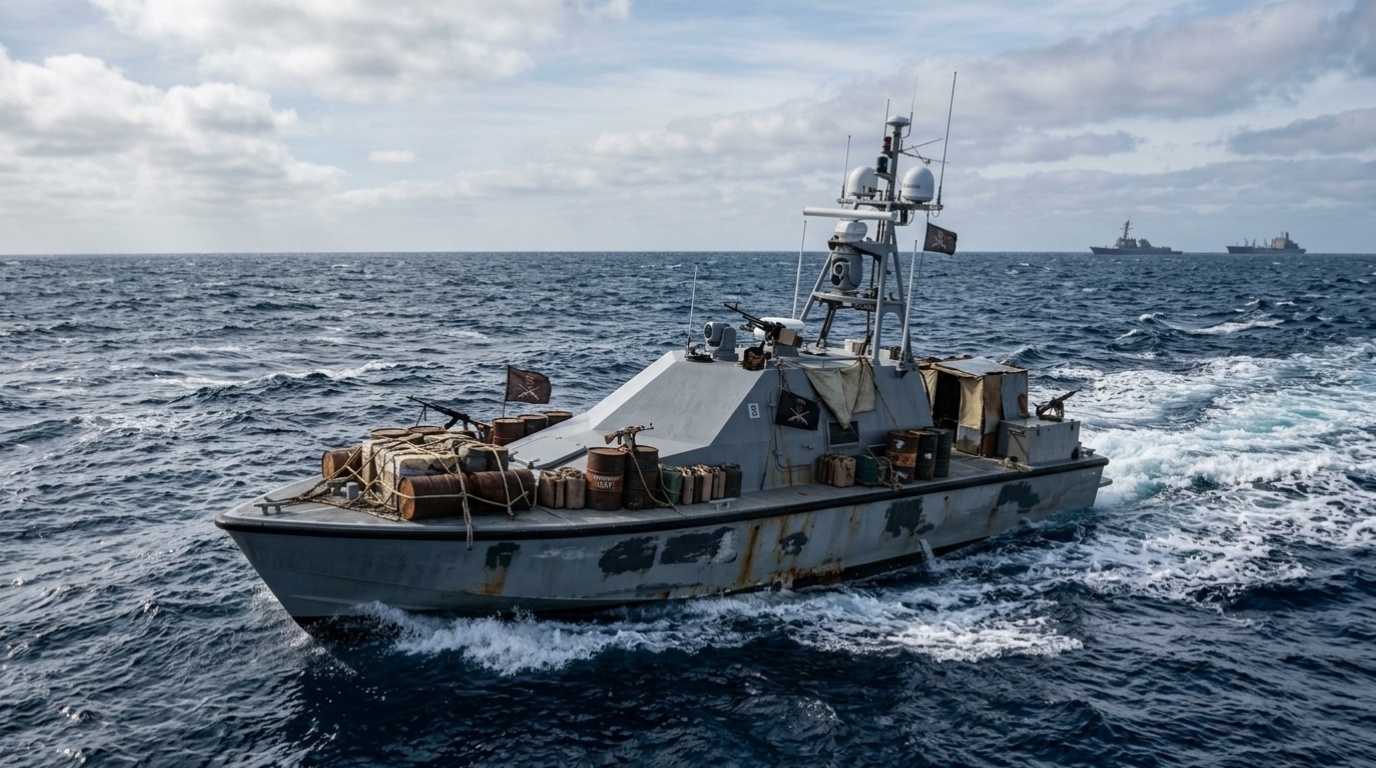
On the night of March 3, 2026, a Russian tanker called the Arctic Metagaz was sailing through the Mediterranean southeast of Malta when something tore through its hull. Multiple explosions ripped the 277-metre ship apart, sending flames into the night sky as the crew of thirty scrambled into life rafts. Russia blamed Ukraine, saying the attack came from sea drones launched off the coast of Libya. Whoever was actually responsible, the tanker didn’t sink outright. It drifted, a burning ghost ship, for nearly two weeks before finally being towed away, its hull blackened and split nearly in half. What makes this incident worth dwelling on isn’t really the politics of the Russia-Ukraine war. It’s the math. Ukraine’s Sea Baby attack drones cost somewhere around 200,000 dollars apiece to build. A single US Navy torpedo costs roughly 4.2 million. Even if it took several drones to bring down one ship, the tanker’s cargo alone, before you even count the vessel itself, was worth an estimated 50 to 60 million dollars in natural gas. That kind of lopsided math, a cheap weapon inflicting an expensive loss, is exactly what makes insurgents and terrorist groups pay attention.
It raises an obvious question for a continent that already has more coastline exposed to armed non-state groups than almost anywhere else on earth: are African insurgents about to start building boats like this too?
The honest answer is that one part of this threat is already here, just not yet in Africa’s own waters in a fully weaponised form. Yemen’s Houthi movement has spent the past few years turning remote-controlled speedboats packed with explosives into a genuine naval weapon, using them alongside missiles and aerial drones to strike commercial shipping across the Red Sea and the Bab al-Mandeb Strait. That campaign sits right off Africa’s own coastline, and it hasn’t stayed confined to Yemen’s side of the water. According to a 2025 United Nations Panel of Experts report, the Houthis have been actively cooperating with Somalia’s al-Shabaab, al-Qaeda’s affiliate there, trading weapons and training in exchange for a cut of the piracy that has surged back to life off the Somali coast. Investigators have already documented the Houthis supplying al-Shabaab with advanced GPS tracking equipment to help pirates find and intercept ships, and separately training al-Shabaab fighters in drone technology. Piracy off Somalia, which had almost disappeared by the late 2010s after years of international naval patrols, is now resurging sharply, with hijackings generating ransom money that reportedly flows straight back into al-Shabaab’s war chest. Put those pieces together and you get the single most concrete pathway anywhere in Africa for maritime drone technology to reach a non-state group: a militant organisation with money, boats, coastal access, and an active technology-sharing relationship with the one force on the planet that has already proven remote-controlled explosive boats work.
Nigeria’s Niger Delta tells a different but equally important part of this story, because the missing ingredient there isn’t the boats or the tactics, it’s just the drone. For nearly two decades, militant groups in the Delta have carried out exactly the kind of complex, offshore attacks that would translate almost seamlessly into unmanned versions. The Movement for the Emancipation of the Niger Delta, active from 2006 to 2009, didn’t just attack pipelines on land, it sent armed men in speedboats to board a semi-submersible drilling rig 35 nautical miles out to sea, attacked Chevron’s floating production platform, and in January 2009 rigged explosives to disable a tanker’s engine entirely, the first time such a group had struck a vessel underway rather than just a fixed platform. Its successor, the Niger Delta Avengers, kept up the same playbook against undersea pipelines and offshore infrastructure between 2016 and 2017. Every one of those operations required a crewed boat, a trained crew willing to take real personal risk getting close enough to plant explosives or board a target, and a getaway. A naval drone removes exactly that risk while keeping everything else the same, which is precisely why Nigeria’s own oil-security contractors have been racing to add better aerial surveillance against a threat picture that has never really gone away, just gone quieter for a while.
It would be irresponsible, though, to treat this as inevitable rather than merely plausible, and it’s worth being honest about why it hasn’t happened yet. A maritime security analysis from Dryad Global has pointedly noted that despite decades of speculation, there’s no evidence of any operational or tactical link between Nigeria’s northern militant groups, like Boko Haram, and the Niger Delta’s oil pirates further south, largely because they operate in completely different parts of the country and have never needed to invest in the specific, unglamorous skills that maritime operations demand. Capability in one place doesn’t automatically transfer to a group somewhere else just because both are technically "African insurgents." Building a functioning naval drone, even a crude one, also asks more of a group than an airborne FPV drone does: waterproofing electronics, achieving stable buoyancy and steering in open water, and navigating currents and waves that a small aerial drone never has to contend with. Ukraine solved these problems with real engineering talent, international support, and a war footing that gave it every incentive to move fast. Most African insurgent and terrorist groups have none of those advantages, which is likely the biggest reason none has fielded a working maritime drone yet, whatever loose talk or wishful thinking might circulate online.
Mozambique’s Cabo Delgado, where the Islamic State-linked insurgency known locally as al-Shabaab, unrelated to the Somali group of the same name, has fought the government since 2017 along a stretch of Indian Ocean coastline rich in offshore gas, is a third context worth watching rather than a confirmed one. The insurgency there has shown it can adapt quickly to new tactics when circumstances allow, but there’s no public reporting yet of any maritime capability beyond small boats used for movement and smuggling, and it’s worth resisting the temptation to treat every coastal insurgency as an equally likely candidate.
Taken together, these three cases point toward a specific, narrower answer than a simple yes or no. The real threat isn’t that African insurgencies in general are about to acquire naval drones. It’s that two very particular sets of ingredients, a live technology-transfer relationship with a group that has already proven the concept, and decades of unmanned-ready tactical experience just waiting for the right hardware, already exist in two different parts of the continent, in Somalia and the Niger Delta respectively. Neither has crossed the line yet. Both are closer to it than almost anywhere else on earth, and if either one does, it likely won’t look like a sudden leap forward so much as the last missing piece finally clicking into place.