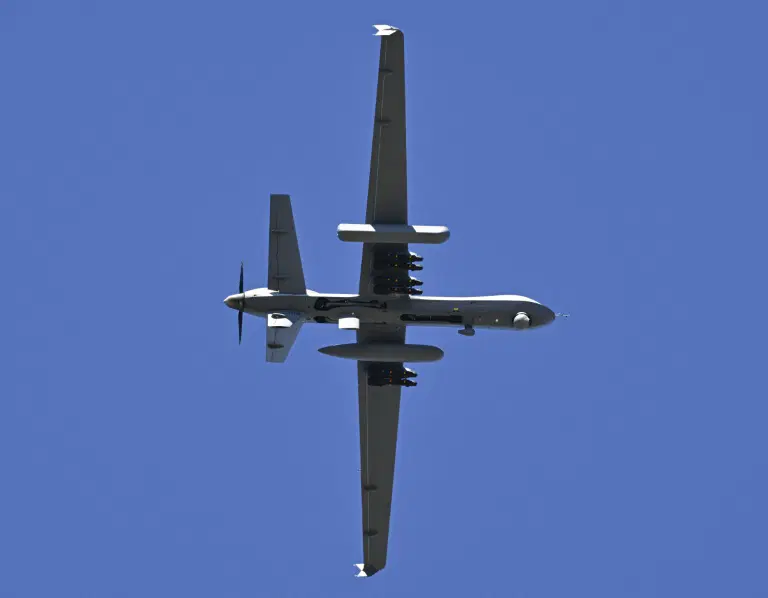
Military drones fly anywhere from under 400 feet, the altitude a cheap FPV kamikaze drone typically holds on its final attack run, to more than 60,000 feet, the cruising altitude of the largest strategic surveillance platforms in the world. That is roughly a 150-fold spread, and the honest answer to “how high can a military drone fly” depends entirely on which of five very different categories of aircraft you are asking about. A tactical quadcopter used to spot artillery targets in Mali and a Global Hawk-class surveillance aircraft used to watch an entire ocean are both, technically, “military drones.” Nothing else about them is comparable, least of all their altitude.
For readers of this site specifically, the more useful question isn’t the theoretical ceiling of drone technology in general. It’s where the actual aircraft flying over African skies right now sit on that spectrum, and why that number matters more than it looks like it should.
The Official Altitude Classes: DoD Groups 1 Through 5
The most widely used framework for sorting drones by altitude comes from the US Department of Defense, which splits unmanned aircraft into five groups based on weight, operating altitude, and speed. It’s a useful starting point even for non-US militaries, because most of the world’s drone manufacturers, Turkish, Chinese, Iranian, and African alike, effectively design toward the same altitude bands this system describes.
Group 1 covers the smallest drones, under 20 pounds, normally operating below 1,200 feet above the ground. Hand-launched systems like the RQ-11 Raven live here, and so, functionally, does most of the FPV kamikaze drone fleet this site has covered extensively across Sudan, Mali and the wider Sahel, even though the DoD framework was written with reconnaissance micro-drones in mind rather than improvised strike weapons. Group 2 runs from 21 to 55 pounds and below 3,500 feet, home to systems like the ScanEagle. Group 3 covers aircraft up to 1,320 pounds flying below 18,000 feet, a category that includes tactical ISR platforms like the RQ-7 Shadow. Groups 4 and 5 are where the real power projection lives: both cover aircraft over 1,320 pounds, but Group 4 stays below 18,000 feet while Group 5 operates above it, and it’s Group 5 that includes the aircraft most people picture when they think “military drone,” the MQ-9 Reaper and the RQ-4 Global Hawk.
One detail that gets lost in most explanations of this system is that the groups describe an aircraft’s normal operating profile, not the absolute maximum altitude it could theoretically reach under ideal conditions. A drone gets classified by the altitude band it’s designed and typically flown in, which is why a platform can occasionally punch well above its assigned group’s ceiling during a specific test flight, as several of the aircraft below have done, without moving into a different category.
Where Africa’s MALE Fleet Actually Sits
Sitting just above the DoD’s Group 3/4 boundary is a broader civilian and industry term this site uses constantly: medium-altitude long-endurance, or MALE. Most of the drones actually flying combat and surveillance missions across Africa today fall into this band, and the spread between them is bigger than it first appears.
The Bayraktar TB2, the aircraft that made this whole category of warfare famous in Libya and has since equipped air forces from Mali to Ethiopia, has a published service ceiling of 8,239 metres, or 27,030 feet. China’s Wing Loong II, currently flying with Nigeria among other operators, climbs slightly higher at 9,000 metres, or 29,527 feet. Sudan’s Iranian-supplied Mohajer-6, the platform at the centre of this site’s extensive shootdown-record coverage of the Sudanese civil war, generally operates in a similar medium-altitude band, low enough that Qaem-series munitions launched from it can still strike ground targets accurately from altitudes of roughly 2,000 to 3,000 metres, a height chosen deliberately because it sits above the effective engagement ceiling of older man-portable air defence systems without climbing so high that targeting accuracy suffers.
South Africa’s Milkor 380, the largest drone designed and built anywhere on the continent, matches the higher end of that band with a stated ceiling of 30,000 feet. Textron’s Aerosonde Mk. 4.7 VTOL, the aircraft Tantita Security Services now flies over Nigeria’s Niger Delta, operates lower still, rated to a 12,000-foot density altitude ceiling, reflecting its design priority of persistent low-and-slow surveillance over a fixed area rather than high-altitude standoff reach. Sudan’s own indigenous Safaroog loitering munition, built specifically to counter Rapid Support Forces jamming, tops out at roughly 4,570 metres, or 15,000 feet, appropriate for a one-way weapon that needs enough altitude to find its target but has no reason to climb further.
The clear outlier in Africa’s inventory is the Bayraktar AKINCI, now flying with Somalia and, per this site’s reporting, sought by Libya’s rival factions. Turkish manufacturer Baykar publishes a 30,000-foot operational altitude and a 40,000-foot service ceiling for the AKINCI, and in June 2022 a test flight actually reached 45,118 feet, setting a Turkish aviation altitude record in the process. That figure puts the AKINCI meaningfully closer to the high-altitude long-endurance, or HALE, category than any other drone this site regularly covers, and it’s the main reason military analysts increasingly treat the AKINCI as a different tier of threat entirely from the TB2 it superficially resembles: enough altitude to operate above the reach of most air defence systems currently fielded on the continent, while still carrying up to 1,500 kilograms of munitions and sensors.
Altitude works differently again for rotary-wing and hybrid VTOL designs, which trade a fixed-wing aircraft’s altitude and speed for the ability to take off and land without a runway. The Aerosonde Mk. 4.7’s Hybrid Quadrotor system, the same runway-independent design Tantita now operates in the Niger Delta’s creeks and mangrove swamps, uses four rotors purely to get airborne and land, then transitions to conventional wing-borne flight for the cruise portion of a mission. That transition costs the aircraft altitude performance a pure fixed-wing design of the same size and weight would achieve, since the airframe has to carry the extra weight of rotors and motors it only needs for a few minutes of each flight, but it buys something a pure fixed-wing MALE drone cannot offer at all: the ability to operate from a patrol boat, a forward outpost, or a stretch of open ground with no prepared strip, which matters more than another few thousand feet of ceiling in terrain where a runway is the scarcer resource.
Why Altitude Is a Tactical Decision, Not Just a Spec Sheet Number
None of these numbers exist for their own sake. Altitude on a military drone is chosen the same way a sniper chooses a firing position: high enough to see clearly and stay out of reach, low enough to still hit what you’re aiming at.
The clearest illustration of that trade-off in this site’s own reporting is the specific altitude band Iranian-made Qaem munitions use when striking from Sudan’s Mohajer-6 fleet. Fly too low, and even a technically unsophisticated adversary with a shoulder-fired missile or heavy machine gun can bring the aircraft down, exactly what happened to at least three Mohajer-6 airframes RSF fighters claimed to shoot down using man-portable air defence systems in the war’s opening weeks in January 2024. Fly too high, and both the sensor resolution needed for precision strikes and the drone’s own radar visibility start working against the operator instead of for them. The 2,000-to-3,000-metre band SAF settled on threads that needle deliberately.
Altitude also interacts directly with the counter-drone systems this site has covered in Nigeria’s build-out against ISWAP and Boko Haram. Radar systems like the 612A unit the Nigerian Air Force has trained on are generally optimised to detect aircraft-sized, higher-altitude threats, the MALE-class drones and manned aircraft radar has always had to track. A Group 5 aircraft flying at 40,000 feet is, in one sense, an easier target for that kind of radar than a cheap FPV quadcopter skimming a few hundred feet above a treeline, precisely because the low-altitude threat is smaller, slower to appear on a radar screen built for bigger, higher targets, and often masked by ground clutter. That mismatch is a large part of why handheld radio-frequency jammers like the Lithuanian-made EDM4S SkyWiper, rather than large fixed radar installations, have become the front-line response to the FPV threat specifically: the problem those systems are solving is fundamentally a low-altitude one, not a high-altitude one.
Radar isn’t the only way altitude affects detectability, and it may not even be the most important one for the cheapest drones in this story. A quadcopter or fixed-wing FPV holding a few hundred feet of altitude is well within range of the human ear, and operators across Ukraine, Sudan and the Sahel alike have reported hearing an approaching drone’s motor, or in the case of larger Shahed-style loitering munitions, its distinctive engine note, before any sensor confirmed it. That acoustic signature is a genuine tactical vulnerability low-altitude drones accept in exchange for the radar-evasion benefit their altitude otherwise buys them, and it is one reason ground troops in several of the conflicts this site covers have taken to simply listening for incoming drones as a first line of warning, a defence exactly as old as anti-aircraft warfare itself and, so far, still often the fastest one available.
Weather and endurance add a second, less dramatic but equally real constraint, and African operating conditions make it a genuinely regional consideration rather than an abstract one. Higher altitude generally means thinner air, which extends fuel efficiency and endurance for a fixed-wing platform but also demands a more capable engine and airframe to reach and hold that altitude in the first place, one reason the smallest and cheapest drones in African conflict zones simply cannot fly as high as an AKINCI or a Milkor 380 even if a designer wanted them to. Seasonal dust and haze across the Sahel and Sudan’s own conflict zones routinely degrade electro-optical sensor performance at the lower and middle end of the MALE altitude band long before it affects an aircraft’s structural ability to fly there, part of why several of the platforms this site covers carry both electro-optical and infrared payloads rather than relying on visible-light cameras alone. Coastal East Africa and Mozambique’s Cabo Delgado present a different problem, low cloud ceilings during the rainy season that can force even a capable MALE-class drone below its normal operating altitude simply to keep a target in view, trading away the safety margin altitude provides for basic mission effectiveness. It’s a large part of why the jump from Group 3 to Group 4 and 5 on the DoD’s own chart tracks so closely with a jump in aircraft weight, price, and sophistication: altitude, endurance, and cost rise together, not independently, and no amount of engineering fully insulates any of them from the specific climate a drone actually has to fly in.
The High-Altitude Extreme, and Why It Isn’t in Africa Yet
Above even the AKINCI’s altitude band sits a genuine outlier class: HALE aircraft like the American RQ-4 Global Hawk, which cruises at roughly 60,000 feet, above nearly all commercial air traffic and most surface-to-air missile systems, and can stay there for more than 30 hours at a stretch. Some classification systems set the MALE/HALE boundary as low as 9 kilometres of altitude; others push it to 18 kilometres, a threshold so demanding that only a handful of aircraft in the world, the Global Hawk chief among them, actually clear it.
No African-operated drone currently approaches that tier, and the gap isn’t really about ambition. HALE-class aircraft demand an engineering and cost base, jet or turboprop propulsion, pressurised systems, satellite-relay communications capable of maintaining a link across an aircraft’s entire operational radius, that sits well beyond what any African air force has so far been willing or able to fund, even as the same air forces have moved quickly to adopt MALE-class systems like the TB2 and Wing Loong II. The AKINCI’s altitude record, impressive as it is on Africa’s regional scale, remains roughly 15,000 feet short of Global Hawk territory.
Altitude Doesn’t Mean Invulnerable
It’s worth ending on a caution this site has documented repeatedly in its own shootdown reporting: a high service ceiling is not the same thing as safety. Sudan’s own war has produced a running exchange of drone kills on both sides specifically because modern air defence systems, from Chinese FK-2000 gun-missile batteries to purpose-built interceptor loitering munitions like Turkey’s Roketsan EREN, are increasingly designed to reach exactly the altitude band MALE-class drones operate in. Further afield, a Saudi-operated Wing Loong II was reportedly shot down by Houthi air defences over Yemen’s Al-Bayda Governorate as recently as July 2026, evidence that even a drone flying near the top of its rated ceiling is not automatically out of reach of a sufficiently capable opponent.
That’s the real lesson underneath all the numbers above. Altitude buys a military drone time, sensor range, and a measure of protection from the crudest air defences, RPGs, small arms, and older MANPADS designs. It does not buy immunity, and the steady arms race between higher-flying drones and better-reaching interceptors, playing out visibly across Sudan, the Sahel, and now the wider Red Sea region, is likely to keep pushing both numbers, the altitude drones fly at and the altitude their opponents can reach, higher for years to come.

Africa’s dedicated and only military drone procurement intelligence.
Unmanned Africa bridges the critical gap between aerospace engineering, defense economics, and geopolitical strategy. As African defense forces rapidly modernize and scale their unmanned capabilities to address asymmetric conflicts, insurgencies, and border security, the platform functions as an essential, independent repository for defense analysts, policymakers, military professionals, and researchers.
Leave a Reply