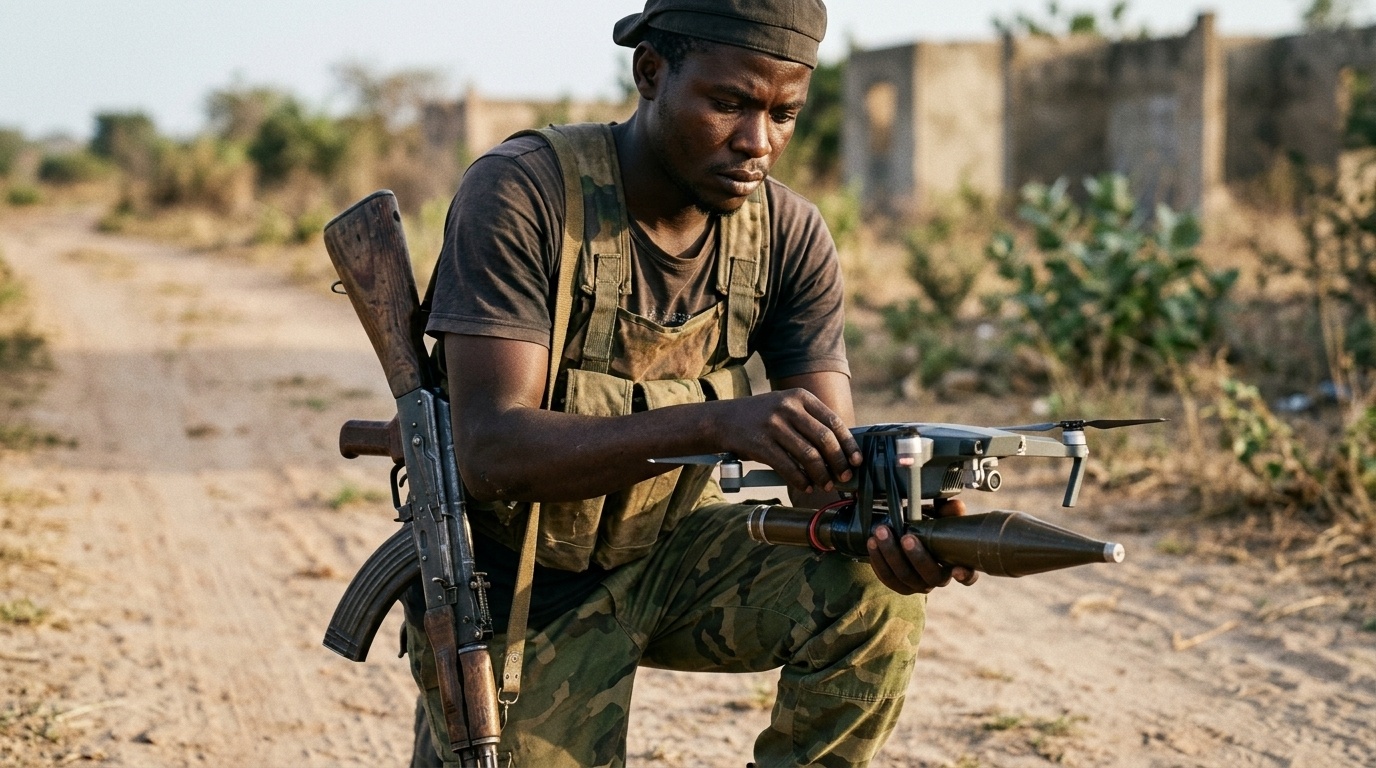
Before Boko Haram’s imitators picked up armed quadcopters in the Sahel, before Somalia’s al-Shabaab turned reconnaissance drones into planning tools, and years before anyone in Nigeria’s northeast strapped a grenade to a commercial airframe, a lesser-known jihadist insurgency in northern Mozambique was already flying drones over its own battlefield. In May 2020, fighters from Ahlu-Sunnah wal Jama’a (ASWJ), the Islamic State’s affiliate in Mozambique, used a drone to identify security force positions ahead of their assault on the coastal town of Mocímboa da Praia, according to Africa Defense Forum and corroborated separately by Military Africa and a Small Wars Journal terrorism research note from Arizona State University. It is one of the earliest confirmed cases anywhere on the continent of a non-state armed group using unmanned aircraft in combat, and it remains the reference point analysts return to when explaining how a tactic once considered exotic became, within a few years, routine.
The insurgency itself predates the drones by three years. Fighters calling themselves Ansar al-Sunna, known locally and confusingly as “al-Shabaab” despite having no connection to the Somali group of the same name, launched their first attacks on police stations in Mocímboa da Praia on 5 October 2017. The group’s grievances trace to Cabo Delgado’s transformation, almost overnight, into one of the most resource-rich corners of Africa: the discovery of massive offshore natural gas reserves and ruby deposits drew billions in foreign investment while doing little for a young, largely excluded local population, a combination that gave Islamist recruiters fertile ground. By the time drones entered the picture in 2020, the insurgency, which the Islamic State now designates its Central Africa Province, had already killed hundreds and was launching more than 20 attacks a month across nine districts, according to the Tony Blair Institute for Global Change.
The Mocímboa da Praia drone sighting was not an isolated data point. Ten months later, during the insurgency’s most consequential single attack, the March 2021 assault on Palma that killed dozens and displaced thousands, ASWJ fighters again used drones for reconnaissance to guide fighters toward government and foreign business targets, according to Military Africa’s tracking of the incident, which also noted unverified private-security reports of small drones monitoring maritime movements offshore, a detail that, if accurate, would predate by several years the debate this site has covered over whether African insurgents might eventually adapt aerial drone tactics to naval ones. Mozambique’s own government confirmed the broader pattern on the record: then-Interior Minister Amade Miquidade told reporters that unmanned aircraft had been deployed by militant groups in Cabo Delgado, a rare instance of a state directly acknowledging the threat rather than leaving it to open-source analysts to piece together, according to the Africa Center for Strategic Studies.
What ASWJ notably did not do, and still has not done, is weaponise any of it. Every documented instance from Cabo Delgado involves surveillance and target identification, never a drone carrying an explosive payload. Analysts Keaton Bunker and John Sullivan, writing in Small Wars Journal, offered a straightforward explanation that has held up well: a reconnaissance drone can be flown again and again as long as it survives, while a drone converted into a one-way weapon is destroyed the moment it succeeds, a poor trade for a group with limited access to replacement hardware. That logic made sense in 2020, when commercial drones were harder to source and less disposable than they are today. What is more striking is that it still appears to hold five years later. Unlike Nigeria’s ISWAP, Somalia’s al-Shabaab, or the Sahelian groups this site has covered extensively, Cabo Delgado’s insurgents have not been reported adopting armed drones even as the tactic spread and cheapened everywhere else on the continent, making Mozambique simultaneously the origin point of the trend and, so far, an outlier in how little that trend has advanced there since.
Cabo Delgado’s significance in the literature is less about what happened next locally and more about what it signalled elsewhere. Multiple analyses frame the sequence explicitly: Boko Haram had already been experimenting with drones in Nigeria before 2020, and Ansar al-Sunna’s adoption of the tactic in Cabo Delgado that year, alongside similar early moves by Somalia’s al-Shabaab, marked the point at which drone reconnaissance stopped being a single group’s innovation and became a technique other insurgencies across the continent recognised and copied. Analysts writing years later, when covering ISWAP’s armed drone attacks in the Lake Chad Basin or the FLA’s fiber-optic FPVs in Mali, routinely cite Cabo Delgado’s 2020 incidents as the earliest well-documented marker in that longer trajectory, the “before” picture against which today’s far more sophisticated and lethal insurgent drone use gets measured.
The wider conflict, meanwhile, has not gone away, even if it has largely gone quiet in international coverage. TotalEnergies’ $20 billion liquefied natural gas project at Afungi, suspended under force majeure after the Palma attack, only announced its intention to resume in November 2025, with production now targeted for 2029, five years later than originally planned. Rwanda’s military deployment, which began with roughly 1,000 troops in July 2021 and has since grown to more than 4,000, has been credited with retaking Mocímboa da Praia and securing the gas project’s perimeter, though the European Union ended its funding for the mission in 2026 over concerns tied to Rwanda’s separate, far more controversial military role backing M23 rebels in the Democratic Republic of Congo, a conflict this site has covered directly. Mozambique says it has secured alternative funding to keep Rwandan forces in place regardless. A regional security monitor’s assessment from early 2026 captured the current state of play bluntly: the persistence of violence in Cabo Delgado reflects not a resurgent insurgency so much as a failure to fully consolidate the military gains made since 2021, with Islamic State-linked fighters still entrenched in the Catupa forest and still capable of striking government positions there, four years after being pushed out of the towns they once held.
Nothing about Cabo Delgado today generates the same volume of coverage as Sudan’s shootdown exchanges or Mali’s FPV campaign, and that is precisely the point analysts keep returning to it for. It is the case that proved the concept, then largely stopped evolving, while everywhere else on the continent kept going. Understanding where the story started is part of understanding how far, and how fast, it has since moved on without it.

Africa’s dedicated and only military drone procurement intelligence.
Unmanned Africa bridges the critical gap between aerospace engineering, defense economics, and geopolitical strategy. As African defense forces rapidly modernize and scale their unmanned capabilities to address asymmetric conflicts, insurgencies, and border security, the platform functions as an essential, independent repository for defense analysts, policymakers, military professionals, and researchers.
Leave a Reply