
In March 2025, two enormous, missile-carrying drones touched down in Mogadishu, delivered by a Turkish military transport plane. They were Bayraktar AKINCIs, among the most capable attack drones in the world, and their arrival in Somalia was meant to send a message to al-Shabaab, the militant group that has fought the Somali government for nearly two decades. But the delivery sent another message too, one aimed less at the militants than at Washington. Days earlier, Somalia’s president had fired his defence minister after the United States leaned on him to pull back from Turkey and lean toward America’s own regional partner, the UAE. The drones arrived anyway. It was a small moment in a much larger story: across Africa, a growing number of governments are buying serious military drones for the first time, or buying a lot more of them very quickly, and the reasons why say as much about the world’s competing powers as they do about the countries doing the buying.
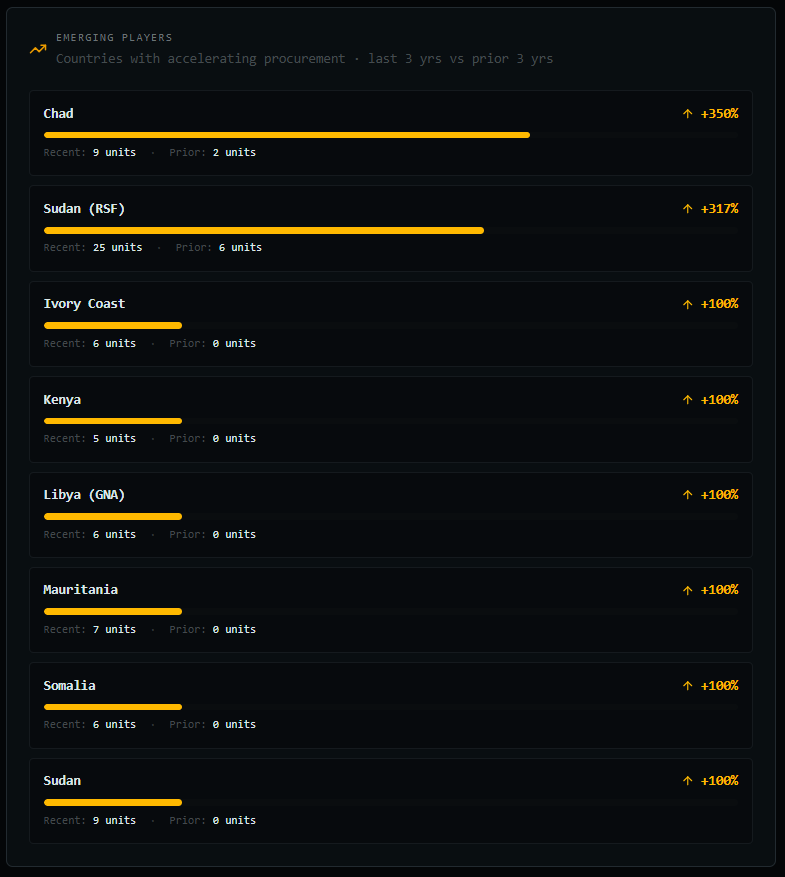
Somalia is the most dramatic example, but it is far from the only one. New procurement figures show at least eight African countries or forces have sharply ramped up drone purchases over the past three years compared with the three years before that. Some of the jumps are enormous on paper, Chad’s drone inventory has grown more than four and a half times over, and the paramilitary Rapid Support Forces fighting Sudan’s civil war have more than quadrupled theirs. Others look even more dramatic at first glance: Ivory Coast, Kenya, Mauritania, Somalia, and Libya’s Tripoli-based government all went from having essentially no recorded drone purchases in the earlier period to having a handful now, technically an infinite percentage increase, though what that really means is simpler: these are countries starting a drone programme from scratch, not accelerating an existing one. That distinction matters, because a country buying its first six drones is telling a very different story than one doubling an arsenal it already had.
Look closely at that list of new buyers and one country’s fingerprints turn up again and again: Turkey, whose rise alongside China to dominate the continent’s drone market is now reshaping air power well beyond any single conflict. Kenya took delivery of six Turkish Bayraktar TB2 drones in the final days of 2024, its answer to al-Shabaab fighters operating near its northern border, and followed up in 2026 by deepening the relationship with Ankara further still. Libya’s Tripoli government has leaned on Turkish drones for years to hold its own against a rival, Russian and Gulf-backed force in the country’s east. Chad’s fleet includes Turkish aircraft alongside a newer set of Chinese drones spotted at an airbase near its border with Sudan, evidence that Chad is trying to cover threats from Boko Haram in the west and spillover from Sudan’s war in the east at the same time. And Somalia, again, is the deepest case of all: Turkey has operated its largest overseas military base there since 2017, and by early 2026 had gone so far as to send its own fighter jets and ground troops into direct combat against al-Shabaab, on top of everything it has sold Mogadishu. Turkey has become, in effect, the world’s most aggressive drone salesman, offering capable weapons with none of the political conditions that Western countries typically attach, and a remarkable number of African militaries have said yes.
Not every country on this list is simply buying into Turkey’s orbit, though. Some are doing the opposite: hedging their bets by buying from as many different countries as possible at once. Ivory Coast is the clearest case. After France withdrew its last combat troops from the country in early 2025, ending decades of military partnership, Abidjan didn’t pick a single new patron to replace Paris. Instead it took European-funded surveillance drones in February 2026, confirmed a purchase of Chinese Wing Loong attack drones months later, and has spent more than a year in talks with the American military about hosting a drone facility of its own. One regional intelligence analysis suggested Ivorian officials are well aware that Chinese-made drones have a spotty reliability record elsewhere in Africa, and are spreading their risk across suppliers on purpose rather than by accident. Mauritania looks similar: its current drones came from China, but its defence minister was in Istanbul meeting Turkish officials as recently as May 2026, suggesting Beijing’s hold on that relationship may not last.
Then there is Sudan, which shows up on this list twice, once as the internationally recognised government and once as the Rapid Support Forces, the paramilitary group it has been fighting since 2023. That is not a coincidence or a data quirk. It is the story of a civil war in which both sides have spent the past three years racing to buy their own drones, the government turning mainly to Iran and Turkey, the RSF fielding Chinese-made aircraft that United Nations investigators say are financed by the United Arab Emirates. When a war generates two competing buyers instead of one, a procurement list like this one simply reflects that reality back.
What ties all of these stories together is a harder, more interesting question than who bought what: does buying a foreign drone actually leave a country any more capable of standing on its own? Here Somalia offers an unflattering comparison, one that a recent DefenceWeb investigation laid out in detail. Morocco started in almost exactly the same place back in 2021, buying its first Bayraktar drones straight from Turkey. But Moroccan law required foreign manufacturers to set up a local operation before servicing equipment on Moroccan soil, so Ankara ended up building an actual production facility outside Rabat, leaving Morocco with a small but real slice of the manufacturing itself. Somalia had no such requirement and extracted no such concession, and by some accounts still relies on Turkish personnel to operate the very drones it nominally owns. Two countries, the same aircraft, the same supplier, and two very different answers to what all this buying actually buys you. The unit counts and growth percentages tell you who is spending. They do not tell you who, five years from now, will have anything to show for it besides an aircraft they still cannot fly, fix, or replace on their own.

Africa’s dedicated and only military drone procurement intelligence.
Unmanned Africa bridges the critical gap between aerospace engineering, defense economics, and geopolitical strategy. As African defense forces rapidly modernize and scale their unmanned capabilities to address asymmetric conflicts, insurgencies, and border security, the platform functions as an essential, independent repository for defense analysts, policymakers, military professionals, and researchers.
Leave a Reply