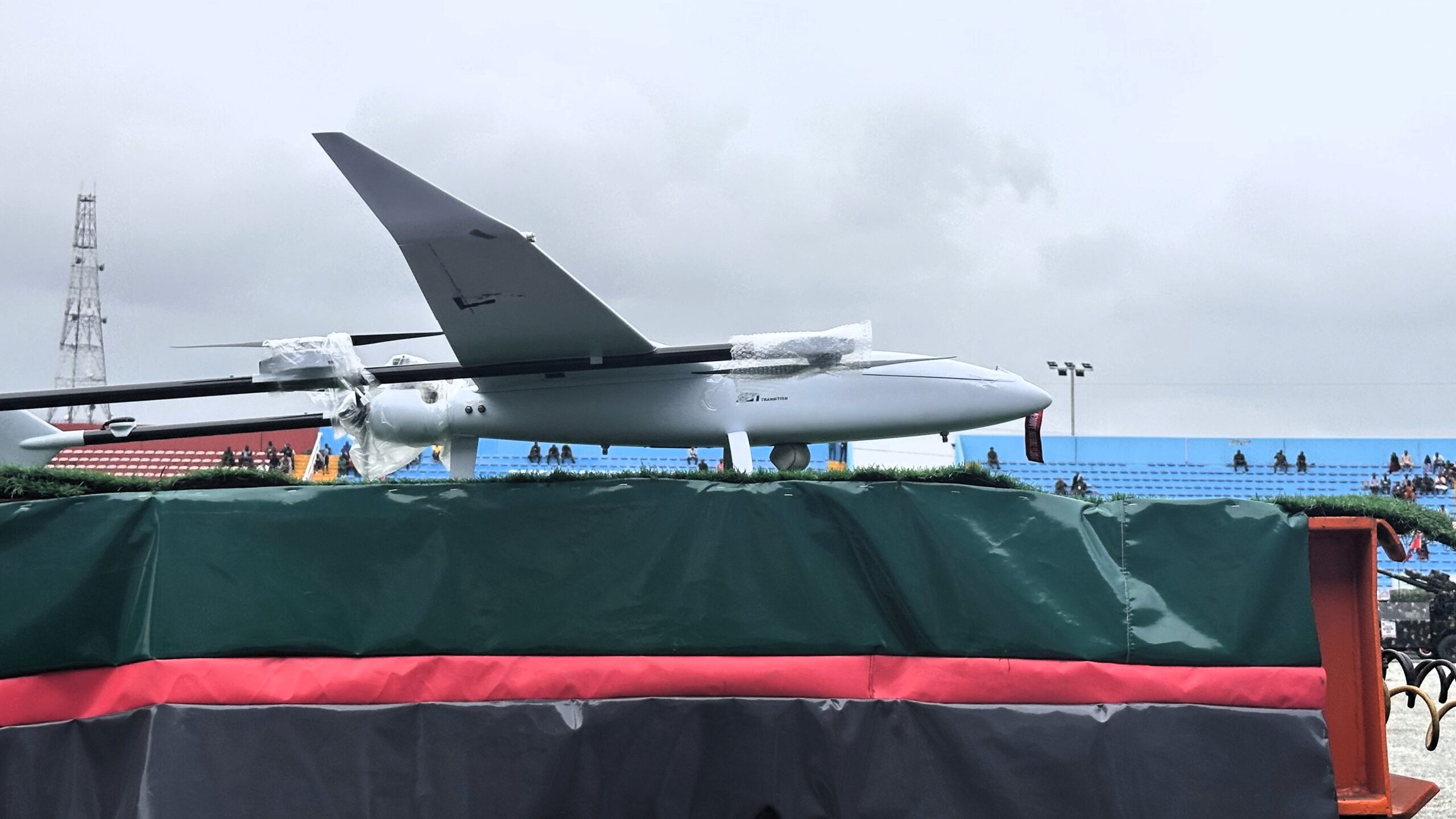
A UAV segment at this year’s Nigerian Army Day Celebration put three very different unmanned aircraft on display side by side — a South African VTOL surveyor, a Chinese unmanned helicopter, and a modified commercial airframe — offering a rare public snapshot of how Nigeria’s ground forces are assembling their drone fleet.
Port Harcourt hosted the 163rd Nigerian Army Day Celebration (NADCEL) from 4 to 6 July 2026, run this year alongside the third Africa Land Forces Forum and drawing Chiefs of Army from across the continent — among them Angola, Cameroon, Ghana, Morocco, South Africa, Tanzania, Uganda and Zimbabwe — plus former Nigerian heads of state Yakubu Gowon and Olusegun Obasanjo. The grand finale at Liberation Stadium on 6 July, presided over by Vice President Kashim Shettima on behalf of President Bola Tinubu, combined a military parade and tactical demonstrations with an equipment and research-and-development exhibition, built around the theme “Protecting the Nation and Serving the People: A Way Forward for the Nigerian Army.”
Much of the coverage to come out of NADCEL 2026 focused on the theatre of the occasion — Army skydivers exiting a C-130 at 12,000 feet, a widely shared helicopter rescue drill involving the Army’s Bell UH-1 Hueys. But for anyone tracking Nigeria’s unmanned systems programme specifically, the more revealing segment of the display was quieter: three distinct UAV types set out together, each representing a different route into the Nigerian Army’s growing drone inventory.
ALTI Transition: long-endurance coverage without a runway
The first aircraft on display was the ALTI Transition, a fixed-wing vertical take-off and landing (VTOL) drone from South African manufacturer ALTI Unmanned. The Transition is what the company calls a “double hybrid” design: electric power lifts it straight up and sets it back down, while a small petrol engine takes over once it’s airborne for level flight. That combination lets it launch and recover from confined spaces without a runway or catapult, while still covering the distances a conventional fixed-wing aircraft can manage. Per the manufacturer’s own published specifications, the Transition has a 3-metre wingspan, a length of 2.3 metres, a maximum take-off weight of around 16 kilograms, and can stay airborne for up to 12 hours depending on configuration — long-duration coverage over a fixed area at a fraction of the cost of a larger platform.
Open-source tracking of Nigerian drone inventories has previously placed the ALTI Transition with the Nigerian Police rather than the Army, so its appearance at NADCEL 2026 points either to a newer Army acquisition or to a joint display drawing on more than one security agency’s equipment. Neither the Army nor ALTI has clarified the point publicly, and it could not be independently confirmed beyond what was shown at the parade.

Ziyan Blowfish: a helicopter that needs no airstrip
The second type on display, the Ziyan Blowfish, has a longer public history with the Nigerian Army. Military Africa first reported the type in Nigerian Army service in July 2023, when it was shown by the Army’s Command Engineering Depot. Built by Guangdong-based Ziyan UAV, the baseline Blowfish A2 is a small autonomous helicopter with a maximum take-off weight of 38 kilograms, a payload of 12 to 15 kilograms depending on configuration, a cruise speed up to 130 km/h and an operational range of roughly 100 kilometres. Its open-cabin fuselage — unusual among helicopter drones for lacking a conventional enclosed belly — accepts electro-optical and infrared cameras, laser rangefinders, jamming equipment and, in some configurations, mortar bombs or guns, making it a compact intelligence, surveillance and reconnaissance (ISR) and light-strike platform that needs no prepared airstrip to operate.

The Blowfish sits inside a wider Army Aviation UAV structure the Nigerian Army set up in 2020, which also includes Textron’s Aerosonde fixed-wing drones and, more recently, Turkish Bayraktar TB2s — a lineup that has expanded considerably since the Blowfish’s 2023 debut. The Army has separately begun work on a $3.2 million aviation hangar at Bola Ahmed Tinubu International Airport in Minna, Niger State, intended to eventually house a dozen MD530 Cayuse Warrior attack helicopters, ten Bayraktar TB2s and roughly eight Magnus MF-212 light attack aircraft — a measure of how far the wider aviation build-up has moved in three years.
Poseidon H6: building military capability on a commercial kit
The third airframe shown, described as Poseidon H6 is a “highly modified” Mugin-6 Pro Long Range VTOL platform, reflects a different procurement logic altogether. The Poseidon H6 is a large, military-grade Vertical Take-Off and Landing (VTOL) Unmanned Aerial System (UAS) manufactured by the Cypriot aerospace company Swarmly Ltd. It is primarily engineered for heavy-lift, long-endurance reconnaissance, and tactical operations across both land and maritime environments.
Mugin UAV, based in Hong Kong, sells the Mugin-6 Pro as an airframe kit rather than a finished military system — a 6-metre-wingspan, carbon-fibre VTOL platform built primarily for civil mapping, surveying and inspection work, with the long-range VTOL configuration shown rated for a 25-kilogram payload and up to five hours of endurance in hybrid mode.

Nigeria already has history with the type, though not previously in a combat role. The Nigerian Air Force has used Mugin commercial airframes for initial UAV pilot training at its 401st Flying Training School in Kaduna, before trainees move on to more advanced platforms. That fits a broader pattern in Nigeria’s home-grown drone development, which has previously produced locally adapted airframes such as the Amebo, Gulma and, most successfully, the Tsaigumi — developed jointly by the Air Force Institute of Technology and Portugal’s UAVision and inducted into service in 2018. Across that programme, Nigeria has consistently favoured adapting inexpensive commercial or semi-commercial airframes for military ISR and strike roles over importing complete foreign weapon systems outright. A “highly modified” Mugin-6 fits squarely into that pattern: a long-endurance, heavy-payload civilian airframe adapted domestically with military sensors and communications equipment, an approach that controls cost while building technical capacity inside the country rather than buying it in from abroad. What modifications were made to the specific airframe shown at NADCEL 2026 were not detailed in available reporting.
A modernisation drive years in the making
Taken individually, none of the three aircraft is new to Nigeria. What the NADCEL 2026 display captured, arguably more usefully, was the range of a strategy already under way: a ready-made VTOL surveyor imported from South Africa; a Chinese combat helicopter already several years into service; and a commercially sourced airframe being adapted in-house. Setting all three out together at the Army’s flagship annual event, alongside a parade, an R&D exhibition and international guests from more than a dozen African armies, reads as a deliberate statement about where the Nigerian Army’s aviation programme is heading — not toward a single supplier or doctrine, but toward a mixed fleet assembled from whichever combination of imported systems and local adaptation gets capability into the field fastest.
That framing lines up with what Nigerian Army leadership has been saying in public this year. Chief of Army Staff Lieutenant General Waidi Shaibu, who took over the role in October 2025, has repeatedly tied the Army’s operational record against insurgents, bandits and armed groups to investment in intelligence and technology, arguing that better sensors and faster information flow let troops identify threats more precisely and respond faster. President Tinubu, addressing the NADCEL grand finale through Vice President Shettima, went further, pledging continued government backing for artificial intelligence, indigenous defence production and other modern military technologies as part of the Army’s ongoing modernisation programme.
The stakes behind that rhetoric are concrete. Nigeria’s military has spent years fighting Boko Haram and its offshoot, Islamic State West Africa Province (ISWAP), across the northeast, alongside banditry and kidnapping-for-ransom networks in the northwest and centre of the country — conflicts in which both sides have increasingly turned to unmanned systems. ISWAP cells have moved beyond using small commercial drones purely for reconnaissance, arming quadcopters with improvised munitions and flying them at military positions in the Lake Chad basin, a pattern that has sharpened the Army’s own case for platforms like the Blowfish and the Transition that can watch remote terrain persistently without exposing ground troops. Seen against that backdrop, the drone segment at NADCEL 2026 reads less as a novelty act than as a status report: evidence of an air-domain build-up that has been assembled piece by piece since at least 2020, and that Nigeria’s military leadership shows every sign of wanting to accelerate.
Leave a Reply