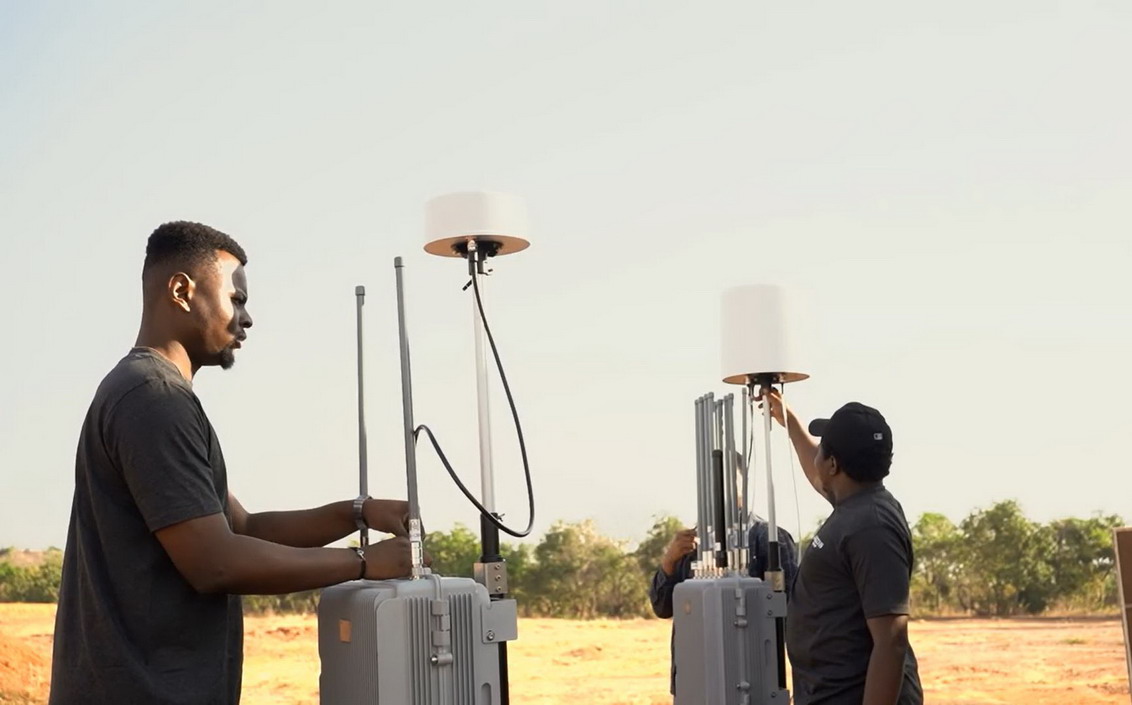
Nigeria is building its counter-drone capability on two parallel tracks at once, one running through the Nigerian Air Force’s own procurement and training pipeline, the other through a wave of homegrown defence-technology startups the military has begun leaning on directly. Both are responses to the same problem: Boko Haram and its offshoot, the Islamic State West Africa Province (ISWAP), have gone from flying commercial drones for reconnaissance to dropping explosives from them in barely two years, and Nigeria’s air defences were not built with that threat in mind.
The shift became impossible to ignore on 24 December 2024, when four drones carrying locally modified grenades struck a Nigerian Forward Operating Base at Wajiroko in Borno State, the first confirmed combat use of armed drones by a Lake Chad Basin militant group. Further armed-drone attacks followed within days at Damaturu and Abadam, and by January 2026 open-source trackers were reporting roughly 35 additional drones smuggled into the region through Lake Chad corridor routes, with interviews conducted by the Institute for Security Studies pointing to foreign Islamic State trainers helping local fighters adapt the tactics. Independent incident trackers cited by Military Africa put the overall scale of the shift at roughly a six-fold increase in documented drone incidents since 2024, a rate of change that has left conventional, centralised air-defence assets poorly matched to a threat that can be assembled from parts bought online for a few hundred dollars.
The Nigerian Air Force’s most visible response has been a dedicated training programme on what it calls the 612A Anti-UAV Radar System, inaugurated on 26 July 2025 at the headquarters of the Air Component for Operation Hadin Kai in Maiduguri, Borno State, under then Chief of the Air Staff Air Marshal Hasan Bala Abubakar. The programme graduated its first cohort that October, with the air force describing the system as capable of detecting the low, slow and small aerial targets that conventional radar tends to miss. Open-source defence trackers have not been able to match the 612A designation to any publicly documented radar system, and Military Africa has suggested it may be a locally assigned name for newly acquired equipment rather than a manufacturer’s original model number, a reminder that even basic order-of-battle details can be hard to pin down for African procurement. Air Marshal Sunday Aneke succeeded Abubakar as Chief of the Air Staff on 30 October 2025 and has since folded the counter-drone effort into a broader National Threat Assessment and security-planning process alongside Nigeria’s other service chiefs.
Alongside the radar, Nigeria has fielded the Lithuanian-made EDM4S SkyWiper from NT Service, a handheld jammer first unveiled in 2019 that disrupts the control, telemetry and navigation links between a drone and its operator, typically paired with NT Service’s own Wingman detector for a fuller picture of what is approaching. A separate layer, Thales Ground Observer 12 radars delivered in 2019, provides Ku-band pulse-Doppler surveillance originally intended for broader battlefield and border monitoring that now does double duty against low-flying drones.
Running alongside the Air Force’s own procurement is a second, distinctly Nigerian track: a cluster of domestic startups building counter-drone hardware from scratch rather than importing it. The most prominent is Terra Industries, an Abuja-based company founded in 2024 by Nathan Nwachuku and Maxwell Maduka that has become the continent’s most heavily funded defence-technology startup, raising more than 50 million dollars in seed funding by August 2026 from investors including 8VC and Lux Capital. Terra’s product line includes the Archer, a vertical-takeoff-and-landing (VTOL) surveillance and strike drone, and the Iroko tactical UAV, but its counter-drone entry is Kama, an interceptor the company says can run down and disable hostile aircraft at speeds of up to 300 kilometres per hour. The company’s existing Abuja factory, Pax-1, is being supplemented by a larger facility in Accra, Ghana, due to reach full operation around mid-2026 and eventually produce up to 50,000 units a year, a scale-up Terra has framed explicitly around the pace of drone attacks across the wider Sahel rather than Nigeria alone. Terra is not working this ground alone: Babasky Technologies, the defence subsidiary of Nigerian conglomerate UNICCON Group, has pursued a parallel counter-drone programme linked to the Defense Industries Corporation of Nigeria (DICON), pairing its own detection-and-jamming platform with a companion strike drone, a project Unmanned Africa covered in detail when it was demonstrated in August 2026. Between them, Nigeria now has at least two well-funded, credible domestic counter-drone efforts running independently of, and in addition to, whatever the Air Force is importing.
Whether any of this closes the gap fast enough is a genuinely open question. Continental market analysts tracking the broader shift from drone procurement toward counter-drone spending put growth in the sector at more than 27 percent a year through 2030, and Nigeria’s build-out fits a pattern seen from the Sahel to the Horn of Africa, where militaries are moving from ad hoc handheld jammers toward layered detection-and-defeat systems. The economics remain stubbornly lopsided in the meantime: an ISWAP or Boko Haram cell can put together a working strike drone for a few hundred to a couple of thousand dollars, while a single radar or jamming installation of the kind Nigeria is now fielding can run into the hundreds of thousands. Insurgent groups have also shown they adapt quickly, shifting to frequency-hopping firmware and, in Mali and the wider Sahel, fiber-optic tethers that defeat radio jamming entirely, an evolution Nigerian planners will need to anticipate rather than simply react to if the current investment is to hold up.
For now, the more telling signal may be less about any single radar or jammer and more about who is building Nigeria’s answer to this threat. A state air force training on imported hardware and a cluster of homegrown startups building interceptors from the ground up are not usually part of the same defence-procurement story, but in Nigeria’s northeast, both have become necessary, and neither looks likely to be enough on its own.

Africa’s dedicated and only military drone procurement intelligence.
Unmanned Africa bridges the critical gap between aerospace engineering, defense economics, and geopolitical strategy. As African defense forces rapidly modernize and scale their unmanned capabilities to address asymmetric conflicts, insurgencies, and border security, the platform functions as an essential, independent repository for defense analysts, policymakers, military professionals, and researchers.
Leave a Reply