
Ten African countries buy every single one of their military drones from one place. Somalia gets all of its drones from Turkey. Benin, Mozambique, Namibia, and the Democratic Republic of Congo get all of theirs from China. Botswana relies entirely on Israel. Burundi relies entirely on the United States. On paper, these ten countries look identical: total dependence, nowhere else to turn if the relationship sours. In practice, they are not the same story at all, and figuring out why is a better way to understand Africa’s drone market than the raw percentages alone can offer.
Start with the supplier landscape underneath these numbers. According to the Africa Center for Strategic Studies, which tracks drone deals across the continent using Military Africa’s own procurement data, Turkey has signed 32 separate drone agreements with African governments, 28 of them since 2021, making it easily the continent’s most active supplier. China follows with 27, Israel with 18, the United States with 15, and Iran with 9. That ranking explains most of the ten countries locked at 100 percent reliance in one stroke: Burkina Faso, Djibouti, Somalia, and Togo all sit entirely inside Turkey’s rapidly expanding sales network, while Benin, DR Congo, Mozambique, and Namibia sit entirely inside China’s. These are not countries locked into a single supplier by accident. They are countries that happened to make their first, and so far only, drone purchase from whichever of the two most aggressive sellers in Africa got there first.
Somalia is the deepest and most consequential of the Turkish cluster, and worth dwelling on because its dependence runs well past hardware. Turkey has operated its largest overseas military base, TURKSOM, in Mogadishu since 2017, has sold Somalia everything from Bayraktar TB2s up to AKINCI strategic strike drones, and by early 2026 was flying its own F-16s and deploying its own ground troops directly into combat against al-Shabaab alongside the hardware it had already sold Mogadishu. A DefenceWeb analysis comparing Somalia to Morocco, which forced Turkey to build an actual production facility on Moroccan soil before it could service its own aircraft, found Somalia extracted no comparable concession and reportedly still relies on Turkish personnel to operate drones it nominally owns. A hundred percent reliance in Mogadishu’s case means something closer to a client relationship than a supply chain. Djibouti and Togo, which have taken smaller, less publicized Turkish deliveries, look statistically identical but almost certainly carry far less of that entanglement, simply because far less has been bought in the first place.
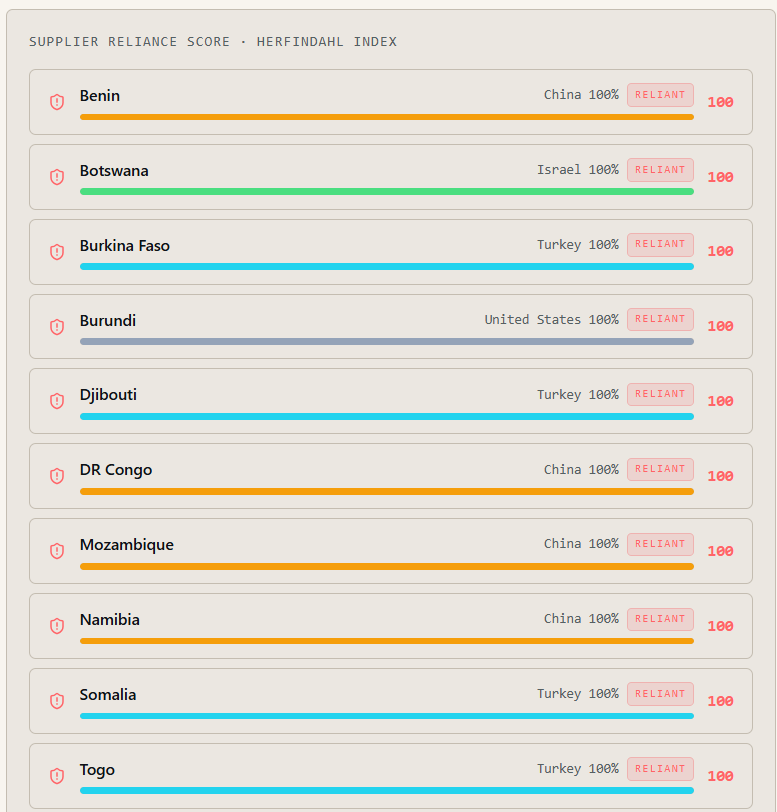
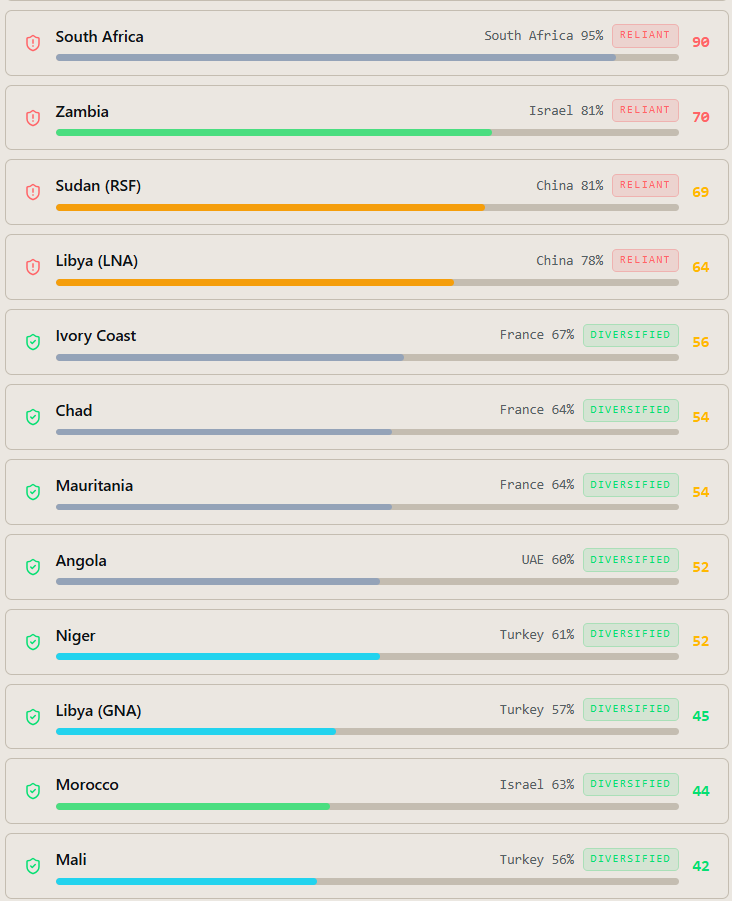

The two genuine outliers in the “100 percent” club, Botswana’s reliance on Israel and Burundi’s on the United States, are outliers for opposite reasons. Israel’s Bluebird Aero Systems has quietly built a real footprint in southern and eastern Africa through its WanderB vertical-takeoff surveillance drone, one of the most widely adopted tactical platforms on the continent according to Africa Center’s tracking, which likely explains why Botswana, and to a lesser extent Zambia and Uganda further up the diversification scale, show Israel as a dominant or leading supplier despite Israel rarely featuring in African drone coverage the way Turkey or China do. Burundi’s case is different again, and more mundane than it looks: the only documented drone transfer on record is a 2011 US military aid package, worth 45 million dollars and shared with Uganda, that included four small surveillance drones for counterterrorism operations tied to the African Union mission in Somalia. Fifteen years with no recorded follow-on purchase is not deep strategic dependency; it is a thin, aging data point that happens to register the same way a genuine patron relationship does once it gets reduced to a single percentage. The lesson generalizes: a Herfindahl score of 100 can describe either a country locked into one supplier’s ecosystem for a decade, or a country that has simply never had reason to buy a second batch of drones from anyone.
A cluster of West and Central African states shows what active diversification looks like when it is a deliberate policy rather than an accident of timing. Ivory Coast, Chad, and Mauritania, sitting in the 64 to 67 percent range with France still recorded as their largest historical supplier, are all in the process of visibly moving away from that legacy relationship rather than deepening it. Ivory Coast took European-funded surveillance drones, confirmed Chinese Wing Loong II purchases, and opened talks with the American military for a drone facility of its own, all within about eighteen months of France withdrawing its last combat troops in 2025. Chad has folded Chinese CH-4s into a fleet built around Turkish Bayraktar and Aksungur aircraft, hedging simultaneously against Boko Haram pressure in its west and Sudan’s civil war spilling across its eastern border. Mauritania’s drones currently come mostly from China, but its defence minister was meeting Turkish officials in Istanbul as recently as May 2026. None of these three countries is dependent in any single direction; all three are actively shopping.
South Africa and Tunisia sit at opposite ends of the table but represent the same underlying idea: a low reliance score is not automatically good, and a high one is not automatically bad, once the identity of the supplier is factored in. South Africa’s score, 95 percent reliant on South Africa itself, looks at first glance like the same kind of concentration as Somalia’s dependence on Turkey. It is nothing of the sort. It reflects Denel’s aerospace programs dating to the 1970s and the newer Milkor 380, the largest indigenously designed drone on the continent, meaning South Africa’s “100 percent” equivalent is actually a description of sovereignty rather than dependency. Tunisia sits at the opposite extreme, just 22 percent reliant on its own domestic production and the most diversified buyer on the entire list, a position that reflects both a genuinely mixed foreign supplier base and a small but real indigenous sector: Tunisian firm ENOVA Robotics has exported dozens of its ground-security robots to the United States, a rare case of the trade flowing the other way. Between them, South Africa and Tunisia demonstrate that the two healthiest positions on this table, deep self-reliance and deliberate diversification, look nothing alike on paper but solve the same underlying problem from opposite directions.
Sudan and Libya appear on this list as split personalities because their wars have split their procurement in two. Sudan’s government sources roughly half its drones from Iran, layered with Turkish and Chinese purchases, while the Rapid Support Forces it has been fighting since 2023 gets 81 percent of its own separate arsenal from China, financed according to UN reporting by the United Arab Emirates. The Africa Center’s own tracking adds a detail that isn’t visible in either government’s or party’s reliance score alone: Sudan’s Military Industry Corporation has unveiled its own indigenous FPV loitering munition, the Kamin-25, meaning the state side of the war is now producing weapons as well as importing them. Libya shows the identical pattern in miniature, its Tripoli-based government diversified across Turkey, Israel, and Austria, its rival eastern administration overwhelmingly dependent on China. In both countries, a single national reliance score would have hidden the fact that there are really two governments buying two separate arsenals from two different parts of the world.
None of this means the Herfindahl Index is the wrong tool, only that it needs a second question sitting next to it before it means very much: reliant on whom, and why. A hundred percent concentration in your own domestic industry and a hundred percent concentration in a foreign patron’s export catalogue produce an identical number and opposite outcomes. The countries worth watching over the next few years are not necessarily the ones with the highest or lowest scores, but the ones like Ivory Coast, Chad, and Mauritania actively moving between the two, and the ones like Somalia where a high score has quietly become something closer to an arrangement than a market.

Africa’s dedicated and only military drone procurement intelligence.
Unmanned Africa bridges the critical gap between aerospace engineering, defense economics, and geopolitical strategy. As African defense forces rapidly modernize and scale their unmanned capabilities to address asymmetric conflicts, insurgencies, and border security, the platform functions as an essential, independent repository for defense analysts, policymakers, military professionals, and researchers.
Leave a Reply