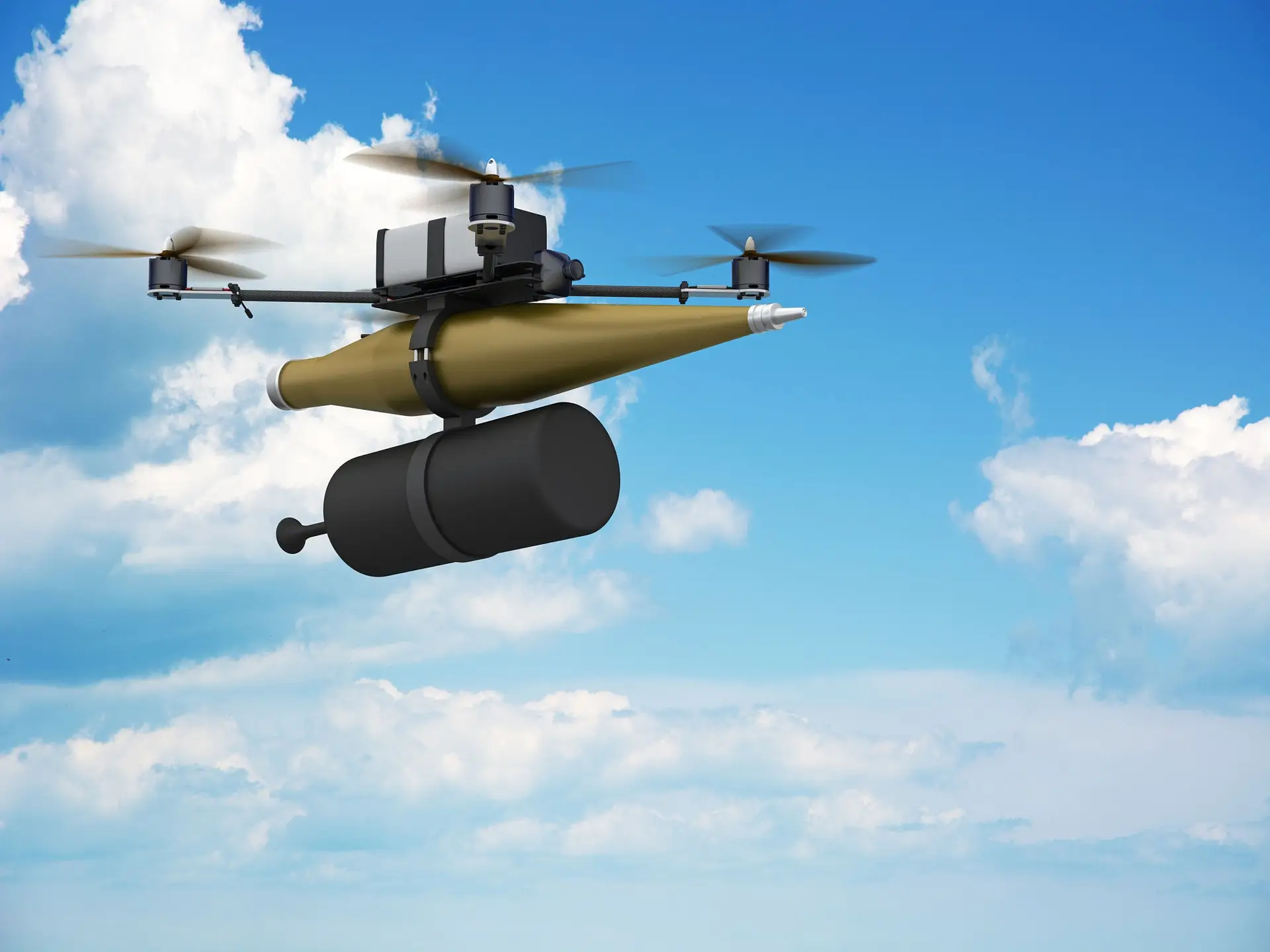
First-Person View (FPV) kamikaze drones have shifted from experimental improvised weapons to primary tactical effectors across active African combat zones. Armed forces and insurgent groups in Sudan, Mali, and across the wider Sahel region are using these lightweight, suicide-style loitering munitions to bypass legacy air defenses, attack armored vehicles, and target personnel. By strapping explosive warheads to maneuverable racing quadcopters or light fixed-wing airframes, combatants gain an inexpensive precision-guided strike asset that delivers real-time target verification directly to an operator wearing video goggles.
How FPV Drones Work
Unlike standard commercial surveillance quadcopters that drop unguided munitions from hovering positions, FPV kamikaze drones function as guided missiles controlled by a human operator in real time. The operator wears a head-mounted display that receives low-latency video directly from the nose camera. Flying at speeds between 80 and 150 kilometers per hour, the operator can maneuver the airframe through building windows, trench networks, or open vehicle hatches before detonating the onboard charge upon impact.
Field units assemble these systems using modular commercial components, pairing high-KV brushless motors with high-discharge lithium-polymer batteries. Operators attach modified Rocket-Propelled Grenade (RPG) warheads, specifically PG-7V anti-tank shaped charges, or improvised fragmentation containers. The total cost of an operational FPV strike package often stays under 600 US dollars, creating a stark economic advantage when targeting combat vehicles, mobile artillery, or command positions valued in the millions.
Sudan and the Sahel
In Sudan, the civil conflict between the Sudanese Armed Forces (SAF) and the Rapid Support Forces (RSF) has become one of the most intense drone battlegrounds on the continent. Both sides deploy FPV quadcopters alongside long-range delta-wing suicide drones to break tactical stalemates across urban centers such as Khartoum and Omdurman, as well as rural hubs in Darfur and Kordofan. SAF troops deploy FPV systems to eliminate snipers, target RSF technical trucks, and breach fortified urban strongpoints. Conversely, RSF units utilize suicide drones to strike fuel storage depots, military airstrips, and supply convoys, expanding the geographical reach of the war into previously stable regions.
In the Sahel, non-state armed actors pioneered the operational deployment of FPV suicide drones against regular militaries and foreign security partners. Tuareg-based insurgent formations under the Azawad Liberation Front (FLA) and jihadist groups like Jama’at Nusrat al-Islam wal-Muslimin (JNIM) in northern Mali aggressively deployed FPV drones against government outposts in Anéfis, Aguelhok, and Kidal. These targeted kamikaze strikes damaged ground facilities, disrupted logistics, and contributed to the retreat of Malian troops and Russian Africa Corps personnel. Insurgent operators in Mali have also introduced fiber-optic guided FPV variants, trailing ultra-thin glass cables behind the airframe. This physical tether renders the drone entirely immune to Radio Frequency (RF) jamming, ensuring continuous video transmission and control authority through heavy electronic countermeasures.
In response to these insurgent successes, Russian Africa Corps personnel and Malian military forces expanded their own FPV strike programs across northern provinces. Sourcing specialized components and training local personnel, government-aligned forces now employ FPV suicide airframes to hit rebel staging grounds, concealed mortar pits, and high-mobility motorized patrols.
Information Warfare and Strategic Consequences
The rise of FPV kamikaze drones extends beyond immediate tactical destruction; it serves as a central asset in psychological and information warfare. Because every FPV mission records high-resolution terminal flight video, operators capture exact impact footage seconds before detonation. Militaries and insurgent groups rapidly upload these video clips to social media channels to verify Battle Damage Assessment (BDA), boost recruitment, and undermine adversary morale. Showing an inexpensive commercial quadcopter disabling an armored vehicle or striking a command post provides compelling proof of operational reach.
This rapid proliferation introduces serious challenges for African defense planners. Conventional air defense radars struggle to track low-altitude, small-radar-cross-section quadcopters flying close to terrain features. Furthermore, the rapid transition toward fiber-optic control tethers and pre-programmed terminal guidance algorithms reduces the effectiveness of traditional electronic jamming guns. Countering FPV suicide platforms will require African militaries to procure multi-layered point defenses, incorporating passive acoustic sensors, automated optical tracking, short-range kinetic shotguns, and physical wire netting over vital infrastructure and armored columns.

Africa’s dedicated and only military drone procurement intelligence.
Unmanned Africa bridges the critical gap between aerospace engineering, defense economics, and geopolitical strategy. As African defense forces rapidly modernize and scale their unmanned capabilities to address asymmetric conflicts, insurgencies, and border security, the platform functions as an essential, independent repository for defense analysts, policymakers, military professionals, and researchers.
