Sudan’s civil war has produced one of the most extensively documented shootdown records of any African conflict, a running exchange of claimed drone kills between the Sudanese Armed Forces (SAF) and the Rapid Support Forces (RSF) that stretches from a single Mohajer-6 brought down with a shoulder-fired missile in January 2024 to a purpose-built air-to-air loitering munition intercepting a strategic drone in July 2026. Piecing that record together says as much about how this war has evolved as any single battle: what began as an improvised response to an unfamiliar threat has hardened, on both sides, into a dedicated counter-drone effort with its own tactics, its own casualties, and its own contested claims.
The underlying war needs little introduction to readers of this site. Now in its fourth year, the conflict between the SAF, commanded by General Abdel Fattah al-Burhan, and the RSF, led by Mohamed Hamdan Dagalo, known as Hemedti, cost the SAF Khartoum before the army recaptured the capital in 2025, and cost the people of El Fasher an atrocity a United Nations (UN)-mandated inquiry said bore the hallmarks of genocide after the city fell to the RSF in October 2025 following an eighteen-month siege. Hemedti was sentenced to death in absentia by a Sudanese court in July 2026. Fighting has continued through the Kordofan states and into Blue Nile state this August. Unmanned Africa has covered the proliferation of long-range strike drones on both sides in detail separately, along with the FPV kamikaze drones both armies increasingly use at closer range. This piece looks at the other side of that story: what has actually been shot down, by whom, and what the pattern of losses says about how the aerial war is being fought.
Sudan’s drone war draws hardware from an unusually wide set of suppliers for an African conflict. The SAF operates Iranian Mohajer-6 drones acquired from Tehran, first confirmed via satellite imagery of Wadi Sayyidna air base north of Khartoum in January 2024, alongside Turkish Bayraktar and AKINCI platforms and its own locally assembled “Safrouq” loitering munition. The RSF, which receives financial and material backing from the United Arab Emirates (UAE) according to UN reporting, fields Chinese-built systems including the CH-95, also marketed as the FH-95, a medium-altitude long-endurance drone from Aerospace Times Feihong Technology, alongside Sunflower-200 and ZT-180 loitering munitions. Both sides have layered in ground-based air defence built specifically to counter the other’s aircraft: the RSF operates Chinese FK-2000 combined gun-missile systems and FB-10A short-range surface-to-air missiles, while the SAF has fielded a Turkish HISAR-A radar and Roketsan-made EREN interceptor munitions.
The RSF’s claimed kills start almost as early as the SAF’s Iranian drones entered service. On 6 January 2024, RSF-affiliated fighters circulated photographs on Telegram of wreckage they said belonged to a Mohajer-6 downed over Khartoum using man-portable air-defence systems (MANPADS); Human Rights Watch later reviewed the imagery and found it consistent with Mohajer-6 debris. The RSF claimed a second within days and, by late January, a third, this one over Omdurman, timed to coincide with satellite confirmation that Mohajer-6 airframes and a ground-control vehicle were operating from Wadi Sayyidna. Despite those losses, Iranian drones were credited, per Radio Dabanga’s sourcing, as a “decisive factor” in the SAF’s recapture of Omdurman’s national radio and television headquarters that April, a reminder that early losses did not translate into the platform being neutralised as a threat.
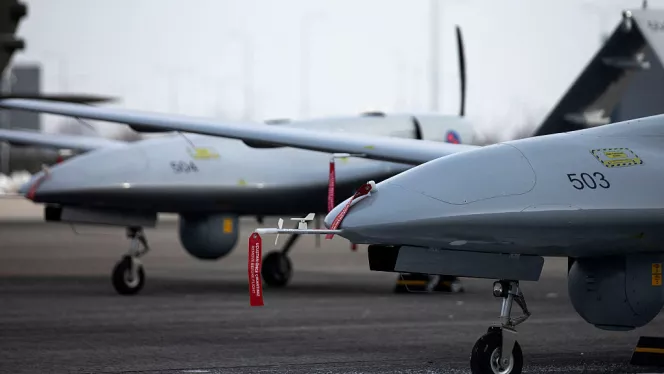
The claimed tally resumed in earnest through the second half of 2025 as RSF reports of downed Turkish drones multiplied. RSF units reported downing an AKINCI over El Fasher, North Darfur, on 10 July 2025; a second and third over Nyala, South Darfur, on 24 and 26 August; a fourth over the Marshang area of South Darfur on 4 September; a fifth over Al Khoei, West Kordofan, on 13 September; a sixth back near El Fasher on 7 October; and a further Bayraktar, unspecified variant, over Abu Quaoud, West Kordofan, on 10 December. The RSF’s 46th Group claimed one more AKINCI near Dilling, South Kordofan, on 24 January 2026. Independent open-source intelligence (OSINT) trackers monitoring the claims have cautioned that the actual kill mechanism behind several of these incidents was probably a Chinese-supplied FK-2000 gun-missile system or FB-10A missile rather than the small-arms and machine-gun fire RSF fighters are frequently filmed directing at falling drones for propaganda value, and that at least some losses may reflect SAF operator inexperience with a new platform rather than any specific RSF technical breakthrough.
The SAF’s confirmed kills of RSF drones follow a different, more recent pattern, concentrated in 2026 and increasingly credited to purpose-built interceptors rather than improvised ground fire. Sudanese officials say SAF air defences used Roketsan-made EREN high-speed loitering munitions, a 35-kilogram, 100-kilometre-range weapon built specifically to catch slower aerial targets, to down at least three RSF drones earlier in 2026: two AKINCIs the SAF says the RSF flew with UAE backing out of Bahir Dar airport in neighbouring Ethiopia, and one CH-95. On 2 July 2026, SAF air defences downed a further FH-95 over Tendalti in White Nile State, releasing footage of the aircraft’s destruction. Five days later, on 7 July, the SAF used a Bayraktar AKINCI in an air-to-air role to shoot down another CH-95 along the export road linking Bara and Omdurman, its fourth confirmed drone-on-drone kill of the year. The pace accelerated further in August: Sudanese officials reported downing two more FH-95s on 17 August alone, one over Jureijikh and one near Bara, both in North Kordofan, bringing the total number of RSF drones the army says it has destroyed in the wider Kordofan region to seven since June.
The shootdown record is only part of a wider contest over air-defence infrastructure itself, one that has arguably shaped the drone war more than any single interception. According to ACLED’s tracking of the conflict’s aerial dimension, the SAF has systematically targeted the RSF’s deployed FK-2000 batteries, destroying at least seven of them in attacks between August 2025 and February 2026, degrading the RSF’s own ability to intercept SAF aircraft. The RSF, in turn, exploited a gap in the SAF’s coverage: after identifying that the army’s Turkish-supplied HISAR-A radar could not reliably detect high-altitude drones, RSF forces destroyed a HISAR-A system in North Kordofan on 21 May 2026, and followed with ten strikes on Khartoum that same month that hit the capital’s airport and destroyed SAF air-defence positions there directly. Each side, in other words, has spent as much effort attacking the other’s capacity to shoot down drones as it has shooting down the drones themselves.
That escalation has come with a civilian cost UN officials have started to quantify directly. The UN High Commissioner for Human Rights condemned what it called a “sharp increase” in drone warfare in June 2026, and separately estimated that drone attacks killed more than 1,000 civilians in the first five months of 2026 alone. Specific incidents bear that out: an RSF drone strike on a convoy of displaced families near Rahad, North Kordofan, in February 2026 killed at least 24 people, including eight children, according to the Sudan Doctors Network, which described the strike on a clearly marked aid convoy as a violation of international humanitarian law. In late January 2026, a day after the SAF announced it had broken a nearly two-year RSF siege of Dilling in South Kordofan, an RSF drone strike hit the town’s market and the headquarters of the SAF’s 54th Brigade, killing dozens. Both incidents illustrate a pattern that holds throughout the shootdown record above: the drones that survive to reach their targets, not the ones intercepted, are doing the overwhelming share of the war’s damage.
None of this suggests either side is close to air superiority in any conventional sense, and the tally above, compiled from RSF and SAF statements, OSINT trackers, and independent monitors including ACLED and Human Rights Watch, almost certainly understates the true total given how much of this war unfolds far from independent observers. What the record does show is a war in which both sides have had roughly three and a half years to adapt, and have used that time to convert an early, improvised response to an unfamiliar threat into something closer to a genuine counter-drone doctrine, one that is shooting down more aircraft than ever even as the raw number of drones in the sky keeps climbing faster still.

Africa’s dedicated and only military drone procurement intelligence.
Unmanned Africa bridges the critical gap between aerospace engineering, defense economics, and geopolitical strategy. As African defense forces rapidly modernize and scale their unmanned capabilities to address asymmetric conflicts, insurgencies, and border security, the platform functions as an essential, independent repository for defense analysts, policymakers, military professionals, and researchers.
