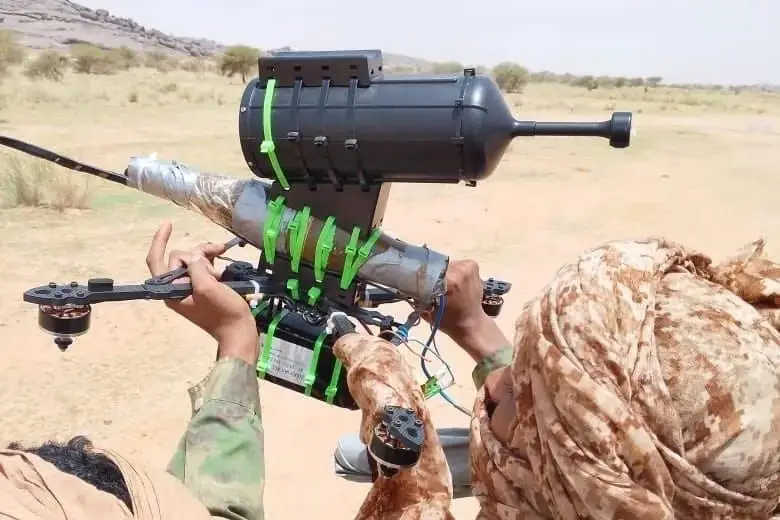
Since early 2026, Tuareg-led separatist fighters in northern Mali have used cheap, operator-guided drones to do what a decade of conventional rebellion could not: drive the Malian army and its Russian Africa Corps partners out of the region’s symbolic capital. The Azawad Liberation Front (FLA), the armed coalition that grew out of the older CSP-DPA political framework, has built a First-Person View (FPV) drone programme that pairs racing-quadcopter airframes with repurposed Rocket-Propelled Grenade (RPG) warheads, giving lightly armed separatist units a precision anti-armour capability that would have been unthinkable for a non-state force in the Sahel only two or three years ago. Unmanned Africa has covered the broader FPV phenomenon across Sudan and the Sahel separately; this piece looks specifically at how the FLA built its programme and what it has meant for the fight over northern Mali.
From CSP-DPA to the Azawad Liberation Front
The FLA’s roots run through nearly a decade and a half of intermittent Tuareg rebellion. The Cadre stratégique permanent pour la paix, la sécurité et le développement (CSP-PSD), an alliance of Tuareg-led factions formed in May 2021 to help implement the 2015 Algiers Accord, which had granted northern Mali’s rebel coalition de facto control of Kidal, lost that peace framework in December 2022, when its constituent groups suspended participation in the agreement’s UN-monitored oversight committee. Mali’s junta, which had seized power in 2020 and brought in Wagner Group mercenaries the following year, moved to end the arrangement by force: Malian and Wagner units captured Kidal in November 2023, ending nine years of de facto rebel control there. The rebel coalition renamed itself the Cadre stratégique pour la défense du peuple de l’Azawad (CSP-DPA) in April 2024, but its fortunes shifted again after a Malian Bayraktar TB2 strike near Tinzaouaten in late 2024 killed several senior commanders. Out of that loss, on 30 November 2024, came the Azawad Liberation Front, a more explicitly military coalition under Tuareg commander Alghabass Ag Intalla. Malian drones killed one of the group’s own top leaders, Fahad Ag Almahmoud, the very next day, an early sign that the drone war in northern Mali would run in both directions. Analysts describe the FLA’s parallel alignment with the al-Qaeda-linked Jama’at Nusrat al-Islam wal-Muslimin (JNIM) as a marriage of convenience rather than an ideological merger: the two share an enemy in the Malian junta but little else, with the FLA seeking an independent Azawad state and JNIM seeking to topple the government in Bamako outright.
The Fall of Kidal
That convergence produced the most serious challenge to Bamako’s authority in years. On 25 April 2026, the FLA and JNIM launched coordinated attacks across Mali, hitting military positions in Bamako, Kati, Gao, Sévaré, Mopti and Kidal in what regional analysts called the most audacious rebel operation in over a decade. A suicide car-bomb attack on the Kati home of Defence Minister Sadio Camara, a central figure in Mali’s 2020 and 2021 coups and the architect of its pivot from French to Russian security partnerships, killed him instantly; JNIM claimed responsibility. The following day, FLA fighters entered Kidal and negotiated an escorted withdrawal of Malian and Africa Corps personnel rather than fighting for the city outright, a reversal so complete that footage of Tuareg fighters mocking departing Russian vehicle columns circulated widely online. Casualty figures remain contested: Mali’s military claims over 200 rebels killed, Africa Corps claims over 1,000, and the FLA claims to have killed several dozen opponents in Kidal alone while capturing more than 200 more, along with an Africa Corps Mil Mi-35 helicopter and its crew. What is not in dispute is the outcome. As of the most recent reporting available, Kidal remains under FLA control, and Malian and Russian forces, unable to retake the city on the ground, have instead resorted to air strikes against it, while Moscow has publicly rejected FLA demands for a full Africa Corps withdrawal from the country.
Fiber-Optic FPVs and the RPG-7 Warhead
The drone campaign that helped set up that collapse had been building for months before the April offensive. Through March 2026 the FLA said it struck Malian and Africa Corps forces seven separate times, hitting joint bases at Anéfis and Aguelhok and, in one raid on Camp Firhoun ag Alinsar in Gao, launching a swarm of roughly 25 armed kamikaze drones in a single attack. A strike on a Malian and Africa Corps outpost at Adghar-Takalot, south of Kidal, destroyed an armoured vehicle and killed or wounded personnel from both forces, one of several attacks that let the FLA reach targets away from the front line with a weapon light enough for a single fighter to carry and operate. In one of the more pointed strikes of the campaign, FLA fighters flew an FPV drone fitted with a PG-7V warhead, the standard high-explosive anti-tank round for the RPG-7 launcher, directly into a facility supporting the Malian military’s own Bayraktar TB2 ground control operations near Tessalit, damaging equipment the army had relied on for years to fly its own drones against the rebels. By late 2025, imagery circulating from FLA operations showed drones flying on a physical fibre-optic tether rather than a radio link, a control method that leaves the aircraft largely immune to the jamming and electronic warfare that had started to blunt radio-controlled FPVs, mirroring a shift that first appeared at scale in Ukraine. Reports from mid-2024 also indicated Tuareg operators had received outside instruction on drone operations, which French outlet Le Monde attributed to Ukrainian personnel training fighters opposed to the Wagner Group, though neither government has confirmed the arrangement on the record.
Why FPVs Neutralize an Armour Advantage
The tactical logic behind the campaign is straightforward. A racing-quadcopter airframe fitted with a repurposed RPG warhead costs a small fraction of the light armoured vehicle it can disable, and northern Mali’s open desert terrain, which normally favours a mechanised force’s speed and firepower over a dispersed insurgency, offers those vehicles little natural concealment from an aircraft that can loiter overhead and pick its moment. The Battle of Anoumalane in June 2025 illustrated the resulting imbalance starkly: FLA fighters attacking a roughly thirty-vehicle Malian and Africa Corps column in rural Kidal region killed around 45 personnel, destroyed or damaged between seven and twenty-one vehicles and captured fifteen more, against three killed and seven wounded on their own side, the heaviest single defeat Malian and Russian forces had suffered since a similar ambush at Tinzaouaten nearly a year earlier. For a force that has never fielded conventional armour of its own, an FPV drone that costs a few hundred dollars and can be flown by a single operator has become the closest thing the FLA has to an equaliser against vehicles that would otherwise dominate open ground.
None of this has settled the wider war. JNIM has maintained a fuel blockade on Bamako since September 2025, Mali’s junta continues to receive fresh Bayraktar deliveries from Turkey, and Russia shows no public sign of scaling back its commitment despite the loss of Kidal. But the FLA’s drone campaign has already done something that a decade of rifles and pickup trucks could not: it has turned Africa Corps’s armoured columns, once the clearest sign of Bamako’s military edge over the separatists, into a liability rather than an asset on the open ground of the Azawad.

Africa’s dedicated and only military drone procurement intelligence.
Unmanned Africa bridges the critical gap between aerospace engineering, defense economics, and geopolitical strategy. As African defense forces rapidly modernize and scale their unmanned capabilities to address asymmetric conflicts, insurgencies, and border security, the platform functions as an essential, independent repository for defense analysts, policymakers, military professionals, and researchers.
