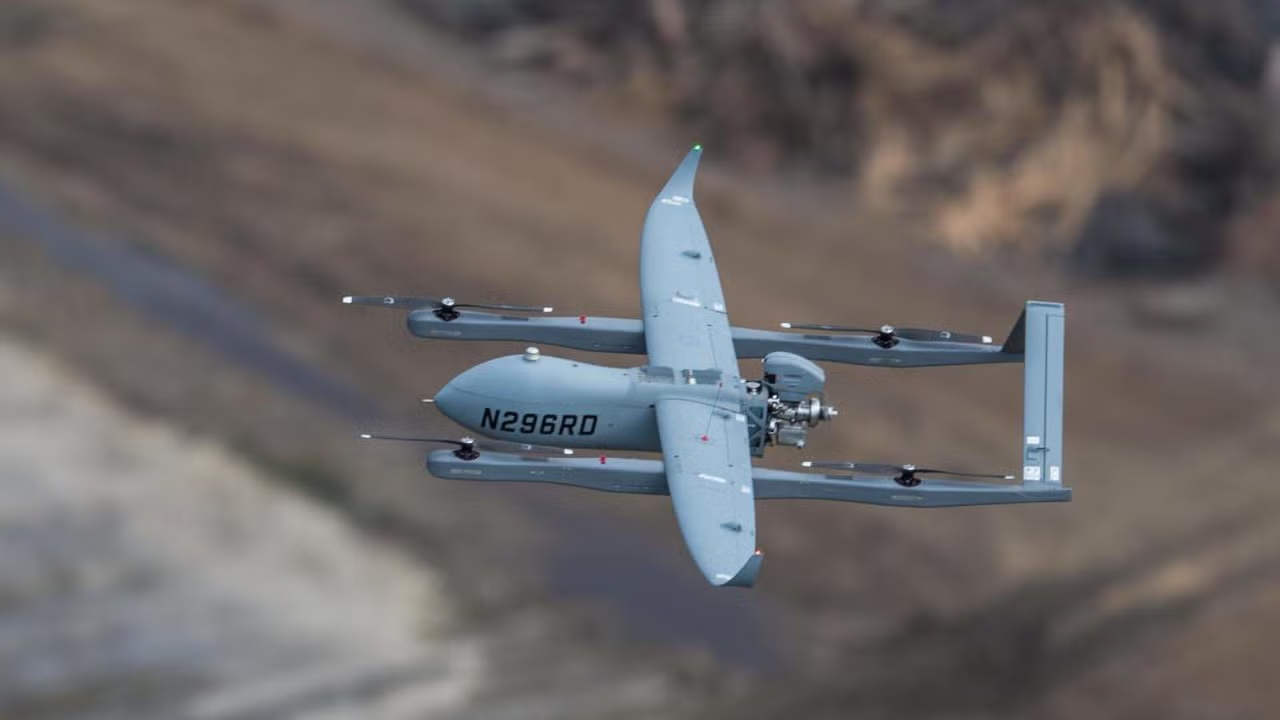
American defence manufacturer Textron Systems Corporation, a subsidiary of Textron Inc. (NYSE: TXT), has been awarded a contract to deliver three Aerosonde Mk. 4.7 vertical takeoff and landing (VTOL) uncrewed aircraft systems (UAS) to Tantita Security Services Nigeria Limited (TSSNL), the private security firm that holds the federal government’s pipeline surveillance contract across the Niger Delta’s oil-producing communities. Textron announced the deal in a statement dated December 29, 2025, saying the aircraft will be delivered in a configuration free of restrictions under the US International Traffic in Arms Regulations (ITAR), the export-control regime that normally limits how far American defence technology can travel once it leaves the United States.
The Mk. 4.7 VTOL differs from the fixed-wing Aerosonde variant Nigeria has operated since 2022 in one important respect: it needs no runway. The aircraft uses what Textron calls Hybrid Quadrotor technology, four rotors that lift the airframe vertically before it pitches into forward flight and cruises on its wings for the bulk of a mission. For an operator working the Niger Delta’s creeks and mangrove swamps, where a conventional airstrip is rarely close to the pipelines and flow stations that need watching, that detail matters more than it would in open terrain. Textron’s own specification sheet for the Mk. 4.7 VTOL lists a range of 140 kilometres on electronic line of sight, up to twelve hours of endurance, a ceiling of 12,000 feet density altitude, and a payload capacity of roughly 20 pounds (about 9 kilograms), enough to carry up to six sensors per sortie from a catalogue of more than 40 payload options that includes full-motion video and signals intelligence packages. The system can reportedly move from transport case to flight in under 20 minutes with a crew of three, and both the airframe and its cases are built for a two-person lift, features suited to operators working from small boats or improvised forward sites rather than fixed bases.
Textron’s own account of the deal credits the award to Arco Worldwide Services (AWS), a Lagos-based drone operator and a subsidiary of Arco Group Plc, an indigenous oil and gas services company with roughly 45 years of operating history in Nigeria. AWS, which describes itself as the country’s first licensed commercial drone operator, will provide the contracted UAS services in support of Tantita’s operations. That role is not new for the firm: Arco Worldwide’s own published account of its work states that it previously facilitated Textron’s earlier Foreign Military Sale (FMS) contract for Nigeria, a $25.6 million agreement signed in 2020 that delivered three fixed-wing Aerosonde 4.7 aircraft to the Nigerian Army, reaching operational status in October 2022 after delays pushed the original 2021 completion date back about a year.
David Phillips, Textron’s Senior Vice President of Air, Land and Sea Systems, called the new aircraft “a mature, highly reliable, and industry-proven autonomous solution” for Tantita’s work. He added that the Aerosonde’s record positions it to help Tantita expand its capacity to protect infrastructure that matters to both domestic security and government revenue. Textron points to the wider Aerosonde family as evidence for that claim: the platform has logged more than 700,000 flight hours across desert, maritime, Arctic and jungle conditions, and it currently flies from more than ten US Navy ships as part of shipboard intelligence, surveillance and reconnaissance (ISR) work.
For Tantita, the acquisition builds on a two-decade-old company and an increasingly technology-heavy operating model. TSSNL was founded in 2005 by High Chief Government Ekpemupolo, widely known as Tompolo, together with engineer Kestin Pondi and two other partners. Tompolo, a former Niger Delta militant leader, serves as a director and remains the company’s most recognisable public figure, while High Chief (Engr.) Kestin Pondi has run day-to-day operations as Managing Director since the firm’s founding.
Pondi has described Tantita’s approach as delivering security solutions tailored to each client, whether government agencies, corporate operators or economies working in high-risk conditions, language consistent with a company that has spent the past year expanding its own technology stack. That stack now includes the Tantita Operations Command and Control Application (TOCA), an in-house platform the company unveiled publicly at Nigeria Oil and Gas Week in Abuja this August, which fuses real-time and historical satellite imagery and lets operators reconstruct vessel movements across Nigerian waters over a two-year window from Tantita’s Command and Control Centres. The new Aerosonde aircraft will feed that system directly, adding a dedicated aerial layer to surveillance work that, in one recent example, saw Tantita intercept a vessel allegedly carrying stolen crude off Delta State in mid-December 2025 and hand the suspects to a federal task force days later.
Independent data offers some support for Tantita’s claims of operational effect, though the picture is not without dispute. A NUPRC-sourced figure reported by Vanguard in September 2025 put average daily crude oil losses at around 9,600 barrels as of July 2025, down from about 102,900 barrels in 2021, a decline of more than 94 percent over the period Tantita has held its surveillance mandate. At the same time, the company’s effective hold on pipeline protection in the region has drawn criticism from Niger Delta civil society groups, who in a March 2026 open letter questioned both the cost of the contract and Tantita’s ability to reach remote swamp terrain.
Textron had not published a delivery timeline for the three aircraft as of late August 2026. In early January, Tantita’s Executive Director of Operations and Technical said company personnel had already travelled to the United States to inspect Aerosonde operations and study the technical processes involved, describing Tantita as the first private security firm in Nigeria to acquire an Aerosonde platform with full ISR capability. The contract also carries options for additional aircraft and further training as Tantita’s needs grow, a structure that lets a customer scale a fleet in stages rather than commit to a large purchase upfront.
The sale places Nigeria among a small but expanding group of countries where Western-built VTOL drones are entering service with private security operators rather than state militaries, a shift likely to draw as much scrutiny as interest across a West African security market where oil theft, pipeline sabotage and maritime crime remain persistent threats to national revenue.

Africa’s dedicated and only military drone procurement intelligence.
Unmanned Africa bridges the critical gap between aerospace engineering, defense economics, and geopolitical strategy. As African defense forces rapidly modernize and scale their unmanned capabilities to address asymmetric conflicts, insurgencies, and border security, the platform functions as an essential, independent repository for defense analysts, policymakers, military professionals, and researchers.
