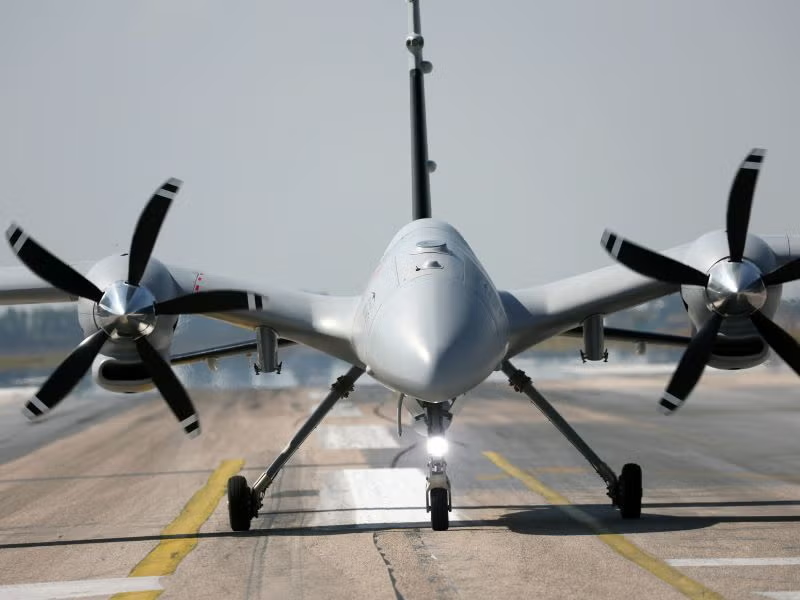
A fresh delivery of Turkish-made combat drones, handed over at Sévaré this week, extends a fleet Mali has already had to partly rebuild once — and lands three months after the country’s defence minister was assassinated in the same rebel offensive that forced Malian troops out of a town their own drones had helped recapture less than two years before.
Mali’s armed forces have taken delivery of another batch of Bayraktar AKINCI unmanned combat aerial vehicles, officially handed over at a ceremony in Sévaré on 30 July. General Oumar Diarra, the deputy minister attached to Mali’s Ministry of Defence, presented the drones to the army’s Chief of the General Staff, General Elisée Jean Dao, who in turn passed them to the Malian Air Force’s chief of staff, General Alou Boï Diarra — a formal chain of custody Malian officials framed as part of the continuing modernisation of the country’s armed forces in the face of the ongoing jihadist and separatist threat. The exact date the aircraft arrived in Mali was not disclosed, though a cargo aircraft was reported landing at Sévaré in early July, several weeks ahead of Thursday’s ceremony.


This is not Mali’s first AKINCI delivery, and not even its first this year. Mali became the fourth African operator of the type — after Burkina Faso, Ethiopia and Libya — when Baykar’s high-altitude, long-endurance UCAV entered Malian service in late 2024, building on the roughly seventeen Bayraktar TB2s Mali had already integrated into its air force since December 2022. The TB2s had already proven their worth by then: drone strikes were credited with disrupting rebel defences during the Malian army’s recapture of Kidal in November 2023, allowing government forces to retake the northern stronghold without a prolonged ground battle.
The AKINCI fleet has had a rougher time of it since. On 1 April 2025, Algeria’s military shot down one of Mali’s newly delivered AKINCIs after it crossed into Algerian airspace near the border town of Tinzaouaten — the first time Algeria’s air force had downed a foreign drone, and, because Mali had only acquired a handful of the type, a loss reported at the time to represent roughly half its entire AKINCI inventory. A further batch was handed over at Sévaré on 30 January this year in a near-identical ceremony, led on that occasion by the then defence minister himself. Thursday’s delivery extends that replenishment again, though Malian authorities have not disclosed how many aircraft were involved in either the January or July handovers, nor the value or scope of Mali’s underlying contract with Baykar.
The steady stream of drone deliveries stands in contrast to the fortunes of Mali’s manned combat fleet, which has absorbed a string of losses over the past several years. Two Sukhoi Su-25 ground-attack jets have crashed since 2022 — one near Gao airport in October of that year, killing the pilot and a ground worker, and a second near Almoustarat in September 2023, from which both crew ejected safely — while a Super Tucano light attack aircraft crashed in 2020, killing both pilots aboard. Mali’s air force has not published a comprehensive account of how many manned combat aircraft remain serviceable, but the pattern of losses, set against the country’s repeated and continuing investment in Turkish UCAVs, points to a military leadership leaning further into unmanned systems as the backbone of its strike and surveillance capability.
Meanwhile, Open-source investigators have produced the clearest evidence yet that Shahed-136-type kamikaze drones — the long-range strike weapon that has come to define Russia’s air campaign against Ukraine — are now being used in combat in Mali.
That shift is not without trade-offs, even within defence circles broadly supportive of drone-heavy force structures. Platforms like the TB2 and AKINCI offer loiter times measured in the tens of hours, a far smaller radar and infrared signature, and no risk to a pilot if the aircraft is lost — a genuine consideration for a military that has already lost aircrew to the crashes above, and an aircraft outright to a neighbouring state’s air defences. The AKINCI in particular was designed specifically to close the payload and altitude gap that separated earlier Turkish drones from crewed strike aircraft, and can carry a substantial mixed load of guided bombs and missiles. What it still cannot match is the raw speed of a dedicated attack jet like the Su-25, built to arrive over a target and deliver a heavy strike within minutes rather than the hours a propeller-driven UCAV needs to transit the same distance — a real constraint when troops in contact need air support immediately rather than after a lengthy transit to station. For an insurgency fought mostly against lightly armed, dispersed groups across Mali’s vast north, the persistent-surveillance and precision-strike case for drones is strong; for the rarer missions that call for heavy ordnance delivered in minutes, Mali’s shrinking manned fleet is a harder gap to paper over with UCAVs alone, whatever their endurance advantages.
The timing of this delivery is hard to separate from the turmoil Mali’s military and political leadership have weathered since the last AKINCI handover. On 25 April, Mali’s defence minister, General Sadio Camara, was killed in a car-bomb attack on his home in the garrison town of Kati, part of a coordinated wave of attacks by JNIM and the Azawad Liberation Front that also struck Bamako and several northern towns and forced Malian and allied Africa Corps troops to abandon Kidal — the same town Mali’s TB2 fleet had helped recapture less than eighteen months earlier. Camara, a central figure in the 2020 and 2021 coups that brought the current junta to power and an architect of Mali’s pivot from French to Russian security partnerships, had personally presided over January’s AKINCI delivery; Thursday’s ceremony was instead led by his successor’s deputy, a changing of hands that reflects how much the chain of command has been reshuffled in the roughly three months since.
Set against that backdrop, the steady arrival of new drones reads less as routine modernisation than as one of the few threads of continuity Mali’s military has managed to maintain. Officials at Thursday’s ceremony described the delivery in much the same terms used in January — as reinforcing surveillance and operational capacity against terrorist threats — but the deeper story is of a military that has lost a defence minister, ceded ground its drones once helped recover, and burned through a meaningful share of both its manned and unmanned combat fleets within the space of little more than a year, even as it continues to receive fresh aircraft from Ankara. Whether that pace of replacement can outrun the pace of loss remains, for now, an open question.
Leave a Reply