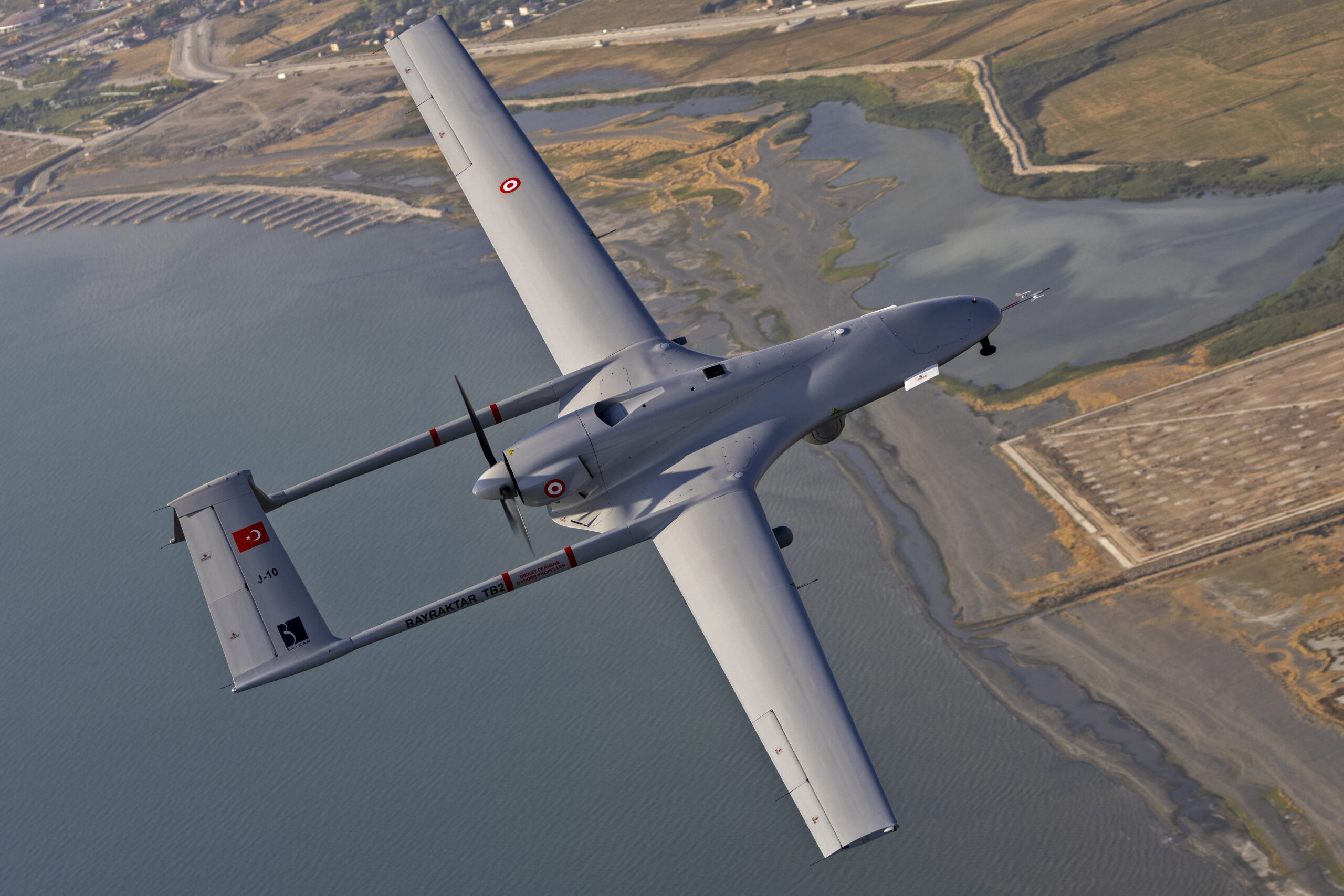
A confidential FARDC intelligence memo reportedly documents near-daily drone strikes launched from Rwandan territory, adding hard numbers to accusations that have simmered for months and further straining the Washington Accords.
Congolese authorities are reviewing intelligence that, if borne out, would mark one of the more serious escalations yet in the aerial dimension of the war in eastern Democratic Republic of Congo. According to the French investigative outlet Africa Intelligence, a confidential intelligence memo produced within the Congolese armed forces (FARDC) concludes that Turkish-made Bayraktar TB2 combat drones — believed to be flying out of at least one airbase in southeastern Rwanda — have carried out an average of five strikes a day across North and South Kivu since mid-June.
The memo, reported on July 16, puts specific numbers behind accusations Kinshasa had already begun airing publicly. Days earlier, on July 12, the DRC’s Deputy Prime Minister of Defense told reporters that the Rwandan army had reinforced its positions in the South Kivu highlands and stepped up its use of attack drones against Congolese forces. Taken together, the two disclosures suggest Kinshasa is building a more detailed case against Kigali — one focused less on the long-standing accusation that Rwanda arms and directs the M23 rebellion, and more on direct Rwandan military drone operations against targets inside Congolese territory.
It would not be the first time a specific Rwandan airfield has surfaced in this context. The open-source defence-intelligence publisher Janes has previously reported that Rwanda’s military flies Bayraktar TB2s out of Kamembe Airport, on the Rwandan side of the border facing Bukavu — one of the two provincial capitals M23 has controlled since early 2025. Separately, a UN Group of Experts report has documented Rwandan electronic-warfare systems positioned near the border, including one blamed for jamming a UN surveillance drone until it crashed. Neither disclosure confirms this month’s allegations on its own, but both add to an increasingly well-documented picture of Rwandan military infrastructure oriented toward the conflict.
The claims also land amid a string of unresolved shoot-down disputes stretching back several months. In late April, FARDC announced that it had downed a drone in mid-flight on April 25 over Point Zéro, a hilltop in the Minembwe Highlands of South Kivu’s Fizi territory — a chronically contested area where pro-government Wazalendo militias and the Rwandan-aligned Twirwaneho group have clashed repeatedly. Interim army spokesperson Lt. Col. Mak Hazukay called the incident an unmistakable violation of Congolese airspace and yet another bid to destabilize an already volatile front line, and said the aircraft had been flying strikes against both military positions and nearby civilians. FARDC linked the episode to the AFC/M23 coalition, framing it as an attempt to undercut recent peace commitments. M23 political spokesperson Lawrence Kanyuka rejected that account, accusing government-aligned forces of carrying out sustained bombardment of populated parts of Minembwe over the same weekend. A near-identical dispute had played out in March, when FARDC said it shot down two Rwandan-linked drones near the village of Mikenge and described the episode as a direct breach of the Washington Accords. Rwanda, which has consistently denied backing M23 or operating on Congolese soil, did not respond publicly to either incident — a silence that has largely held with this month’s reporting too.
The alleged Rwandan TB2 operations add to an already crowded and contested sky over the Kivus. Kinshasa has spent recent years building out its own unmanned fleet, fielding Turkish-made TAI Anka drones and Chinese CH-4 Rainbow aircraft alongside a small number of Bayraktar TB2s of its own, first delivered in 2023 and reinforced with further units acquired from Turkey in 2025. FARDC’s drones, flown partly out of Kisangani and Kindu, have backed a sustained interdiction campaign against M23 supply lines — though not without cost: M23 has claimed to shoot down both a CH-4 and a Bayraktar TB2 belonging to the Congolese army in recent months. Nearly every operator flying over the Kivus today, in other words, is taking losses. The TB2 itself, built by Turkey’s Baykar, is a medium-altitude, long-endurance platform with more than 24 hours’ endurance and the ability to carry precision-guided munitions; it is now flown by more than a dozen African militaries and has played a prominent role in conflicts from Libya to Nagorno-Karabakh to Ukraine.
Beyond the military balance sheet, rights monitors have flagged a rising civilian toll from the highlands’ drone war. Human Rights Watch has documented strikes in the Minembwe area that killed at least two members of the Banyamulenge community in March, including an elderly man, and has described the humanitarian situation facing highland communities as a severely under-reported crisis.
The timing is awkward for an already fragile diplomatic track. Under the Washington Accords, ratified by Presidents Félix Tshisekedi and Paul Kagame in December, Rwanda committed to withdrawing its troops from eastern DRC within 90 days and ending support for armed groups including M23, while both governments pledged action against the Rwandan Hutu rebel group FDLR. Just this month, FARDC officers traveled to Goma for the first time since M23 seized the city in January 2025, joining a ceasefire-verification meeting held under a parallel diplomatic track in Doha, and the UN Security Council imposed fresh sanctions on AFC/M23 and allied commanders. A documented pattern of near-daily drone strikes originating from Rwandan territory would sit uneasily beside those steps — and would raise fresh doubts about how much practical weight the ceasefire framework still carries in the skies over the Kivus, whatever progress it registers on paper.
Leave a Reply