While state acquisition of heavy fixed-wing Uncrewed Aerial Vehicles (UAV) dominates headlines, a parallel tactical revolution is taking place at ground level across African conflict zones. Non-state armed groups, irregular insurgent units, and front-line military patrols increasingly deploy low-cost Commercial Off-The-Shelf (COTS) quadcopters and customized First-Person View (FPV) loitering munitions. This democratization of vertical airpower enables non-state actors in the Lake Chad Basin, the Sahel, Cabo Delgado, and eastern Democratic Republic of the Congo to challenge conventional military formations without maintaining expensive airbases or technical supply chains.
Asymmetric Weaponization of Civil Platforms
Commercial quadcopters engineered for agriculture or aerial photography provide irregular forces with immediate, low-cost Intelligence, Surveillance, and Reconnaissance (ISR). Operating at altitudes between 100 and 300 meters, standard civil platforms remain virtually silent and nearly invisible to unassisted ground spotters. Insurgent operators use high-resolution optical cameras to map forward operating base perimeters, monitor patrol movements, and conduct artillery spotter routines. These civilian systems require minimal flight training, operate using intuitive handheld mobile interfaces, and cost a tiny fraction of military-grade tactical drones.
Beyond surveillance, asymmetric actors modify civil airframes to carry kinetic payloads. Operators fabricate lightweight drop mechanisms using 3D-printed latches, electronic servomotors, and photo-sensitive relays wired directly to the drone’s auxiliary navigation lights. When an operator toggles the light switch on the ground controller, the circuit triggers the servo latch, releasing modified 60mm mortar bombs, hand grenades, or improvised explosive devices over defensive positions. In more aggressive tactical configurations, operators assemble high-speed FPV racing quadcopters packed with contact-fused explosives. Moving at speeds exceeding 100 kilometers per hour, these makeshift kamikaze platforms strike light armored vehicles, supply trucks, and troop concentrations with lethal precision.

Localized Counter-Uncrewed Aerial System Tactics
To defend Forward Operating Bases (FOB) and mobile columns against commercial drone attacks, African field commanders employ a combination of electronic warfare, radio frequency detection, and physical hard-kill countermeasures. Because COTS quadcopters rely heavily on unencrypted 2.4 GHz and 5.8 GHz control links alongside standard Global Positioning System (GPS) signals, electronic countermeasures offer the most effective non-kinetic defense.
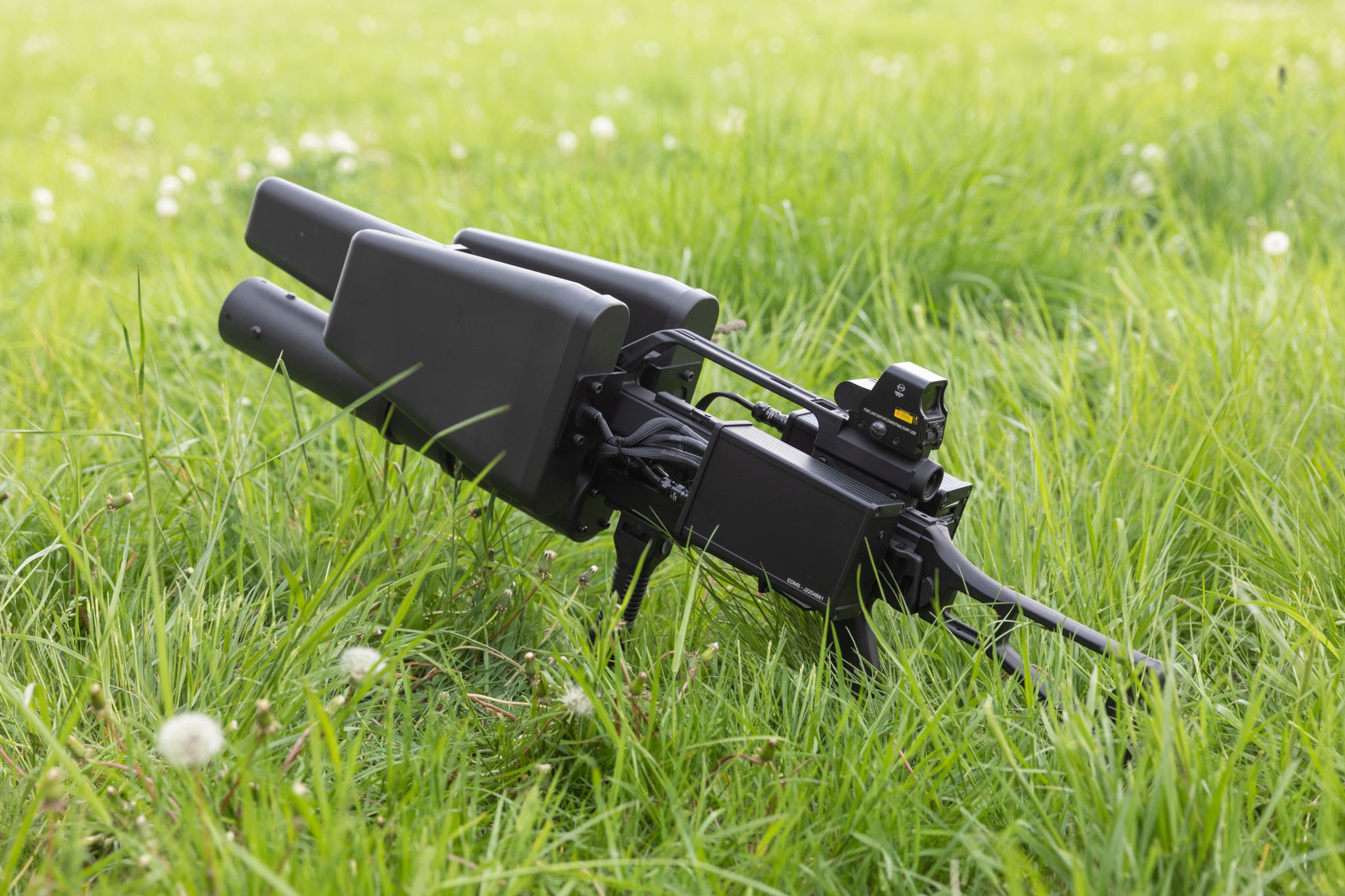
Handheld directional Radio Frequency (RF) jammer guns serve as the first line of electronic defense for infantry squads. When a spotter detects an incoming quadcopter, the operator aims the jammer directly at the target, flooding its receiver with high-powered radio noise across control and satellite navigation bands. Deprived of operator inputs and satellite positioning, standard commercial flight controllers automatically trigger fail-safe protocols, causing the airframe to hover in place, slowly land, or return to its launch point. For stationary base protection, military units deploy multi-directional RF jamming domes that establish a continuous electronic bubble around command posts, blocking unauthorized control frequencies within a two-kilometer radius.
When electronic warfare assets are unavailable or when adversaries deploy autonomous, jam-resistant FPV airframes, African forces rely on kinetic countermeasures. Field units frequently adapt legacy twin-barrel 23mm anti-aircraft guns and 12.7mm heavy machine guns to saturate low-altitude approach corridors with high-explosive ammunition. At close ranges, infantry squads deploy 12-gauge tactical shotguns loaded with heavy birdshot, creating a dense pattern of kinetic lead that disables lightweight plastic rotors and electronic circuit boards. Modern field installations also construct overhead physical screening, stretching heavy wire mesh and camouflage netting above vehicle parking areas and troop trenches to catch dropped explosive munitions before detonation.
Operational Constraints
Deploying Counter-Uncrewed Aerial Systems (C-UAS) across rugged African environments presents notable logistical and technical challenges. Handheld jammer rifles require continuous battery recharging, straining power generation systems at remote, off-grid outposts. Continuous broad-spectrum RF jamming also creates severe electromagnetic self-interference, disrupting friendly tactical radio communications, satellite phones, and military data links.
Adversaries continuously adapt to electronic countermeasures by modifying communication protocols. Insurgent technicians increasingly flash custom firmware onto commercial flight boards, enabling dynamic frequency hopping across non-standard radio channels or utilizing analog video links that resist standard digital jammers. As asymmetric operators move toward fiber-optic guided FPV systems that remain immune to all radio jamming, African military planners must invest in integrated C-UAS networks that combine passive acoustic detection, thermal imaging sensors, and automated kinetic weapons to maintain airspace control over forward battlefields. Dataset records verified as of July 2026 show an increasing allocation of continental defense procurement toward tactical electronic warfare, reflecting a clear commitment to protecting ground troops from commercial aerial threats.
Leave a Reply