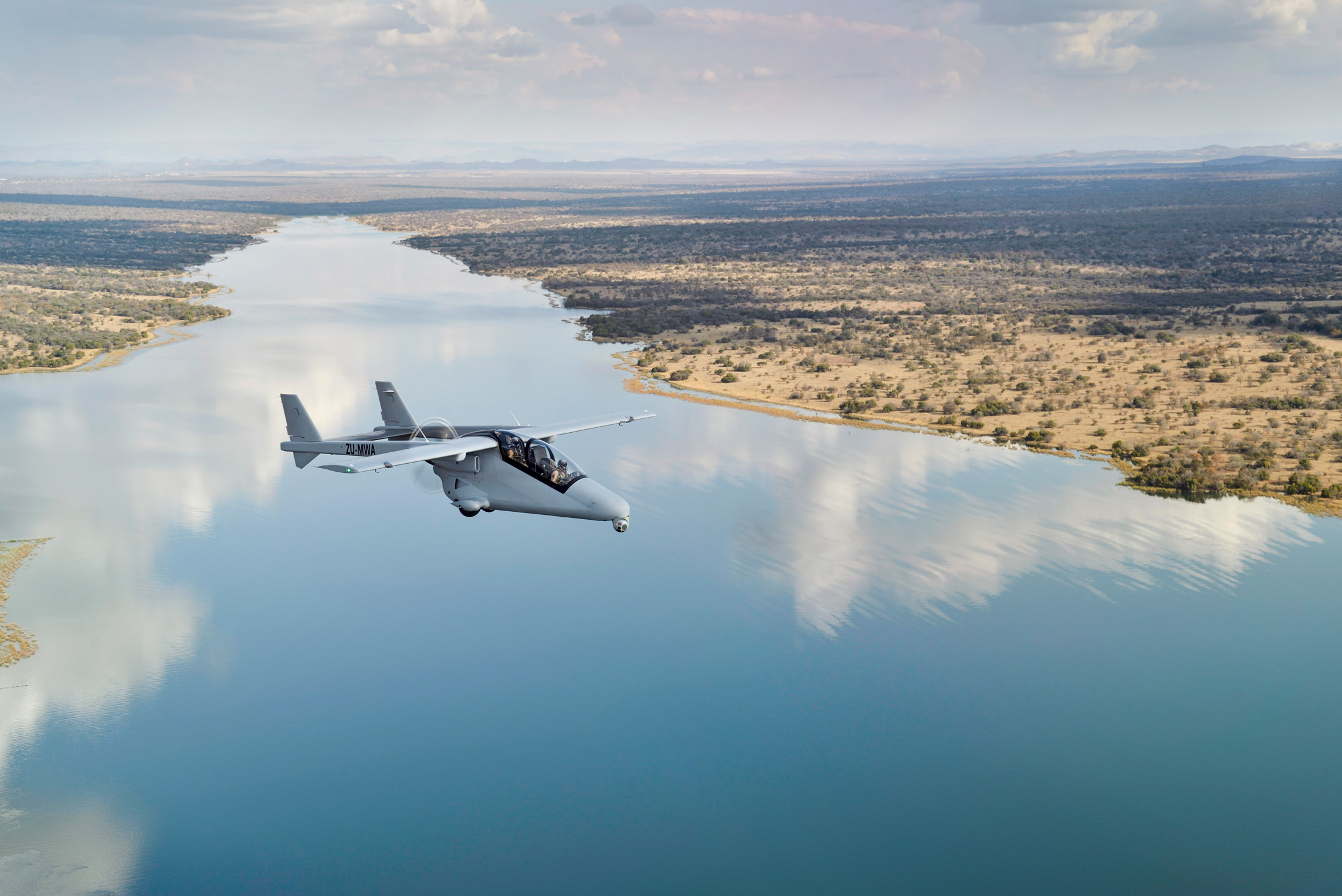
Paramount Aerospace Industries has added a dedicated drone-hunting configuration to its South African-built Mwari aircraft, aimed squarely at the low-altitude, one-way attack drones that most ground-based radar networks struggle to catch.
South African manufacturer Paramount Aerospace Industries has rolled out a new counter-drone configuration for its Mwari light attack and surveillance aircraft, giving African defence forces and infrastructure operators another option against a threat that has outpaced most existing air defence systems: the cheap, slow, low-flying one-way attack drone. The company unveiled the configuration on 16 July 2026 in Pretoria, pitching it as a direct answer to the loitering munitions and modified commercial drones increasingly used against military bases, ports, and energy infrastructure across the continent and beyond.
Conventional air defence was not really built with this threat in mind. Ground-based radar tends to be tuned to catch fast, higher-flying aircraft and missiles, which makes it poorly suited to something that flies low and slowly with a radar signature not much bigger than a large bird. And even once such a drone is spotted, shooting it down with a surface-to-air missile system designed for faster, higher threats is a losing financial trade — the interceptor often costs many times more than the drone it destroys. Paramount Aerospace Industries CEO Lee Connolly put the imbalance plainly, describing the wave of low-cost attack drones as having created “an acute vulnerability” for militaries and infrastructure operators alike, adding that for many countries, simply detecting the threat can be as hard as defeating it.

The Mwari Counter-UAS configuration is Paramount’s attempt to close that detection-and-defeat gap with a single airframe. It combines an electro-optical and infrared targeting system with a flexible sensor suite and a choice of weapons, giving a two-person crew the ability to find, identify, and, if authorised, engage a drone without ever taking a human out of the decision loop. One crew member flies the aircraft while the other, working from a dedicated mission station, manages the sensor feed and owns the call on identification and engagement — a human-in-the-loop arrangement that reflects both operational caution and the legal reality that misidentifying a target in this kind of mission carries real consequences.
The system is built to work two different ways, depending on what infrastructure a customer already has. Where a country already runs a ground-based radar and command-and-control network, the Mwari can plug into it, flying out to intercept targets the network has already flagged and visually confirming the identification before engaging. Where that ground infrastructure doesn’t exist — which describes a great many African militaries, and most operators tasked with protecting a single high-value site such as a port or power plant — the aircraft can instead fly its own barrier patrols, using onboard sensors to search for slow, low-altitude targets ahead of the area it’s defending. In effect, Paramount is offering the aircraft as a stand-in for a sensor network the customer hasn’t built yet, not merely an add-on to one that already exists. Weapons options follow the same logic: gun pods for threats that get in close, guided or precision rocket systems for engagements further out, drawn from an open architecture that lets Paramount integrate effectors from multiple international suppliers rather than locking a customer into one ammunition type.
What makes all of this possible is designed into the aircraft rather than bolted on for this particular announcement. The Mwari — better known during its long development as the AHRLAC, or Advanced High-Performance Reconnaissance Light Aircraft — was built around a swappable mission bay in its belly, which Paramount calls the Interchangeable Mission Systems Bay. Sensors, weapons, and other mission equipment can reportedly be swapped in under two hours without any permanent change to the airframe, which is largely why the same aircraft has been marketed for ISR, border patrol, light strike, and now counter-drone work without needing a distinct variant for each role. The airframe itself is a distinctive twin-boom, single-engine design — a single Pratt & Whitney PT6A-66B turboprop driving a rear-mounted pusher propeller — with a cruise speed of roughly 500 km/h, a service ceiling above 30,000 feet, and the ability to operate from rough or unprepared airstrips of around 500 metres. It first flew on 26 July 2014, the product of a joint venture between Paramount Group and South African firm Aerosud, and survived a rocky patch in 2019 when a dispute between the two partners put the programme into business rescue before Paramount took full ownership.
This is not Paramount’s first attempt at drone-hunting with the Mwari, either. Back in 2022, around the time the aircraft reached its first paying customers, the company fitted it with technology aimed at a very different target: Medium Altitude Long Endurance drones such as the Bayraktar TB2 or Wing Loong II, which typically fly at 20,000 to 30,000 feet — an altitude band that otherwise requires expensive ground-based missile systems or a scramble by fighter jets to reach. The 2026 configuration effectively completes that picture, extending the aircraft’s drone-hunting role down to the low, slow end of the threat spectrum that systems built for MALE drones tend to miss entirely.
Unlike many concept-stage defence announcements, the Mwari has an actual flight record behind it. Mozambique became the launch customer, taking delivery of its first aircraft in December 2022 and flying it on reconnaissance and surveillance missions in Cabo Delgado province, where government forces have spent years fighting an Islamic State-linked insurgency — making it one of a relatively small number of African-designed combat aircraft to log real hours in an active African conflict zone. The Democratic Republic of Congo became the second customer, ordering six aircraft in 2023 and bringing the total sold to nine. Production continues at Paramount’s Wonderboom facility outside Pretoria.
The timing of the new configuration tracks a broader shift in how drones are being used in African conflicts. Insurgent groups that flew little more than basic surveillance drones a few years ago are increasingly arming cheap commercial quadcopters with improvised explosives and flying them directly at fixed positions. In Nigeria’s northeast, Islamic State West Africa Province has adopted exactly this pattern against military bases along the Lake Chad basin, a shift security analysts say has accelerated sharply over the past year and pushed Nigeria’s military and its regional partners to treat counter-drone capability as an urgent gap rather than a future problem.
Paramount is not alone in chasing this market. Brazil’s Embraer is pursuing a comparable concept for its A-29 Super Tucano, partnering with US firm Valkyrie Aero to integrate an AI-assisted targeting suite called Gunslinger, with a marketable version expected following further demonstrations later this year — and Embraer has separately forecast Africa as its single largest market for the A-29 over the next two decades. Ground-based systems from established suppliers in Israel and Turkey, among others, remain an option too, though they solve the problem differently and, in much of Africa, require exactly the kind of sensor infrastructure many operators don’t yet have.
What Paramount is ultimately selling with the Mwari, though, is not really a single new capability — it’s the idea that one airframe can keep absorbing new roles as the threat changes, without a customer needing to buy a new aircraft type each time it does. A country that bought the Mwari for border surveillance can add weapons, reconfigure it for MALE drone intercepts, and now fit it for low-altitude counter-drone work, all on the same production airframe. Whether that pitch converts into new export orders remains to be seen; Paramount has not said which customers it expects to take up the configuration first. But as one-way attack drones become a fixture of conflicts across the continent, it’s a pitch aimed squarely at the capability gap African defence budgets are struggling hardest to close.
Leave a Reply